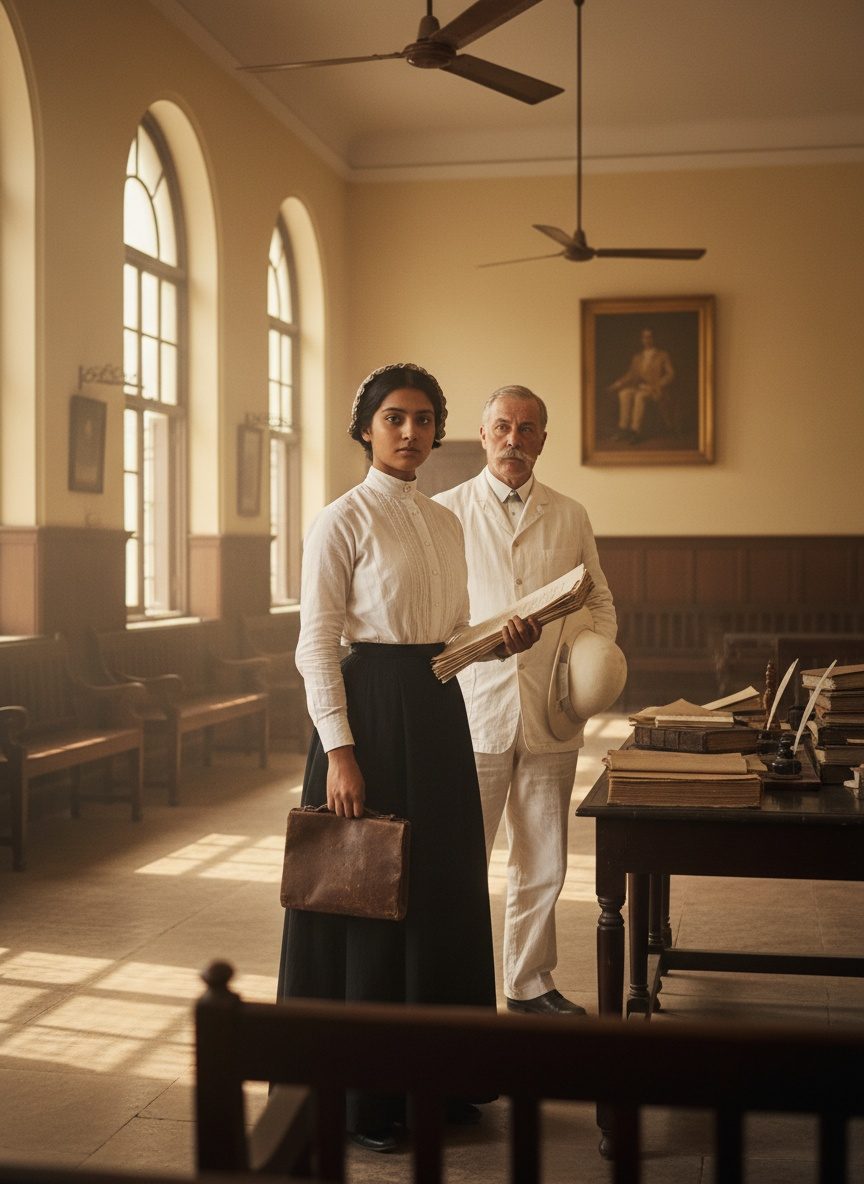
Her voice was often described as quiet and unassuming, yet it echoed through the chambers of British justice in India. The British legal world hadn’t anticipated an Oxford-educated woman challenging the status quo.
Stepping Into the Unknown
July 1904 marked a defining moment in the colonial courts of India. In Allahabad, Cornelia Sorabji, destined to become India’s first female barrister, crossed the threshold into an exclusively male courtroom. While the barristers’ wigs bobbed in befuddlement and the gavel heralded the start of proceedings, Sorabji’s presence defied convention. As she stood before the Viceroy, she didn’t merely represent her gender; she carried the collective voices of purdahnashins—widows ensnared within the confines of tradition and societal expectations.
The British Raj was unfriendly terrain for women, particularly one seeking to practice law. However, Sorabji had a secret weapon—a formidable intellect shaped at Somerville College, Oxford. Despite smashing academic barriers by being the first woman to sit for the Bar Final exams, her gender kept the doors of the Bar firmly shut. Yet, it was precisely this gender that became her unique qualification for uncharted legal battles.
Behind the Zenana Walls
The term "purdahnashins" refers to women, often of higher caste and wealthier families, who adhered to strict privacy customs, shielding themselves from the sight of men outside their families. Behind the lattice screens of their zenanas, these women faced tangible predicaments. With no voice in legal affairs, they fell prey to unscrupulous relatives and opportunistic administrators. Indian widows found their inherited wealth withering under deceitful claims and mismanagement, unable to seek justice in a male-dominated judicial system.
Sorabji’s distinct societal role unlocked the zenanas to judicial scrutiny for the first time. The British government, recognizing the impasse, employed Sorabji to pierce this veil of seclusion. Her task was monumental: to translate the unspoken pleas of purdahnashins into effective legal action, ensuring the preservation of their rightful legacies.
The Barrister Without the Bar
Despite her educational accolades, Cornelia Sorabji faced persistent rejection from English law’s institutional barriers. Yet her resolve to champion the voiceless thrived on ingenuity. She navigated the separate spheres of colonial society with grace, dedicating herself to her vocation even as she remained formally unrecognized.
In her meticulous and heartfelt inquiries, Sorabji exemplified the principles of justice. Each case she undertook was akin to a piece of a larger human puzzle—a narrative woven from whispers and shared confidences behind enigmatic screens. Her empathy transformed legal disability into a determined force for equity, a beacon drawing attention to the inequities faced by a significant segment of Indian society.
The Viceroy’s Court and the Power of Empathy
As Cornelia presented her case before the Viceroy, historical prejudices faltered under the weight of her advocacy. Strategically, she articulated the cultural intricacies of the purdahnashins’ predicaments, demonstrating how these women were unfairly marginalized in both colonial and traditional landscapes. Her work stood apart not only for its rarity but for its demonstration of what the intersection of cultural understanding and legal proficiency could achieve.
The Viceroy, and indeed the broader court, observed how this diminutive figure, seemingly so unassuming, could wield such compassion and scholarly prowess to unmask terrible injustices. Cornelia’s courage did not just confront resistant courtrooms; it laid the foundation for discussions on inclusion that ripple through history.
The Unyielding Legacy of Listening
Cornelia Sorabji’s journey was remarkable not solely for her personal achievements but for the doors she opened and the bridges she built between widely disparate worlds. In an era when femininity was often synonymous with silence, she cried out with eloquence and purpose. Her legacy extends beyond her groundbreaking role as India’s first female barrister: she challenged a global system to reevaluate how justice is perceived, accessed, and administered.
In today’s legal reforms and gender equality movements, Sorabji’s story resonates loudly. Her moment before the Viceroy in 1904 underscores a timeless truth—empathy, when fearless and articulate, can topple the most entrenched barriers. While Cornelia Sorabji's name might not appear in every textbook, her legacy persists where it matters—in the pursuit of justice for those sidelined by society, quietly waiting for someone to listen.