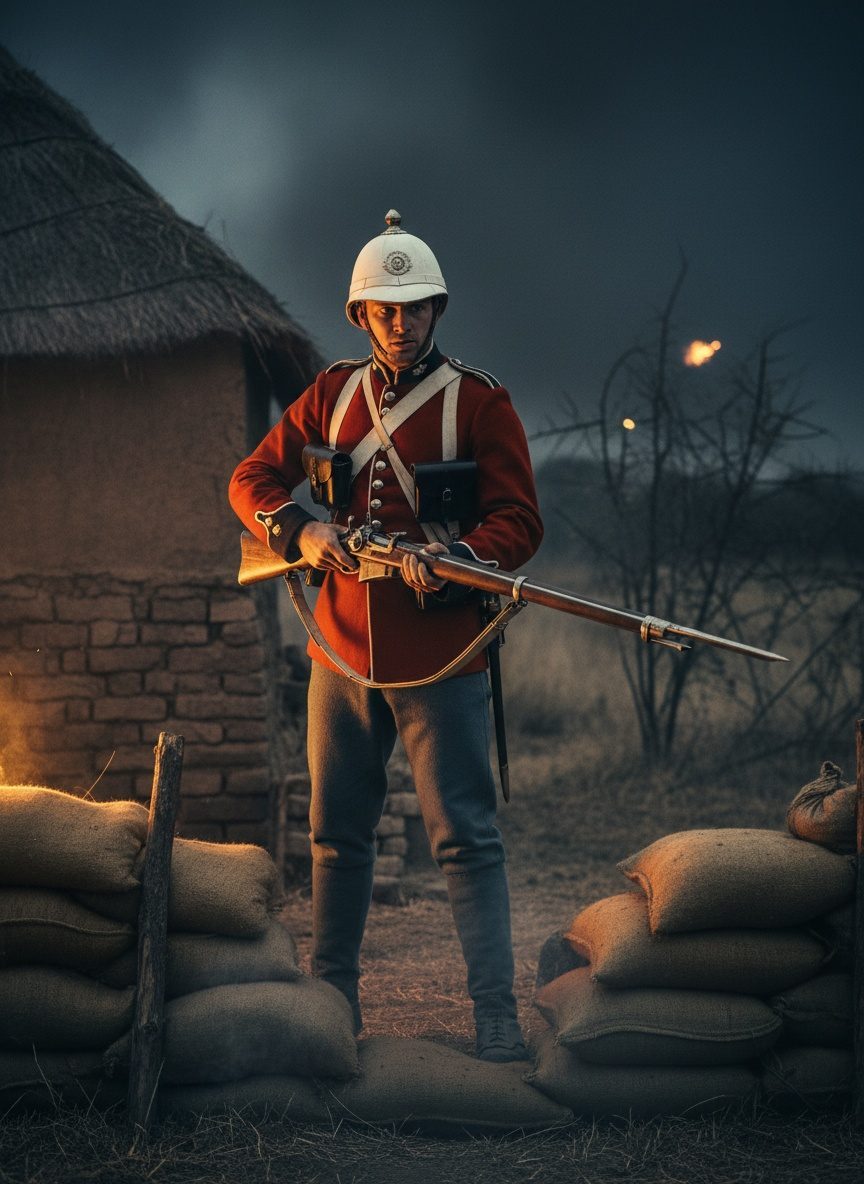
Frank Bourne felt the ground rumble beneath the weight of thousands of feet. The moon flickered intermittently as clouds raced across the night sky, casting moving shadows over the improvised barricade. Behind it, British soldiers, barely more than boys, clutched their rifles, their nerves stretched taut as a drumhead. Bourne walked among them, his steps deliberate, his face a mask of concentration, while his presence alone seemed to lend them courage.
It was late January in 1879, and the British outpost at Rorke's Drift stood precariously against the impending tide of Zulu warriors. Earlier that day, a force of over four thousand Zulu fighters had emerged, intent on washing the small outpost away like the tide erasing a sandcastle. But here at this fevered clash, under a sky trembling with the chaos of war, Colour Sergeant Frank Bourne held the line.
Bourne was young for his rank—at only twenty-four, he was the youngest colour sergeant in the British Army—but the brass chevrons on his sleeve bore more than just authority; they bore the weight of history that was unfolding in real-time. The legacy of British military power, the ambitions of empire, all mosaic pieces in the larger tapestry of the Anglo-Zulu War, converged on this isolated point in Natal.
The Zulu attack waves descended upon them, waves breaking against the makeshift defenses. Sandbags, biscuit boxes, and mealie bags formed the crude barricade meant to stall a force with overwhelming numerical superiority. Gunfire snapped through the air, where the acrid smell of gunpowder mingled with sweat and adrenaline, and cries of the wounded echoed off the ochre earth.
Bourne had walked these grounds before the siege, often overseeing the men with the same quiet assurances he offered now in battle. His outward composure suggested a normalcy that betrayed his youth. Yet, beneath that stoic exterior, his thoughts were a flurry of assessments—rations, ammunition, morale. Calm and efficient, like a metronome in perfect rhythm, he moved through the ranks, distributing food and ammunition as if it were a drill. There was no room for panic here.
As dusk turned to darkness, the shadows competed with the flickering flames of scattered fires and the periodic muzzle flashes, each spark briefly illuminating the etched lines of fear and determination on the men’s faces. Rallying them when an officer fell, Bourne filled the gap. He took the role of both leader and stabilizer—a still, resolute axis around which the chaos spun. The men needed assurance that the world, at least in their immediate proximity, had not ended its turn.
The Zulus were relentless, their courage undeniable. With disciplined ferocity, they hurled themselves at the barricades, undeterred by the hail of bullets. Their chants filled the night air, a thunderous, rhythmic sound, like the pounding of a relentless storm. Each new assault was met by Bourne’s steady command, his words calm yet piercing, telling his men, “Steady, lads, remember your training.” The command was deceptively simple, ensuring that no man slipped into the abyss where fear paralyzes action.
The sun rose the next day on a scene of scorched earth, smoke lingering like old ghosts in the air. Against all odds, Rorke's Drift had repelled the Zulu attacks. Bodies scattered the fields, many wearing the tattered remnants of traditional Zulu garb, testament to a courage notable even in its defeat. Among the British, seventeen men lay dead, but for the remnants who still held their rifles unsteadily, there was life, thanks in part to the actions of one extraordinary non-commissioned officer.
Bourne proved a cornerstone throughout that long night, his ability to think three moves ahead ensuring that no section of the defense fell without reinforcements. His actions went far beyond simple duty, capturing the essence of stoic leadership that would resonate through military folklore. This ordinary man, with the responsibilities placed on him by a uniform, wrapped the fate of so many around his courage and resolve.
As the dust settled, tales of heroism spread across the Empire. Victoria Crosses were dispensed with the promise of further accolades, but Colour Sergeant Frank Bourne, choosing modesty over recognition, declined the immediate honor of a commission, favoring instead to work his way through the ranks. For him, duty was woven of steady endurance, and his legacy would speak with silent authority, one best acknowledged through action rather than words.
The story of Rorke's Drift remains a testament to the power of human resilience against all odds. It is a narrative that stands at the intersection of imperial ambition and individual valor, raising questions beyond the pages of textbooks. What defines the line between perceived civility and so-called savagery? At what cost does an empire expand its borders? Frank Bourne's role underscores that lines are not just held by firepower or numbers but by the character and unyielding spirit of those who stand on them.