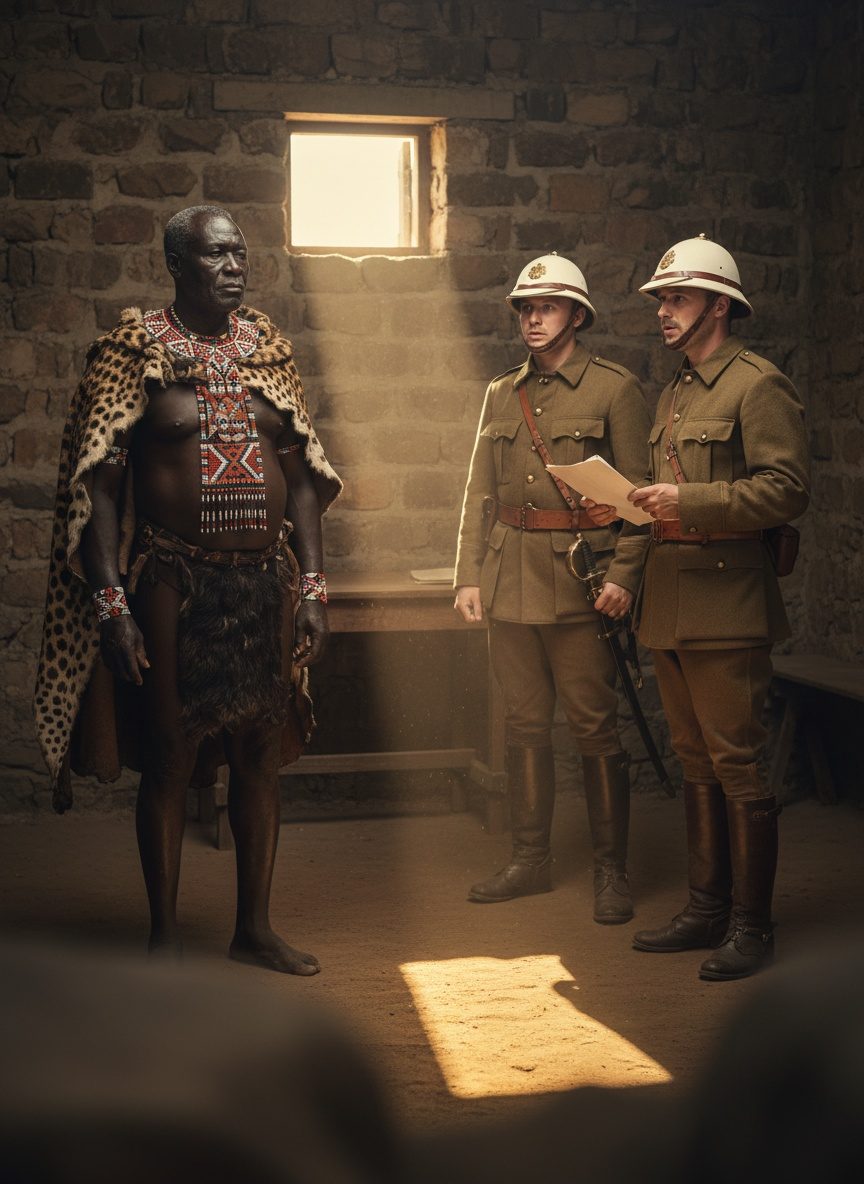
The room was opulent, a stark contrast to the dusky African landscapes he knew so well. Heavy fabric draped the windows, muffling the bustling sounds of London outside. In the center of this chamber, under the gilded ceiling, a chair was offered. But Cetshwayo kaMpande, the formidable king of the Zulu, stood tall, his presence commanding even in defeat. Silence hung in the air, thick with the remnants of gunpowder dreams and colonial condescension. He rejected the seat with a subtle but firm admonition, a gesture that echoed louder than any battle cry. He would not be made small; he would not kneel. The men in frock coats observed him with a mix of curiosity and unease, aware they were in the presence of dignity unbowed. This moment was about more than just a chair — it was about a legacy of defiance and integrity that stretched far beyond the polished walls of British authority.
A Battle for the Ages
Long before Cetshwayo found himself in this London room, the windswept plains of Isandlwana had seen the might of his resolve. On January 22, 1879, the sun had barely crested the horizon when the first sounds of conflict pierced the morning. The British, accustomed to swift victories against what they perceived as primitive forces, were about to face a shocking reckoning. The Zulu impis, a disciplined war machine steeped in centuries of martial tradition, surged over the ridge with a tactical precision that confounded their red-coated adversaries.
The clash that ensued was one of the worst defeats the British Army would face in the Victorian era. Over 1,300 British troops, armed with the latest military technology, fell to the spears and bravery of the Zulu warriors. Isandlwana became a name synonymous with colonial humiliation, a stark reminder that empire's reach was not as invincible as it seemed. Propaganda makers in London struggled to spin the catastrophic loss into anything but sheer disaster. Despite their attempts, the black clouds of that day loomed over British prestige across the globe.
For Cetshwayo, Isandlwana was not just a battle but the culmination of his life’s commitment to his people and lineage. It was about preserving the sovereignty of Zululand against the inexorable advance of colonialism. Under his leadership, the Zulu nation had rejected the ultimatum delivered by Sir Bartle Frere, High Commissioner for Southern Africa. Cetshwayo's defiance was not mere obstinance; it was a calculated assertion of his people's right to exist under their own governance. But the empire struck back with renewed determination, leading to further bloody engagements and, eventually, his capture.
Walking into Captivity
With his defeat ordained on colonial terms and the Zulu kingdom fragmented, Cetshwayo was forced into the ignominy of capture in August 1879. Transported from Africa to England, his presence in Europe stirred a mixture of awe and political intrigue. Here was a man who had defied one of the world's most powerful nations and lived to tell the tale. His arrival in the British Isles was nothing short of an imperial spectacle; newspapers ran stories that bordered on sensation, depicting him as both a noble savage and an astute politician.
Though a prisoner, Cetshwayo's presence in London became a spectacle, a reminder of Britain's vulnerability in the fading rays of its imperial grandeur. He was not cowed by his circumstances but met each audience and inquiry with a regal demeanor that impressed even his captors. Most notably, his interactions with Queen Victoria left an indelible mark. The Queen's interest in him grew beyond mere politeness; she sought to understand the man behind the icon and the reasons for his steadfast resistance.
Inside Britain's hallowed halls of power, Cetshwayo's treatment became a subject of fierce debate. Humanitarian sympathies were mixed with imperial strategies, complicating the response. The Zulu king's dignified conduct contrasted sharply with the inflated caricatures that had once circulated about bloodthirsty chiefs and barbarian hordes. His audacity to stand tall even in defeat, refusing the symbolism of subservience, unearthed an uncomfortable truth for his adversaries: the moral complexity of their own imperial ambitions.
The Force of Dignity
Cetshwayo's unwavering dignity eventually bore fruit. By 1883, through a combination of public pressure and changing political tides, Britain acknowledged what had been undeniable from the start — they could not erase the spirit of a king by mere exile. Under a veneer of diplomatic maneuvering, the British government allowed Cetshwayo to return to Zululand, albeit with limitations. While his restored rule was under British overseeing and his kingdom divided, the symbolic return carried weight beyond territorial lines.
In the annals of colonial history, Cetshwayo's story is more than a footnote; it is a chapter written in enduring bold ink. His defiance and subsequent restoration spoke of a world slowly acknowledging the complexity of the cultures imperialism sought to digest into its fold. His refusal to kneel remains a potent symbol of resistance against the erasure of identity and the imposition of foreign values upon rich, existing cultures.
The lesson is perennial: dignity isn’t found in military victories alone but in the quiet resilience of the human spirit. In a time when empires measured their glory in territories and resources, Cetshwayo kaMpande's refusal to take a seat stands as a reminder that some victories lie far beyond battlegrounds. They are found in the intangible realms where spirit, integrity, and history converge, where one man's choice to stand reverberates through corridors of time, demanding to be heard.