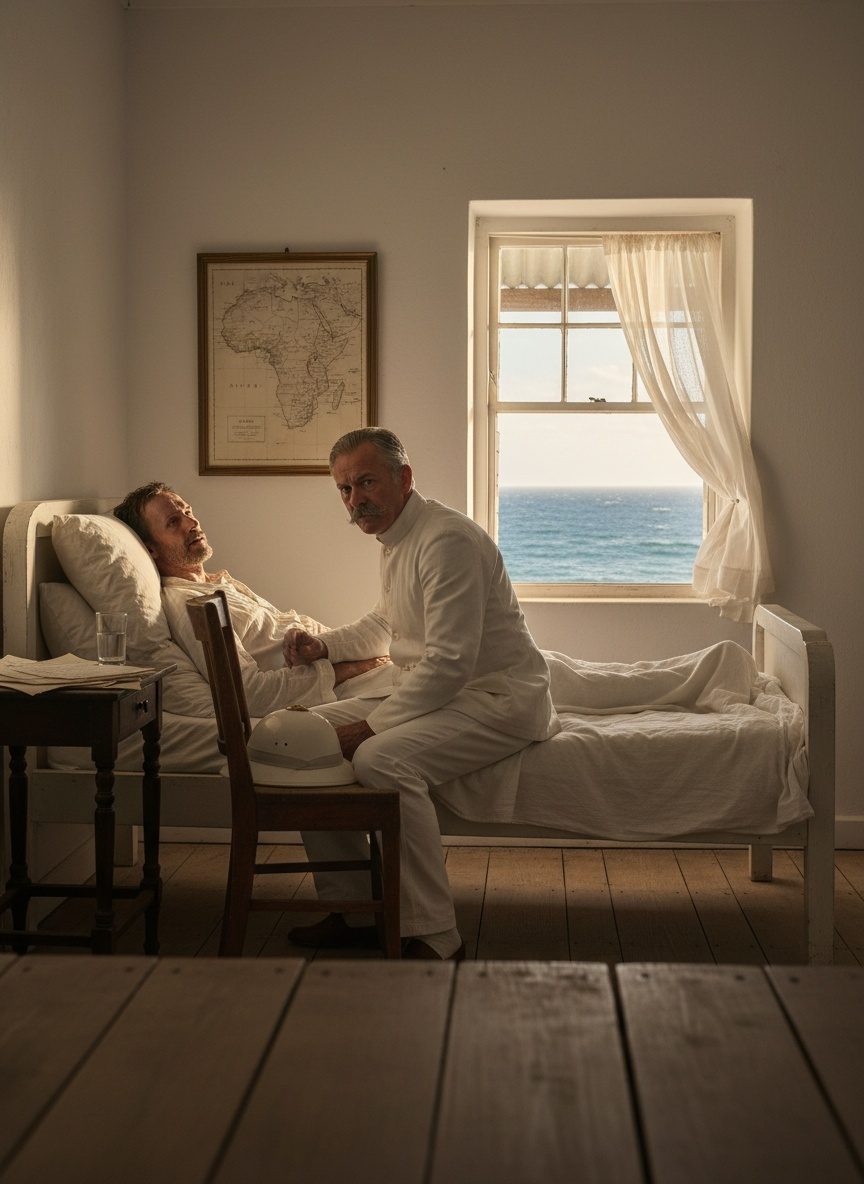
The golden sunlight of late March danced across the waters of False Bay, casting shimmering reflections onto the nondescript corrugated-iron walls of a cottage nestled near the Cape. The coastal breeze carried with it the scent of salt and a touch of late summer's warmth, yet all was still and somber inside the modest abode where Cecil Rhodes lay precariously between life and death. The outside world scarcely hinted at the turmoil left brewing in his wake, a legacy as vast and complex as the African territories he once so boldly claimed.
Born on July 5, 1853, in the quiet parish of Bishop's Stortford, Hertfordshire, Rhodes was the son of Francis William Rhodes, a vicar whose modest position never foreshadowed the imperial ambitions of his younger son. At sixteen, frail and diagnosed with a lung ailment unlikely to withstand the humid chill of an English winter, Rhodes was dispatched to the distant sun-laden frontier of southern Africa. Few might have imagined that this sickly youth, adrift on foreign shores, would become one of the architects of British imperial expansion, his name forever entwined with the histories of lands thousands of miles from his native England.
By eighteen, Rhodes immersed himself into the burgeoning diamond trade of Kimberley, a remote town transformed into a frenzy of wealth-seekers by the shimmering promise of its diamond-rich soils. The Rothschilds, seeing potential in this ambitious young man, provided the financial buoyancy he needed to weave his way to the top of the diamond trade. Within two decades, he had built a mighty empire, founding De Beers in 1888, the firm that forged diamonds not just as precious stones but as indelible instruments of economic power. Through consolidation and cunning, Rhodes seized a near-total monopoly over the diamond market, a stranglehold that catalyzed fortunes and blindsided rivals.
Rhodes's acquisitions were not limited to minerals. His dreams spanned landscapes, fueled by an imperial vision of a British dominion extending from the Cape to Cairo. As prime minister of the Cape Colony from 1890 to 1896, Rhodes was a pivotal figure in the annexation and administration of territories that bore his name. Rhodesia—now recognized as Zimbabwe and Zambia—testified to his zeal for land and loyalty to the crown. His British South Africa Company orchestrated much of this expansion, navigating the entwined politics of conquest, commerce, and colonization.
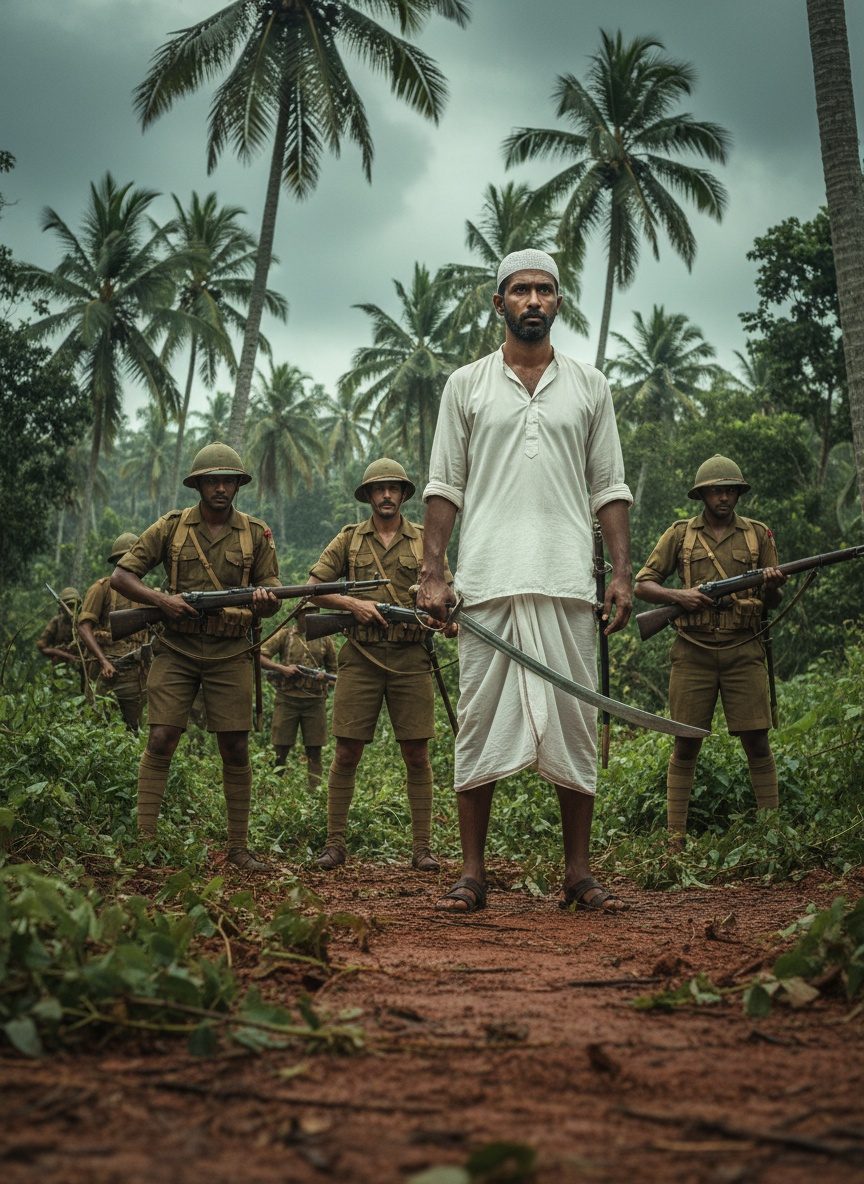
Yet, like the empire he revered, Rhodes's tenure bruised under the weight of its machinations. The ill-fated Jameson Raid in December 1895, a botched coup attempt against the Boer-run South African Republic, sullied his reputation and forced his resignation. This debacle was merely the prelude to broader conflicts; the tensions it stoked between British settlers and Dutch Boers exploded into the Second Boer War in 1899, a bloody actor on the stage of Africa's colonial theater. Even as Rhodes receded from political office, the effects of his grandiose schemes live on in the shadows.
In his final months, the resonance of this legacy lay heavy upon him. Nestled in the seaside cottage at Muizenberg, Rhodes faced his mortality. News of mounting tensions and ongoing conflicts dispatched from the front lines of the Boer War deprived his mind of tranquility. The war was a battle not just of arms, but of iron wills and cutthroat ambition—a crucible of the dreams he had nurtured amidst the jagged South African landscapes.
His will, carefully crafted and diligently executed thereafter, remains an enduring component of his posthumous influence. Even in death, Rhode's gaze reached far beyond southern Africa through the Rhodes Scholarship, an academic philanthropy designed to educate future custodians of the British Empire at Oxford University. For many, it was an open-door invitation promising prospects far greater than those realized by its progenitor on African soil. Yet grievances lingered, as the polarizing figure left South Africa entangled in a web — economic exploitation tethered to cultural and territorial disruptions whose resolutions defied century's worth of endeavor.
The tale of Cecil Rhodes’s ascent into the annals of history is one echoing the complexities of the land he so tirelessly sought to master. Under a weathered African roof, amidst the echoes of ocean tides and the encroaching silence of a life reached its denouement, Rhodes's mind could not escape the struggles of a continent fraught with contradiction—of empire and liberty, idealism and exploitation. A man who, from the edge of the British Empire, reshaped a portion of the world and, with his actions, kindled fires that few have since managed to contain.
As we ponder Rhodes's indelible imprint, the moral reckonings of his pursuits remain subjects of intense scrutiny—a testament not just to human ambition, but to the enduring struggle for justice, independence, and unity in lands that continue to grapple with the echoes of colonial expedition. His story is a vivid reminder that the legacies we leave are as much wrought by what we build as by those we leave broken, waiting in silence for their histories to be told. In the convergence of light and shadow at the Cape, Rhodes's life finds its singular place within the mosaic of human endeavor, a legend left untold in the simplest of textbooks.