April 22, 1796. A lone seagull circled overhead, its cries lost in the roar of the Atlantic.
Clash of Frigates
The day belonged to the sea—a chaotic battleground spread across the Atlantic's restless surface. Against the backdrop of the French Revolutionary Wars, two naval giants engaged in a fierce contest. The British frigate, a formidable vessel under the command of Captain Edward Pellew, locked horns with the French frigate Virginie. Cannons boomed and masts splintered as the duel intensified, each salvo a test of might and resolve.
Virginie, graceful and defiant, began her day with the tricolor flying proudly at her stern. But as the sun climbed higher, determination gave way to desperation. The British had gained the upper hand. Captain Pellew, known for his tactical ingenuity and unyielding courage, directed the relentless bombardment from the quarterdeck, his eyes never leaving the enemy prize he sought to claim.
Virginie's crew, valiant in the face of overwhelming odds, fought bravely to save their ship. Yet, as plumes of gunpowder smoke faded into the ocean spray, the Virginie was in tatters, her timbers creaking, her future sealed. With no means to continue the fight and the hull breached by the British onslaught, her captain ordered the colors struck. The battle was over, yet the sea’s fury had not abated. The French frigate began to list dangerously, the ocean hungrily claiming its spoils of victory.
Most captains would have relished the triumph from afar, content to let the waves decide the fate of those vanquished. But Pellew was not a man cut from ordinary cloth. As Virginie succumbed to the depths, a cry went up—a French sailor had been thrown overboard by the explosive force of the conflict. It was a cry not just of distress, but a summons to the heart of a seaman.
A Sudden Plunge
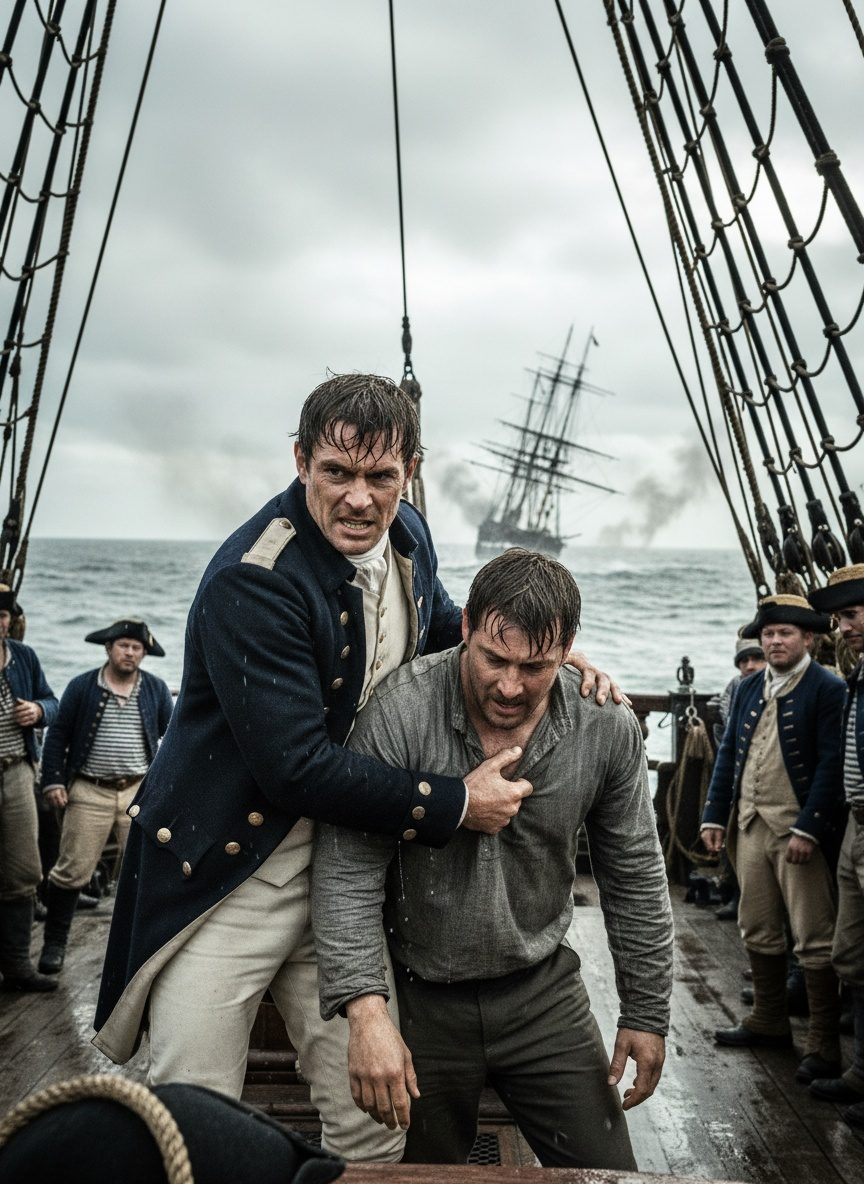
It was a moment that peeled back the veneer of enmity and animosity—a reminder that amid the clash of empires, humanity still breathed through the smoke of battle. Without hesitation, Captain Pellew left the security of the quarterdeck and dove headlong into the tumultuous sea. The Atlantic was cold and unforgiving, churning with debris and echoing the groans of a dying ship.
The sea that day was not merely a theater for war but a test of character. As Pellew struck the water, salt stung his eyes, and the world inverted. His uniform, once a symbol of British superiority, became a hindrance, pulling him down as he swam fiercely against the currents. Each stroke carried an urgency, driven by something deeper than duty—the inviolable call of compassion.
Clawing against the angry ocean, Pellew’s gaze locked onto the struggling figure of the French sailor. The enemy, not in uniform but in plight, now lay within reach. The sailor, exhausted and defeated, could barely muster strength. Yet, in those brief moments, language, nationality, and allegiance dissolved before the simple act of rescue.
Reaching the floundering sailor, Pellew anchored the man's slight frame against his own with the grip and conviction of humanity itself. Together, they rose and fell with the waves, the dual pounding of heartbeats almost audible above the noise. Swimming back, Pellew willed strength into fatigued muscles, spurred by the thought that survival meant victory for both.
Acts Beyond Valor
The journey to safety was a small eternity, but Captain Pellew's resolve never wavered. On board the British frigate, Pellew—a living exemplar of naval valor—was greeted with astonishment yet admiration. Here was a captain who understood that victory wore many faces and courage many forms. The French sailor, sputtering and grateful, was taken aboard, no longer a foe but a fellow man spared from the abyss.
This act of bravery did not go unnoticed. Among the gathered ship's company, whispers of Pellew's daring grew, stories that would ripple through the waves all the way to the Admiralty and beyond. It was incidents like these that subtly redefined the character of the Royal Navy during its finest hour. Honor and humanity shone as brightly as any brass button on a sailor's uniform, woven into the ethos that Britannia strove to exemplify.
For Pellew, and many who commanded alongside him, the sea was more than just a domain of conquest—it was a crucible of character. As the sun set on that April day in 1796, the lesson resounded forcefully: victory achieved without human compassion is hollow indeed. Such stories of maritime chivalry became the lifeblood of a navy that ruled not only by might but through the subtle power of honor.
In centuries past, as in years to come, it is a reminder that amidst the vast seas of history, acts of individual courage ripple endlessly outward, shaping the world far beyond their moment. In pulling a single sailor from the depths, Pellew forged a legacy that has inspired, prompting us to dwell on an enduring truth—that beneath every flag and uniform, the heart of a seaman is tethered to the same horizon.