He was a giant among men in stature and spirit. Fred Burnaby, towering at over six feet, had the endurance of an iron horse.
The Road to Defiance
In January 1875, the Russian Empire's forbidding decree echoed through the corridors of the British military: no British officers were to venture into Central Asia. This was a strategic marrow of the Great Game, a geopolitical chess match where empires teetered on the brink of war over influence in Asia. But to Captain Frederick Gustavus Burnaby of the Royal Horse Guards, the decree was less a command and more an enticing dare. A man of insatiable curiosity and a heart that knew not the meaning of 'enough,' Burnaby saw the Russian mandate as a direct challenge—a thick fog shrouding lands he yearned to see for himself.
Born into a world that valued exploration and empire, Burnaby was no stranger to perilous adventures. His boldness was legendary, having already explored vast swathes of Europe and the Middle East. Yet, the allure of Khiva called to him with the intensity of a siren's song. Nestled deep within the Turkestan deserts, Khiva was not just a place on a map but a crucible of intrigue and untapped knowledge. What lay there was a mystery the Russian Empire guarded zealously, marking it forbidden under the watchful eye of Tzarist expansion. Burnaby's response was simple: saddle up.
Venturing to the Edge of the World
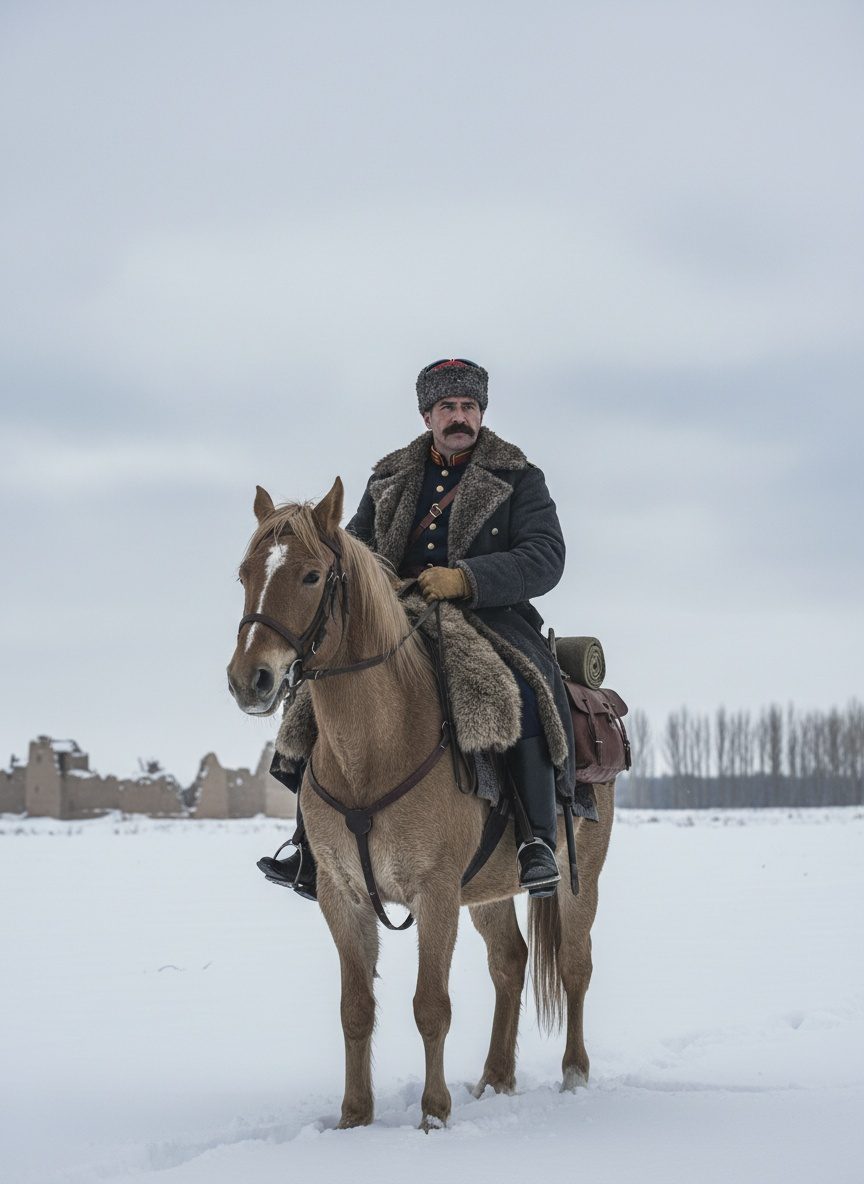
With determination matching his formidable physicality, Burnaby set out alone, under the stark gaze of winter. The Central Asian steppe is not known for its welcoming embrace, especially in the harshness of winter where temperatures plunge mercilessly, and wailing winds sweep across an endless expanse of snow and ice. For 800 miles, Burnaby rode onward, the expanse offering little respite, only the occasional specter of a village offering scant refuge. His journey was not just a test of physical endurance, but a profound mental trial—a solitary expedition where the horizon never seemed closer, and the world above and below merged into one vast whiteness.
Riding mostly at night to avoid detection, his path was filled with the chilling echo of his horse's hooves and the whispering promise of discovery that lay beyond. It was a solitude echoed by the frozen wasteland, as Burnaby faced the elements and perhaps even the specter of madness that loneliness can evoke. But each step closer to Khiva was a push against the very boundaries of the British Empire’s understanding of the region, an act of defiance wrapped in the cloak of exploration.
The Enigmatic City of Khiva
The culmination of his journey was the city of Khiva, a place suspended in time, where the clash of cultures and the tendrils of Russian influence melded into a turbulent dance. Khiva was a place of mystical allure for the West—a city that few Europeans had seen, let alone understood. As Burnaby breached its threshold, what he found was an empire within an empire—a microcosm of power, resistance, and survival.
Khiva was more than just sand-worn walls and arched gates; it was a center of power dynamics between local Khans and Russian emissaries. Russian ambitions were palpable, and what Burnaby observed was a calculated chessboard where every move was part of a larger game. This was no desolate hinterland but a land buzzed with activity and a crucible of political tension—the very fuel for imperial conflict. Burnaby’s observations of Russian fortifications and native attitudes were a stark revelation to the British Empire lurking thousands of miles away.
Words that Echoed Through Empires
Returning to England, Burnaby was not the same man who had set out. The experience had etched itself onto his very being, and as a testimony to his remarkable feat, he penned a narrative that would send ripples through empires. His book, crafted with the keen eye of a seasoned adventurer and the eloquence of a master storyteller, recounted his daring journey and the volatile powder keg he discovered in Khiva.
The narrative was more than just accounts of tired nights and snow-bitten days; it was a clarion call that exposed Russian expansionist ambitions in stark detail. Captivating and alarming, his writings prophesied the potential for conflict that lay buried under layers of diplomatic civility and mutual suspicion. As his tales spread through the salons and military circles of Victorian Britain, they became impossible to ignore—a cause célèbre that urged closer scrutiny and strategic recalibration.
Reverberations of an Extraordinary Ride
The solitary ride of Fred Burnaby was not just an act of individual bravery but a spark that ignited awareness and, indeed, paranoia within the British corridors of power. His story mattered far beyond the romanticism of adventure; it was a testament to the age-old truth that information and insight can sway the balance of power more effectively than any battalion. Burnaby’s observations urged the British Empire to alter its perspective and take heed of the silently simmering threats that lurked beyond the known world.
In a world driven by both adventure and intrigue, Captain Burnaby’s journey underscored an essential theme: exploration is not merely about conquering lands but understanding—and sometimes challenging—the forces of destiny. His ride to Khiva in the snow remains a poignant reminder of the complexities and perils of empire-building, a narrative as chilling as the steppes he traversed and as compelling as the future it foreshadowed.