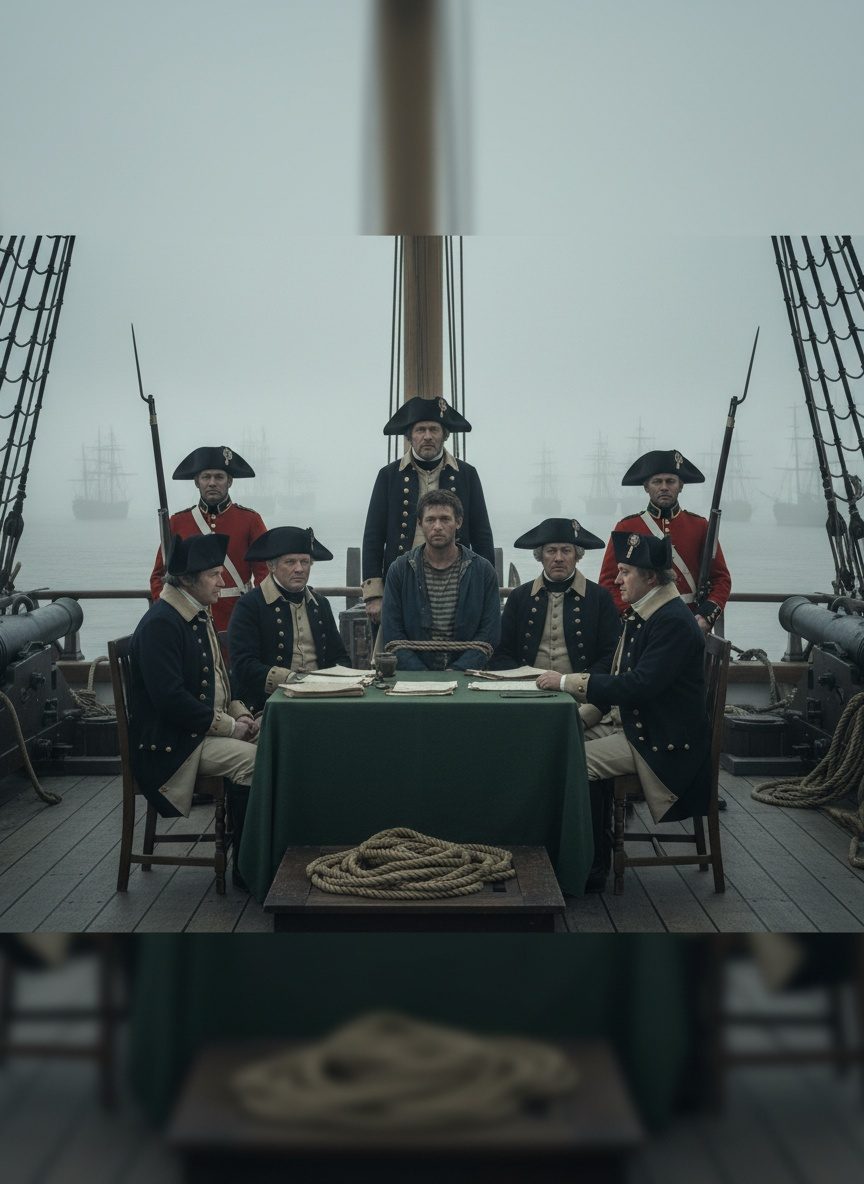
The sharp crack of the drum pierced the salty morning air, echoing ominously over the formidable line of warships at anchor. On the quarterdeck of HMS Neptune, eyes remained fixed on one lone man stripped of his naval regalia, Richard Parker. His defiant gaze met the assembled fleet, a witness to the crescendo of an audacious chapter in British naval history, one started by a whisper and carried to the mouths of cannons while Napoleon watched from across the Channel.
The Mutiny Ignites
The day-to-day life of a sailor in the late 18th century was one of arduous toil and relentless monotony; the sea a companion, master, and sometimes nemesis. Yet it was not Poseidon's wrath but the injustices of the Admiralty that roused the sailors to rebellion. It was the spring of 1797, and the English Channel waters were frigid, matching the strained and stiff spirits on deck. Discontent had simmered long below deck, nourished by meager rations, brutal discipline, and withheld wages.
The linchpin came at Spithead, but it was Richard Parker who ignited the powder keg at the Nore anchorage, a key strategic point near the River Thames. Amidst the clatter of chains and the clanging of metal on metal, whispers spread like wildfire — Parker was their chosen leader, the voice for over 100,000 sailors, caught between the precarious edge of mutiny and the hope for humane conditions. There was no turning back; the sailors had locked horns with the formidable British fleet.
The Stand at the Nore
Under Parker's command, the ships formed an impenetrable barrier across the mouth of the Thames, showcasing the unthinkable: blockading their own nation at the height of the French Revolutionary Wars. Menacing like a fortress afloat, the fleet of 28 ships stood defiant, their cannons silent for now but threatening in their presence. The grey clouds and frothy waves bore witness to the vessels' rigid discipline as Parker and the mutineers set forth demands echoing those unmet at Spithead.
Parker, wearing the makeshift title of "President of the Delegates", organized the discontented rabble into a disciplined force, a silent testament to their desperation and resolve. Through the salty spray and the howl of the wind, their intentions were clear; a stand for dignity at a time when life at sea was often crueler than the enemy's gunpowder. The Admiralty was locked in a tense standoff, and from Paris, Napoleon speculated with interest — would this internal unraveling render his cross-Channel ambitions fruitful?
Downfall and Retribution
The stalemate slided slowly toward an inevitable end as alliances strained and provisions dwindled. Days turned to weeks, and whispers of dissent grew among once-united ranks. The Admiralty, brewing fury and cunning, stoked the division, promising amnesty to those who would lay down arms. The rift widened until unity crumbled, and Parker found himself deserted by those who had once championed him.
It was June when the iron grip of retribution wrapped around Parker’s throat. Torn from his brothers-in-arms, he stood before a military court of stark faces and gleaming epaulettes. Conviction came swift and merciless; in the eyes of the Admiralty, a traitor’s fate awaited.
The Ceremony of Degradation
Stripping Parker's rank became not just a legal formality but a grand performance designed to quench the Admiralty’s thirst for dominance. As the fleet assembled, a dreadful silence blanketed the scene, broken only by the persistent sqwawk of seabirds. The line of mighty wooden hulls gleamed in the pale sunlight, their crews at attention, awaiting what was to come.
Amidst the formal tangle of command uniforms, Parker was summoned, a symbol in shackles, to endure a final act of humiliation. Stripped of his insignia, Parker stood bare before the very navy he had nearly toppled. The act was brutal in its ceremonial precision, an indelible moment hammered into the consciousness of every man who bore witness. It was punishment transformed into spectacle, engineered to root fear deep into the timbers of Her Majesty’s Ships.
Forgotten Legends and the Lure of the Sea
A chorus of sails unfurled, the fleet swallowed Parker's lone figure as their masts vanished into the horizon, weighed by the Judgement of the Admiralty. Yet the echo of those mutinous days lingered over the waves, whispered in the hawse pipes and among the lowliest of decks across the world’s oceans. In choosing to strip a mutineer of humanity as well as rank, Britain carved out a tale steeped in paradox; a powerful navy revealed vulnerable and a self-proclaimed king among sailors, defiant to the end.
This story, largely forgotten amidst the grandeur of British maritime triumphs, challenges the narrative of an invincible Royal Navy. It speaks to the unquenchable thirst for justice, even in the face of unimaginable power, and the raw human tendency to rise against overwhelming odds. As the tides continue to weave through history, Richard Parker and the mutineers at the Nore remind us of the deeply human elements embedded within the canvas of empire: rebellion, justice, and the price of defiance.