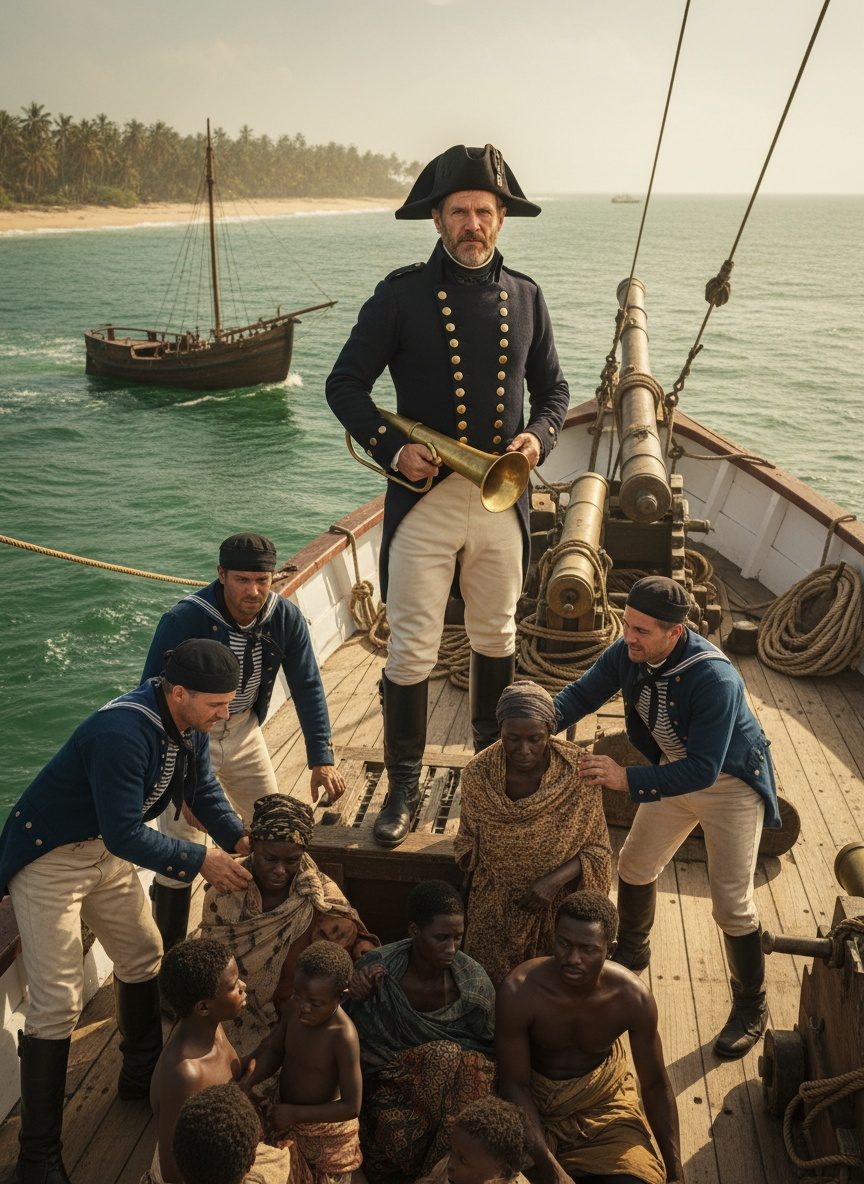
June 18, 1823. The burning African sun shimmered off the waves.
The Birth of a Squadron
In the early 19th century, a significant shift in the winds of history occurred. Britain, which had long profited from the trade of human lives, decreed an end to its participation in the transatlantic slave trade in 1807. This edict was not just a legal declaration but the beginning of a crusade. To enforce this ban, the British government dispatched a specialized group of vessels known as the West Africa Squadron.
Established in 1808, the squadron was tasked with patrolling the Western coast of Africa—a swath of tumultuous waters some 3,000 miles long. It was a monumental effort, and one that was equipped not with the politicking of diplomats but with the guns and ironclads of Her Majesty's Navy. The squadron's mission was straightforward yet daunting: stop the slavers, seize the ships, and free the captives. The aim was nothing less than to uproot a practice ingrained in economies and societies around the globe.
On the Trail of the Felonious Fleet
The West Africa Squadron operated out of Sierra Leone, a small colony founded as a haven for freed slaves. From here, its vessels set sail, cruising the Gulf of Guinea where slavers frequently attempted the illicit run across the Atlantic. The patrols were often grueling and perilous; the waters could be treacherous, and the climate unforgiving. The sailors bore witness to the grim reality within—overcrowded hulls filled with frightened captives, shackled and yearning for mercy.
With legal authority granted by the 1819 Abolition of the Slave Trade Act, British warships patrolled the sea lanes, intercepting suspect slaver ships and scouring them for evidence. Acelerations of speed, false papers, hidden compartments—the resourcefulness of the slavers knew no bounds. Captains of the Royal Navy had to become adept detectives, piecing together clues that might save hundreds of lives hidden beneath the decks.
The Price of Enforcement
While the West Africa Squadron's efforts in halting the abhorrent trade were nothing short of heroic, there was an immense cost. In the 60 years of its operation, between 1808 and 1867, the squadron captured over 1,600 slave ships and liberated more than 150,000 enslaved Africans. Yet, these astonishing achievements came at a dire price.
The greatest enemy the squadron faced was not the slavers, but the very environment they sought to defend. Malaria and other tropical diseases were rampant along the West African coast, and the squadron suffered casualties at an appalling rate. More men of the Royal Navy succumbed to fever than were lost to the cannon—an attrition rate so severe that naval duty in these waters was regarded with dread.
Yet this did not dissuade the conviction of those who served. Their sacrifice was an implicit testament to the transformation of Britain’s moral landscape. The actions of these sailors, unseen and unheralded, sent ripples through the ocean of history.
The Resilience of Those Freed
For those hundreds of thousands who were rescued from the holds of slaver ships, the journey had only just begun. Upon liberation, many freed individuals found themselves relocated to Sierra Leone, where Freetown became a growing settlement of diverse yet unified communities. The liberated slaves—comprising myriad tribes, languages, and customs—struggled together to forge a new life.
Countless individuals had lost nearly everything, except perhaps the most fundamental craving for freedom. Despite their harrowing ordeals, the resilience of these freed Africans shone brightly. They carried cultural fragments and traditions from their homelands into this new world, creating a vibrant and unique society. In a strange twist of fate, Sierra Leone emerged as a bewitching amalgam of Africa's cultural tapestry—a living testament to human fortitude.
A Legacy Charted in the Waves
Today, the harrowing odyssey of the West Africa Squadron is a largely untold chapter of history. Few remember the sacrifices of the sailors, nor the trials faced by those they saved from the jaws of the ocean’s darkness. But their imprint resonates still. It serves as a stark reminder of the cost of vigilance in the face of inhumanity.
The squadron's mission encapsulates the tension between moral principle and pragmatic realities. It is a story of transformation, about a nation grappling with its conscience, seeking redemption through action. The Royal Navy's presence on the high seas declared a belief that the laws written on parchment should span the spaces where freedom was most at peril—the windswept waters beneath which human dignity was being drowned.
This era in maritime history is more than dates and statistics; it is a chronicle of courage and conviction. It compels us to ponder the sacrifices made not in a blaze of glory, but in steadfast, stoic resolve. From the heart of darkness, the light of humanity flickered brighter, illuminating a path for future generations.