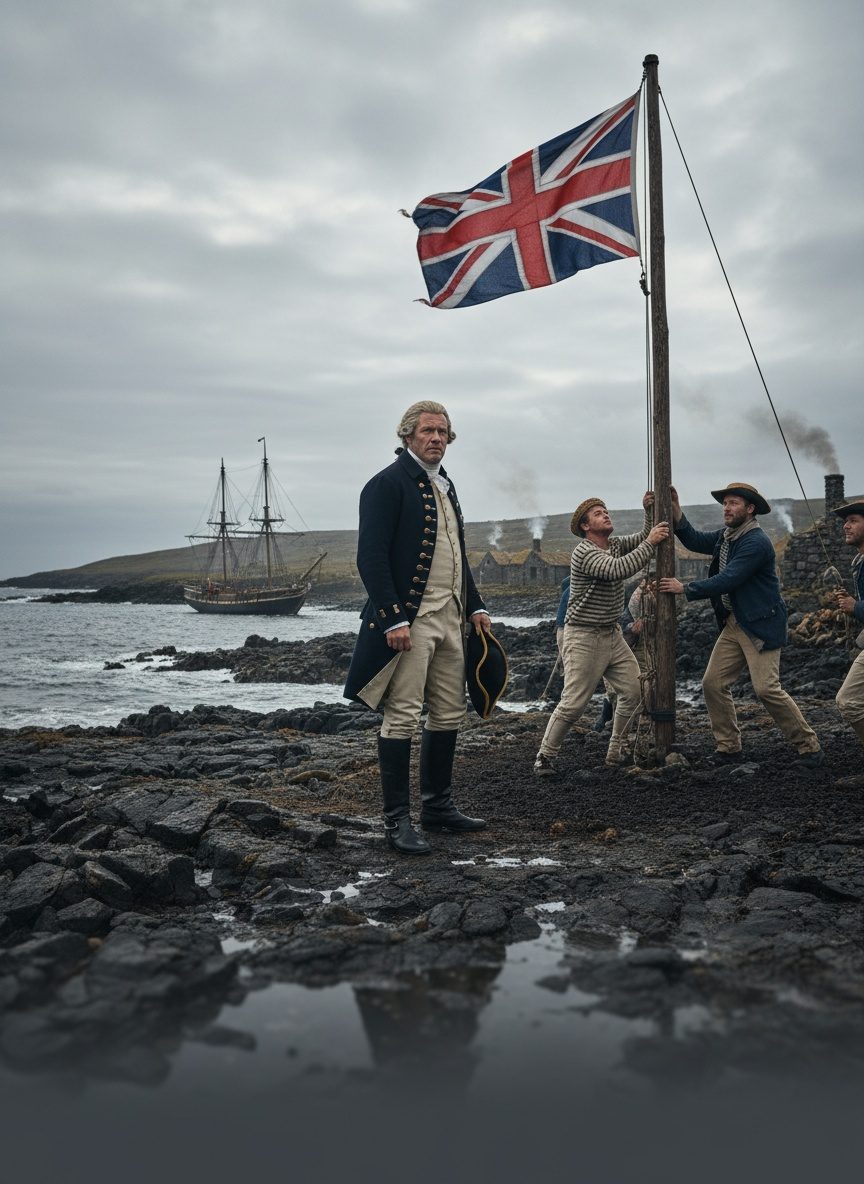
February 14, 1764. A biting Atlantic wind cut through the rigging of the ships anchored off a desolate archipelago. These were the Falkland Islands, a bone of contention before the world had ever heard of the colorful flags of South America. Here, in this southern Atlantic wilderness where tussock grass swayed under gray skies, European ambition would play an unscripted overture.
On this windswept morning, French sailors from the expedition led by Louis Antoine de Bougainville set foot on a bleak and almost unknown island, where they established Port Louis, the first settlement in the Falklands, naming them the "Îles Malouines". These settlers from St. Malo had no inkling that their nascent colony would soon stir a pot of colonial rivalry that would endure long after their departure. To Bougainville and his compatriots, the Falklands were a place to extend French influence, perhaps a stepping stone to the vast, unexplored territories lying beyond.
Unbeknownst to them, the British were nearly on their heels. By the following year, in 1765, British Captain John Byron arrived at a different part of the islands, unaware of the French claim. With the Union Jack fluttering in the Atlantic breeze, Byron ceremoniously claimed the islands for the British Crown, naming it Port Egmont. Such was the era — nations planting flags in lands scarcely explored, their audacity as vast as the open seas around them.
The Falklands, though often perceived as an inconsequential cluster, loomed large as a geopolitical chessboard poised on the edge of the Atlantic, its importance lying less in its resources, more in its strategic perch for maritime power. It was in this location that these two European powers, separated not by territory but ideology and ambition, found themselves suddenly eyeing one another with suspicion across stormy waters — each believing they possessed rightful dominion.
The situation grew thornier when Spain, asserting ancient claims inherited through a sweeping papal decree that had once divided new world territories, expressed its own ambitions. Adding a twist, Spain negotiated with France; the two kingdoms shared a Bourbon lineage, and Spain convinced France to sell its settlements, France acquiescing due to pressures closer home and retreating while still keeping its dignity untarnished by leaving their original claim officially undetermined.
Spain’s demands were clear and unyielding: the British withdrawal from these quarrelsome lands. It was a diplomatic dance fraught with tension, one irritating step after another. Britain, impervious to Spanish commands, stood its ground in the claim despite the dominion largely largely lesser-known beyond a handful of seafarers. Fragile colonial possessions were volatile tokens in greater schemes of royal relations at the time, where diplomacy could be daggers drawn in whispered parlors, or an implicit threat through surreptitious alliances and counterclaims.
Eventually, in 1771, Britain found itself besieged by the pragmatic dictates of its era. Reluctantly, they conceded, leaving the Falklands with an understanding that Spanish possession was subject to future British recognition — a vagary that cleverly kept doors slightly ajar. This diplomatic concession was merely an interval in a longer dance of imperial claims, where the Falklands continued to exist as quarries of contention rather than willing hosts to foreign dreams.
Despite being strong-armed into an agreement, the British departure was not an admission of failure but more a tactical withdrawal. Britain nursed its intention as if a simmering choice, biding time as it calculated gains and the winds of political change. This retreat from the windswept islands was but a prelude to their return. With the passage of time, the British reoccupied the islands, fortifying their claim and spelling yet another chapter in the saga of Falkland possession.
The tale of European dances over the smothering Falklands had laid bare the obsessions and ambitions that guided explorers and empires alike. This small scattering of land, carved by relentless winds, proved to be more than a geographical point — it was a litmus test of imperial resolve and rivalry. Its resonance echoed into the ages; a disputed ground signifying continuity within an ever-changing game of territorial chess.
As one considers this pastel of colonial gambits, it is a poignant reflection not merely on the geopolitics of 18th-century Europe but on the very nature of empire-building — a ceaseless pursuit of dominion often dictated by whimsy as much as strategy. This contest over seemingly inconspicuous islands prefigured a world where lines on maps became battlegrounds, and where departure never truly equated to capitulation. The Falklands saga underscores the enduring dance of possession, a territorial tango which, though subdued, thrums with the vibrance of defiant legacy.