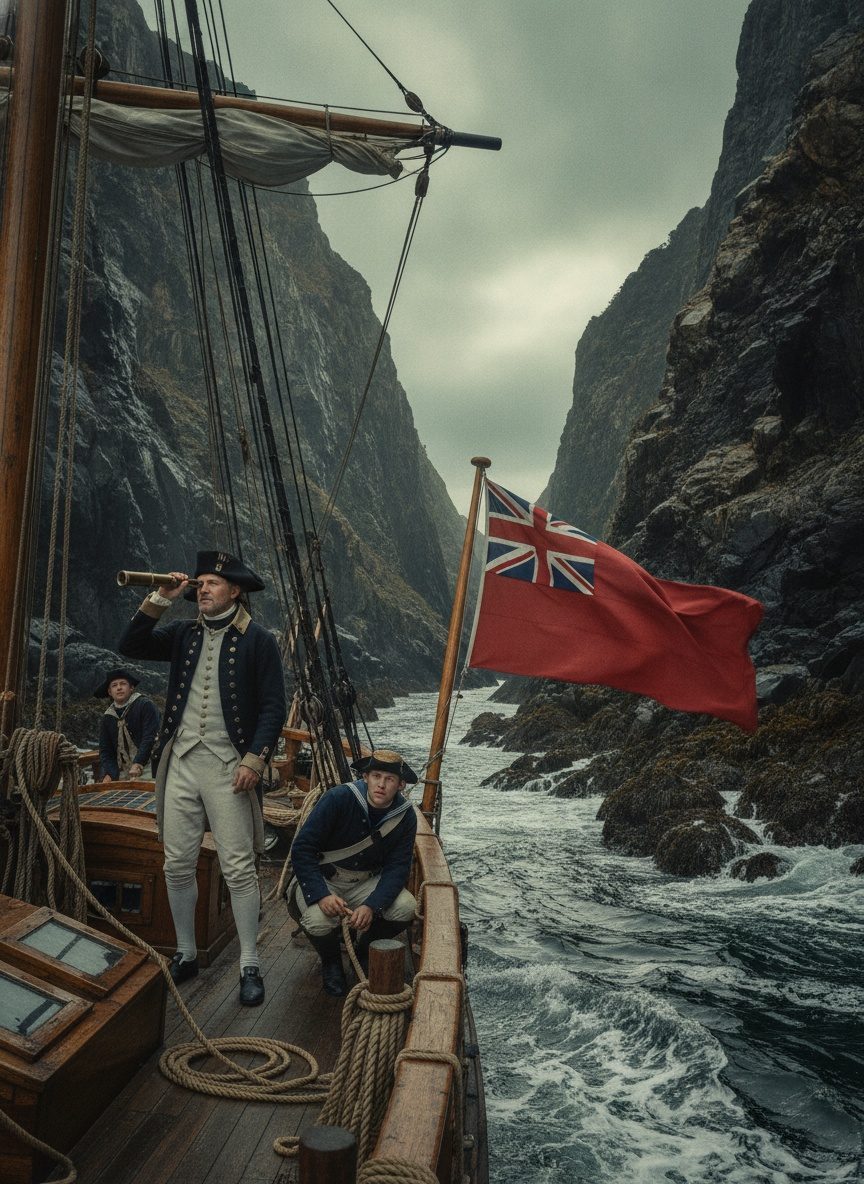
The Strait of Magellan was Spain's exclusive waterway. Yet Britain sailed its ships through without hesitation.
Spain’s Coveted Passage
In the early 16th century, the Strait of Magellan became Spain's treasure trove—an invitation to the riches of the Pacific. Cut below the southern tip of South America, it was a shrouded passage wreathed in fog and legends. When Ferdinand Magellan's expedition first navigated its treacherous waters in 1520, the strait was baptized with his name, carving a path through oceanic myths. To Spain, it was more than a maritime shortcut; it was a seal of their imperial conquest, an enclosure to later be guarded under the Treaties of Tordesillas, dividing newfound lands with Portugal.
The strait was a bottleneck of international intrigue, a stretch that promised dominion over emerging trade routes and the wealth of the Orient. Yet nature hedged its use with relentless winds and icy waves, dissuading many prospective explorers. It was this fearsome reputation that shielded it under Spain's dominion for decades, a maritime phantom less traversed, and thus less disputed.
Britain Launches into Uncharted Waters
By the 18th century, the drums of naval power and economic expansion beat louder across Britain. The Royal Navy, always on the hunt for new territories and trade avenues, looked keenly at the passages that had laid dormant in use but wealthy in potential. The Strait of Magellan, once merely a hushed whisper on navigational charts, transformed into a siren's call.
In the absence of a coherent political challenge — after all, the modern nation of Argentina had yet to ink its borders — Britain pursued with audacity where formal declarations had not. British ships began threading the needle of the strait, not as intruders, but as inheritors of navigational freedom enshrined in the evolving law of the sea. Spain’s waning grip and internal turmoil presented an opportunity wrapped in maritime legitimacy; the waterways became arteries of British assertion.
Pathways of Law and Sea
The seas, governed by their own law, had always been a testament to the bold and the intrepid. Centuries prior, the seas were highways for explorers, pirates, and empires alike. While Spain called the Magellan Strait its private corridor, Britain stood by the ancient principle: the freedom of the seas, a concept championed by the Dutch jurist Hugo Grotius in the early 17th century.
This said that no nation could clench the seas in its fist — that they were a realm inherently boundless, a shared heritage no sovereign claim could bind. Herein lay Britain’s open defiance: they sailed these routes as a manifestation of these principles, staking claims not through possessive decree but through the public act of navigation.
Churning Waters and Strategic Gains
Though tranquil on maps, the Strait of Magellan’s waters churned with strategic ambitions. British presence in the strait was not merely symbolic, its tangible benefits were manifold. As Britain expanded its trade to the Pacific, securing a reliable passage sharply curtailed the hardships of navigating with the tempests of Cape Horn. This conduit also hinted at possibilities of territorial enticements; the Falkland Islands, for instance, served as a testament to Britain’s desire to station influence in these remote waters.
Navigating the strait under harsh conditions became a right claimed through usage rather than occupation. The Royal Navy, with its storied prowess, lent this passage a cloak of inevitability. It was a subtle play for dominance where the ships coursed through not out of conquest but of accepted practice.
The Enduring Straits of Memory
Thus, Britain charted a course that was as much about exerting naval power as it was about expanding maritime philosophy. The Strait of Magellan, long before Argentina hoisted a flag as a symbol of national sovereignty, served as a backdrop to the forces that shaped its region’s destiny. How pioneers challenged territorial identities by proving the legitimacy of movement and commerce across the seas is a notion that reverberates even today.
As Argentina emerged, it would redefine this boundary — but long before, Britain’s sail was already set within these tempestuous waters. The enduring lesson? Dominion is as much about negotiation and practice as it is about the written word. The Strait of Magellan was a testament to the saga where nations navigated the narrow gauntlets of both sea and intent, defining legacies that textbooks often leave behind.