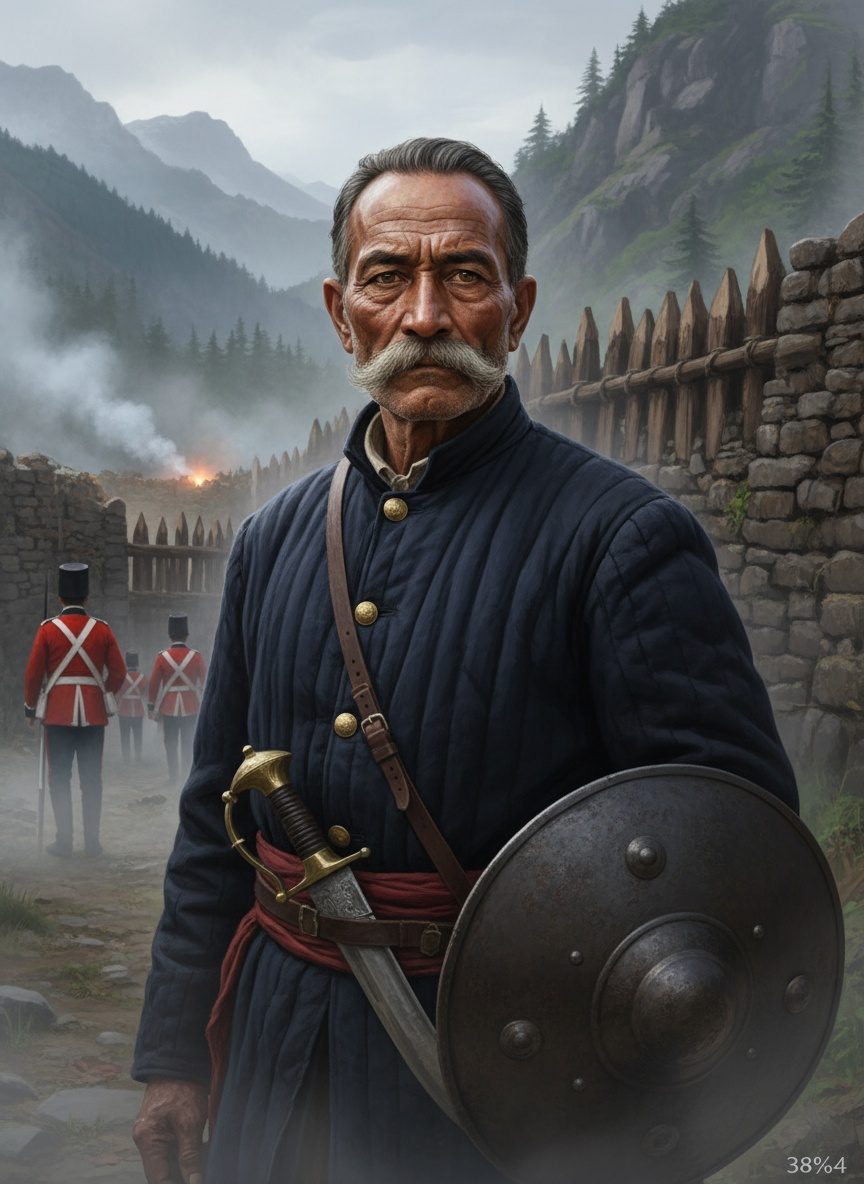
The air was thick and wet, the chilly October winds rustling through the dense foliage of the Himalayan foothills. Amidst this rugged and forbidding terrain, the twilight cast long shadows over an imposing figure: the stockade of Nalapani, a wooden fortress etched against the backdrop of looming mountains. Here, in the mist-shrouded valley, an epic struggle was unfolding. Down below, 3,500 British troops were poised for battle, their ranks firm and ready. Above them, in the humble fort that overlooked a realm rich with history and conflict, 600 Gurkhas stood their ground, resolute against a foreign wave. At the heart of this defense was Bhakti Thapa Chhetri—a warrior whose spirit was unyielding, even at 74 years old. His legacy would be forged in defiant acts that defied colonial ambition.
The Grand Old Man of Nepal: Bhakti Thapa's Stand
In the shadowy recesses of Nepal's history, few names carry as much weight as Bhakti Thapa. Born in 1741 in the picturesque yet embattled kingdom of Lamjung, he rose from noble lineage to become a celebrated figure in Nepal's military annals. This journey from local sardar to national hero was not straightforward; it was chiseled by battles, betrayals, and the relentless efforts to stitch fragmented principalities into a cohesive Nepalese state. Thapa first served the Kingdom of Lamjung but soon found himself taken prisoner after a fateful clash with the Gorkhali forces. However, fate had other plans for him. Redirected from prisoner to a revered sirdar in the victorious Gorkhali army, Thapa eventually became the supreme commander of troops stretching from the west of Kathmandu to nearly the Sutlej River.
As British forces pushed into the mountainous region of Nepal in search of conquest, they confronted an impasse symbolized by Nalapani. Commanded by General Robert Rollo Gillespie, the British anticipated a swift and decisive victory. Instead, they collided with an implacable wall of resistance, led by Bhakti Thapa, who now, as the leading force in the western front of Deothal, sought not only to defend his homeland but to ensure its sovereignty. With his mere presence, Thapa inspired 600 men, a garrison commanded to hold their bastion against an army nearly six times their size. Each charge by the British was met with an equally fierce and unwavering shield, and Thapa’s knowledge of the terrain and guerrilla tactics turned the formidable stockade of Nalapani into an anchor of resistance.
Daybreak of Resurrection: Courage Amidst Chaos
The light of dawn on October 31, 1814, crept over the battleground, revealing a landscape scorched and scarred from relentless warfare. The Gurkha defenders, entrenched within their fortress, might have been lesser in numbers, but their legendary courage, unmatched knowledge of the terrain, and unwavering leadership compensated for what they lacked in artillery. Bhakti Thapa, at over seventy years of age, embodied the spirit of Yamraj, the god of death, valiantly commanding and fighting alongside his soldiers. On that fateful morning, he chose to don his battle gear to personally lead the charge against the incoming British troops.
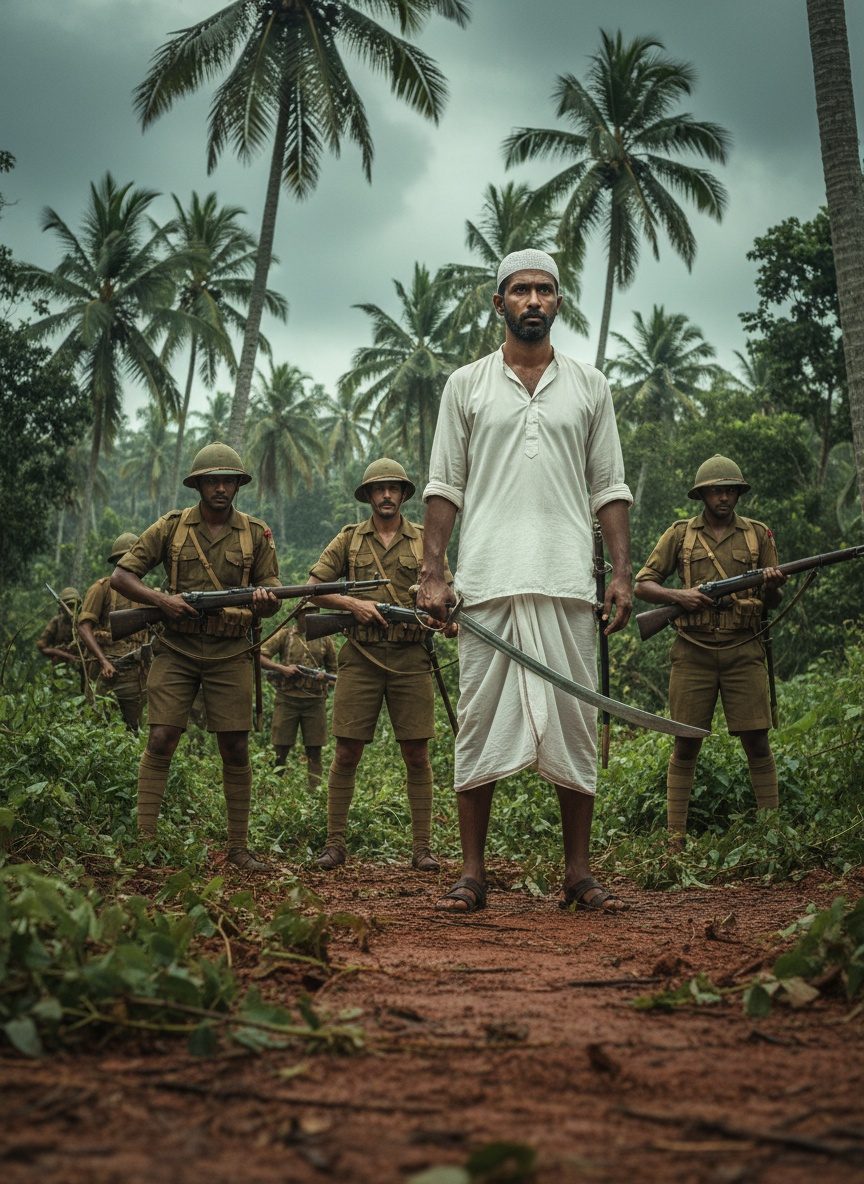
Thapa believed his presence would ignite a fire in the hearts of his men, a testament to his belief in leading by example. Adorned in full traditional armor, he strode out into the open field, a sole silhouette against an advancing tide—one man's audacious challenge to an empire's ambitions. Bhakti Thapa's confrontation with the British forces would take his life, but not the will of his men. Defying destiny itself, his fall became a rallying cry. In the face of staggering British advances, the Gurkhas of Nalapani fiercely defended what was left of their commander’s legacy.
The siege would take its toll on both sides. As the monsoon ceased, British forces knew they had underestimated their adversaries. Bhakti Thapa’s sacrifice at Nalapani encapsulated more than mere defense of territory; it embodied an enduring spirit that would resonate through generations. The British, shaken by the ferocity of the Gurkha resistance, were forced to acknowledge that they were locked in combat with warriors of formidable tenacity and valor. By the end of the prolonged battle, the cost was staggering: advanced British forces suffered heavy casualties and significant logistical delays.
The Legacy Beyond the Battlefield
The battle of Nalapani eventually drew to its bittersweet conclusion. After three weeks of siege, the Gurkhas, beset by dwindling water supplies, were forced to vacate their fort under the cover of night. Yet, the true victory lay not in the tactical withdrawal but in the moral and historical weight of their stand against such overwhelming odds. The British succeeded in occupation, but they carried with them a profound respect for the Gurkha warriors they now considered worthy adversaries.
What followed was not merely an expansion of British dominion but an unexpected bond formed out of mutual respect. Over time, the British Empire would come to rely heavily on Gurkha soldiers, whose discipline and fearlessness became legendary. Thapa's sacrifice secured not just a place in the annals of Nepalese history, but also an indelible chapter in the broader historical tapestry of resistance against colonialism. His actions reverberate through the ages, an enduring reminder that even in the face of insurmountable challenges, a steadfast heart and an unfaltering spirit can reshape the course of history.
In remembering Bhakti Thapa and the defense of Nalapani, we do more than honor a singular act of courage; we recognize a broader struggle for autonomy and identity in a world swept by colonial intent. It’s a saga not only of the walls that held against the tide, but of the undefinable and enduring spirit that cements legends into eternal narratives. For in the shadows of history, lit by the fiery resolve of men like Bhakti Thapa, we find stories that sharpen our sense of understanding—truths that instruct not just nations, but humanity at large, about valor, sacrifice, and the indomitable quest for freedom.