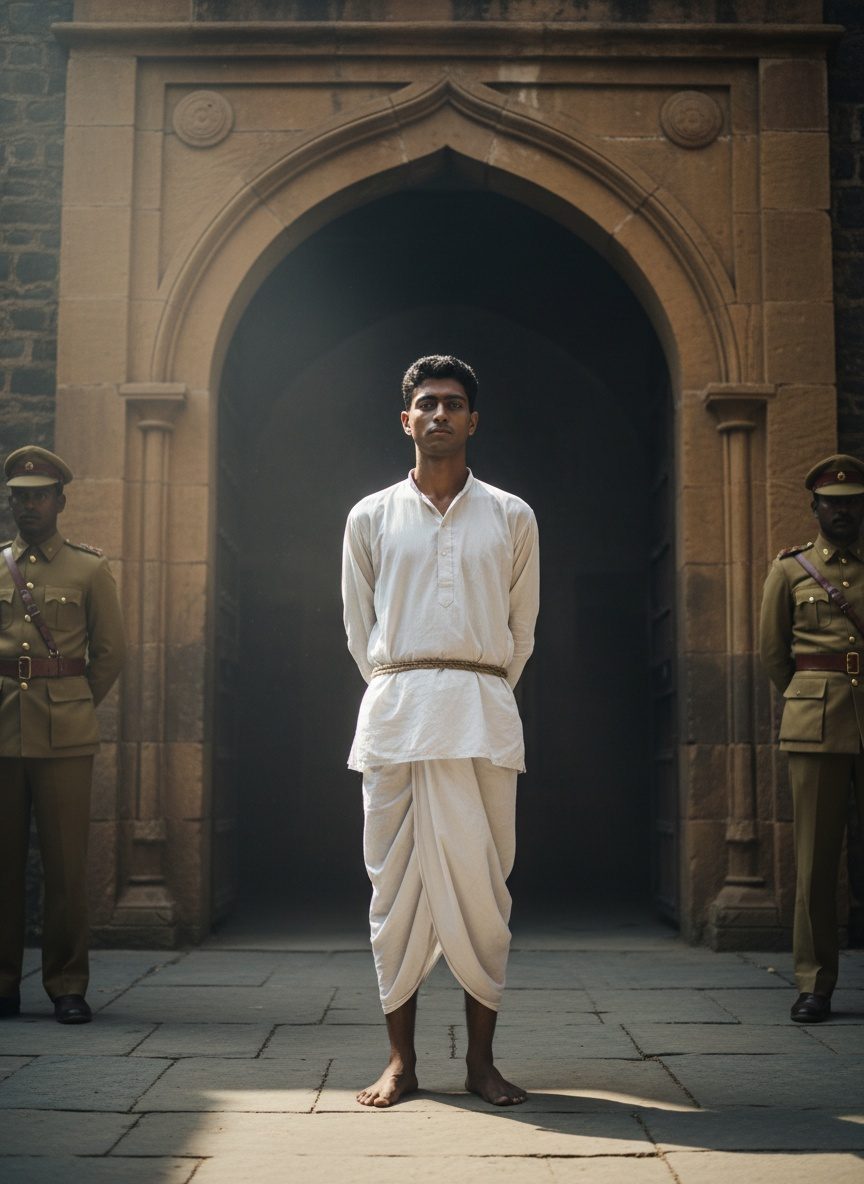
The dull thud of the wooden doors closing echoed through the silent corridors of the jail. Bhagat Singh, with a serene determination, stepped forward, his chains clanking with each step. The atmosphere was heavy, charged with a palpable tension, as though even the stones beneath him awaited this moment with bated breath. The gallows stood ahead, but Bhagat's spirit soared beyond the confines of his physical reality.
The Revolutionary's Resolve
Born on 27 September 1907, in a small village of Banga, in the Lyallpur district of Punjab, present-day Pakistan, Bhagat Singh was raised amidst the turmoil of the Indian independence movement. From a young age, he was enthralled by stories of valor and sacrifice that imbued him with a fierce sense of purpose. By the time he was a teenager, Bhagat Singh was already deeply involved in the revolutionary struggle against British colonial rule, a path that would lead him to join the Hindustan Socialist Republican Association (HSRA).
In December 1928, Bhagat Singh, alongside his comrade Shivaram Rajguru, directed their defiance against British authority by mistakenly assassinating Officer John Saunders in Lahore, as retaliation for the death of the nationalist leader Lala Lajpat Rai. This act of defiance marked him as a passionate crusader for justice in India. However, it was the bombing of the Central Legislative Assembly in Delhi on 8 April 1929 that turned him into a symbol of revolutionary bravery. The bombs, deliberately non-lethal and accompanied by leaflets declaring "It takes a loud voice to make the deaf hear," were intended to awaken the slumbering consciousness of an oppressed populace rather than cause harm.
Bhagat Singh and his associate, Batukeshwar Dutt, surrendered immediately, not in defeat, but as a calculated move to use their trial as a stage to spotlight the cause of Indian independence. Throughout their trial, encapsulated by the media frenzy, Bhagat and his fellow revolutionaries delivered poignant speeches articulating their ideological stance, seamlessly merging ideas from socialism, anarchism, and anti-imperialism. His eloquence and defiant demeanor captivated the nation, turning the courtroom into a theater of revolutionary fervor.
The Hunger Strike and Jail Battle
Inside the prison walls, Bhagat Singh continued waging his battle through a new weapon: hunger. Commencing a hunger strike to protest against inhumane treatment and demand the rights of political prisoners, Singh's resolve drew immense attention and brought Indian public opinion squarely behind him. For weeks, Bhagat Singh's hunger strike became a battle cry transcending the prison barbed wires, causing anxieties amongst British authorities and further agitating their faltering grip on India's populace.
Sympathetic coverage emerged predominantly in Indian-owned newspapers, fueling Bhagat Singh's transformation into a household name, particularly in the Punjab region. It was not just an individual's hunger strike; it became the embodiment of the nationwide thirst for freedom. Indian leaders, including the sober Gandhi, were compelled to navigate this emergent wave of revolutionary spirit carefully — a new phase in the ongoing struggle for sovereignty.
The British, wary of the growing lionization, sought an end to the spectacle. Despite their concerns, the pressure only intensified the journey to his inevitable death. The manner in which Singh adopted martyrdom compelled introspective dialogues within the Indian National Congress and nationwide on the use of violence as a tool against colonial oppression.
The Final Hymn
On 23 March 1931, as dusk turned to night, and the clock ticked relentlessly toward his execution, Bhagat Singh not only faced death — he embraced it. Walking towards the gallows, he sang the timeless revolutionary hymn "Mera Rang De Basanti Chola," evoking the pride and sacrifice of revolutionaries who had walked before him, painting his passing as a sacred act of patriotism rather than an end.
The execution itself bore the marks of fear and hurried remorse by the British authorities. Singh, just 23, was determined to embrace his fate, leaving behind an indelible legacy that resonated more loudly than the fear he intended to dispel. As the rope tightened, India's resolve for independence grew more robust, his sacrifice searing an eternal flame into the consciousness of its people.
The passing of Bhagat Singh was not merely the cessation of a life but the ignition of a spirit that would embolden India's relentless pursuit of freedom. His story of courage not only illustrates a chapter in India's struggle but underscores the enduring power of conviction against insurmountable odds. It reminds us that even in the face of colonial might, the voice of one can echo through time, shaking the very foundations of an empire. While the British Raj sought to silence him, Singh's gallows hymn swelled in the hearts of millions, an undying serenade for liberty.