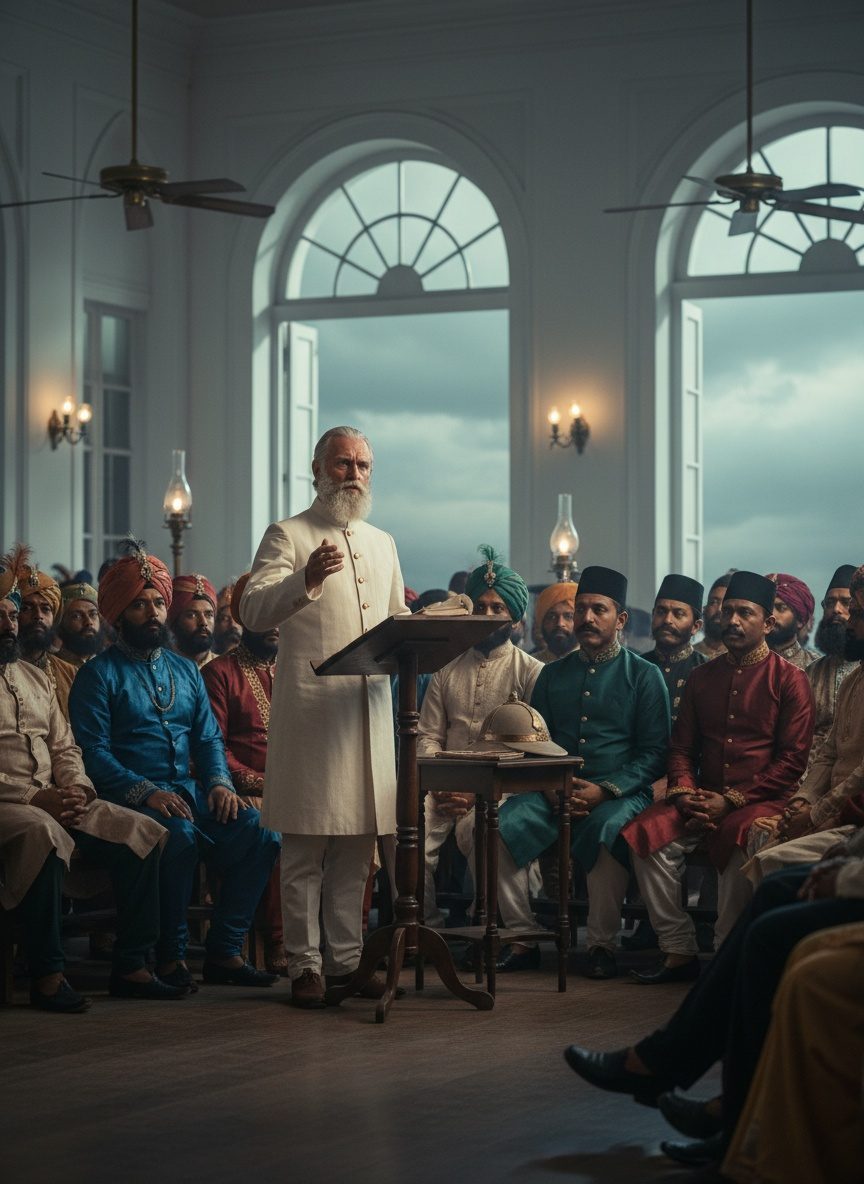
The late December air in Bombay carried a chill that night in 1885, an unusual briskness in this coastal city where the Indian Ocean normally lent warmth. The streets were a cacophony of life, the city's vibrant pulse echoing from every corner. Outside a modest building, flickering oil lamps threw restless shadows on the intricately carved facades, whispering tales of the past. Inside that hall, however, was lighting of a different kind—the illumination of potential, the bright sparks of change being ignited by an unlikely British visionary.
A Voice in the Raj Wilderness
The man at the heart of this transformation was Allan Octavian Hume, a retired British civil servant whose decades-long service to the Crown had been a chronicle of dedication and purpose. Known neither for flamboyant politics nor for rebellion, Hume had become deeply introspective during his tenure in India. As the Raj tightened its grip, he perceived the murmurs of discontent among the educated Indians and the conspicuous absence of any platform where these voices could be heard.
December 28, 1885, witnessed the assembly of over seventy men from all corners of India in Bombay. Imagine the scene: a gathering draped in the diversity of India, their garments marked by regional patterns, their conversations a mosaic of languages, yet united by the English tongue for this historic congregation. Here, in the heart of the colonial seat of power, they embarked on a journey to reshape their own destinies, to claim a space within the empire that had so often marginalized their existence.
What many don't realize is that Hume’s initiative was initially met with outright skepticism by both Indian intelligentsia and his British peers. To the former, he was just another colonial figure, an outsider. To the latter, he was dangerously idealistic, perhaps a naïve radical. Yet, Hume was steadfast, a characteristic shaped by years of arduous but fair governance in the North-Western Provinces of India.
His vision for the Indian National Congress was clear: not as a tool for revolution, but as a forum for dialogue. The notion was radical in its simplicity. Hume believed that the Empire, at its core, should be able to encompass the desires and grievances of its subjects. He was a man of his time, yet thinking beyond it, advocating for the establishment of a platform that was not merely ornamental but designed to actively engage the opinions of Indian societies with those who ruled them.
The Bombay Bonfire of Ideas
The atmosphere inside the Bombay hall was electric. Delegates debated with vigor that belied the otherwise staid reputation of the era. The proceedings began with discussions that ranged from taxation grievances to the need for legislative reform—topics close to everyday lives yet largely ignored by the Raj. Hume watched keenly, knowing that what they were creating was far beyond the strategic maneuvers of his former bureaucratic life.
This first session of the Indian National Congress was not just a meeting; it was a manifesto in action, an unyielding bonfire of ideas destined to outshine the flickering torches illuminating its beginnings. The men discussed heartfelt pleas for home rule, fair administration, and eventually independence—themes that would gain thunderous momentum in years to come.
Amidst the fervent debates, there were exclamations of admiration for Hume's audacity. Yet, he remained humbly behind the scenes, orchestrating the flow of discussions, embodying the ideal that true leadership sometimes meant stepping back to let others find their voice. Remarkably, he demonstrated respect not only for Indian tradition but also for the potential within. His act was less of a betrayal to the Crown than a betrayal of injustice that the Crown might perpetuate, a subtle insurrection grounded firmly in moral fortitude.
London's reaction was predictably volatile. The mere suggestion of Indian autonomy, even within the safe confines of debate, was viewed with mistrust and alarm. However, Hume’s acquaintance with the inefficacies of British administration in India gave him insight; he argued that an engaged India would be less inclined to revolt if it felt heard and respected.
A Legacy of Foundations
The inception of the Indian National Congress did not reverberate through the world's capitals, nor did it immediately usher in an egalitarian society. However, what started that December evening planted seeds of empowerment that would grow into a mighty banyan of liberation.
Hume's dedication was not temporary. He continued to support and guide the Congress, nurturing it to become an irrefutable force within Indian politics. What began as a calculated risk evolved into a movement that forged leaders like Mahatma Gandhi and Jawaharlal Nehru, who would lead India to independence decades later. Hume himself faded into the background, casting a light of hope through others, a perpetual reminder of the silent strength inherent in transparent intentions.
Allan Octavian Hume's actions remain a seldom-told chapter in the expansive story of India's path to freedom. By bravely initiating what seemed then an unlikely union of dialogue and diplomacy, he reframed the narrative of imperial dominance, challenging the very ideologies that propped up the British Raj. His legacy reminds us that sometimes, true bravery lies not in defiance for its own sake, but in the courage to see what is right and the integrity to act upon it.
As the sun sets over modern India, a country now rich with its diverse voices, the echoes of that fateful year in Bombay remain. It’s a gentle reminder that the first whispers of freedom often come not in the thunder of conflict, but in the quiet determination to reshape a future yet unwritten.