July 22, 1793. The sky met the water in a shimmering horizon of endless blue.
A Journey Unmapped
In the summer of 1793, a solitary man emerged from the North American wilderness onto the rocky coast of what is now British Columbia, Canada. This was Alexander Mackenzie, a name mostly etched into the granite of history’s less trodden paths. His eyes, weathered and tired, gazed not out of discovery's surprise but from the end of a quest that had swallowed years of his life. As he stood overlooking the vast expanse of the Pacific Ocean, the sheer magnitude of his journey must have pulsed through his veins. What began as an enigmatic pursuit had culminated here — the first confirmed overland crossing of North America by a European.
Mackenzie’s venture was not embroidered with the customary pomp of exploration. He had neither maps nor precedents. While later explorers, such as Lewis and Clark, would journey with governmental support and considerable resources, Mackenzie’s expedition relied on a handful of hardy voyageurs, an indomitable spirit, and the full embracement of uncertainty. He was a fur trader by trade, driven not by imperial ambitions but by the pressing demand for new fur trading routes, which spurred his corporate employer, the North West Company, to seek a route to the Pacific. The hope was to establish a trade route to bolster commerce away from the monopolistic grip the Hudson’s Bay Company held over trade routes to the east.
Mackenzie’s journey into the uncharted was more than a geographical conquest — it was also a collision of cultures. His expedition was profoundly dependent on the aid of Indigenous peoples, whose knowledge of the land and river systems were pivotal to his survival and success. Their oral traditions and guidance helped Mackenzie navigate through dense forests, formidable mountains, and expansive river systems. The entirety of North America lay stretched before him as an unrolled parchment, every section of terrain an encounter with the untamed and unknown.
Painted Words Amidst the Wilderness
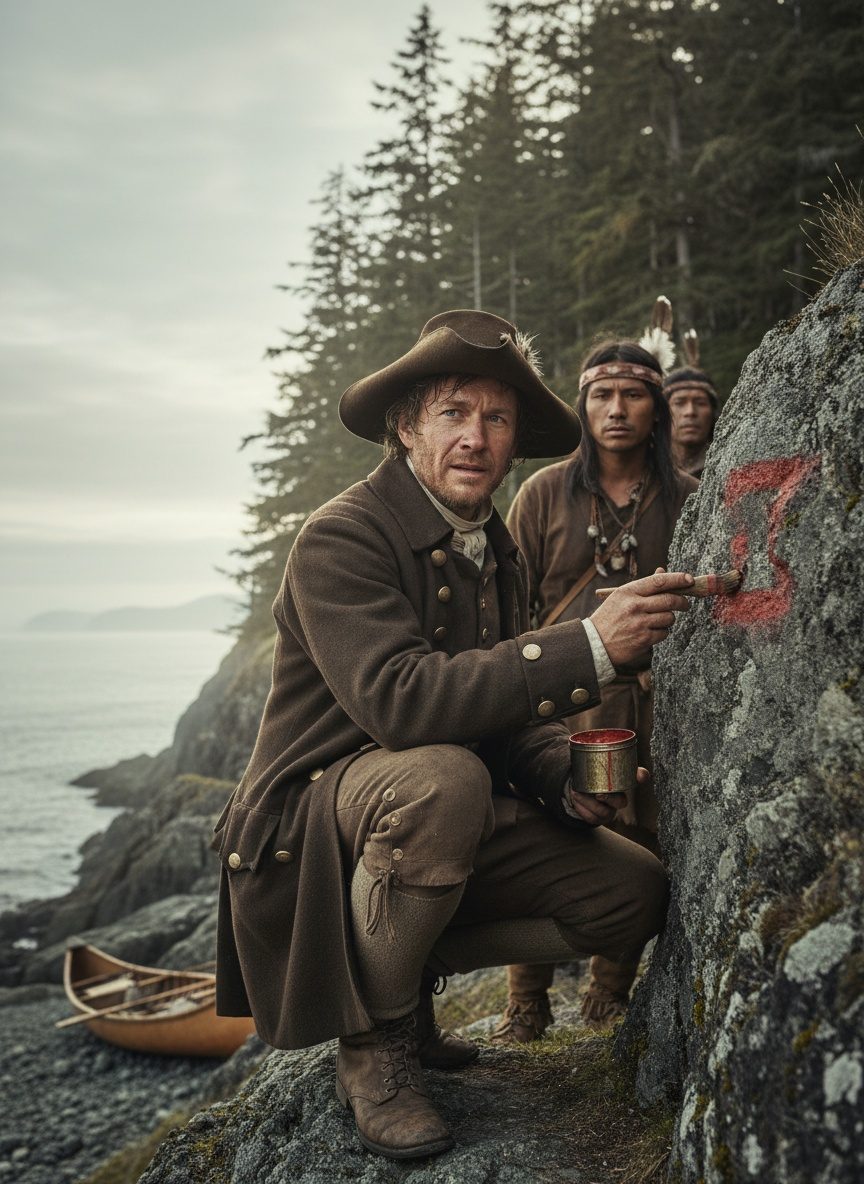
The moment Mackenzie reached the Pacific, he took to another kind of recording, not by quill and paper — but through paint. He mixed vermilion with grease and painted a sentence on a rocky outcrop: "Alexander Mackenzie, from Canada, by land, 22nd July 1793." These words, that symbolized his triumph, are his lasting monument — a testament to human resolve against the indifferent vastness of the wilderness.
Yet it was a journey marked by more than just natural obstacles. The expedition experienced profound isolation, a wrenching sense of detachment that stretched the limits of human endurance. Against the backdrop of towering cedar forests and the ethereal symphony of Pacific waves, Mackenzie likely stood tumultuously on the cusp of revelation and exhaustion. The path back to the eastern sea was not a retracement through an open trail, but a challenging odyssey back through rugged landscapes freshly carved into the annals of unexplored frontiers.
While the carved words offered a glimmer of Mackenzie’s triumph, they underscored a less fortunate narrative — one of itches unresolved. Unlike other imperial explorers of the time, Mackenzie returned to Britain not amidst triumphant fanfares but as a man who had quietly accomplished a monumental feat, received with only casual acknowledgment. His achievement, overshadowed in the influential corridors of London's aristocratic circles, remained largely unnoticed within the grander tapestry of British imperial expeditions.
The Echo of Footsteps
Mackenzie’s narratives, once shared, fueled the imperial ambitions of competitors like the Kingdom of Spain and visionaries who sought to challenge the British across the unexplored waters. His journey foreshadowed what would become a relentless era of exploration and expansion across the North American continent. It was a critical thread in weaving the fabric of a emerging nation, a deep-rooted precursor to the westward expansion that would placate the youthful hunger of the burgeoning American republic.
Yet, what endures beyond the completion of Mackenzie’s daring journey is a salutary reminder of an expedition beyond the landscape. It was a journey that unearthed the complex interplay of endurance, survival, and the stubborn pursuit of a vision against all odds. The Pacific Ocean may have marked Mackenzie’s endpoint, but the story begins again in every reading and retelling of his journey.
For Mackenzie, standing alone on those damp, salty shores, the Pacific was both a boundary and a beginning. It epitomized the vastness of unknown realms and possibilities, a perpetual inspiration for those who dared to look beyond the horizon. It serves as a narrative unfilled, a universally resonant sentry at civilization’s edge, where pioneers conquer with endurance and paint their silent, defiant words upon the world. Mackenzie wept perhaps not from relief or triumph, but from the weight of the deed and all it promised yet would remain just beyond reach — a legend left out of textbooks, yet forever carved into the stone of exploration itself.