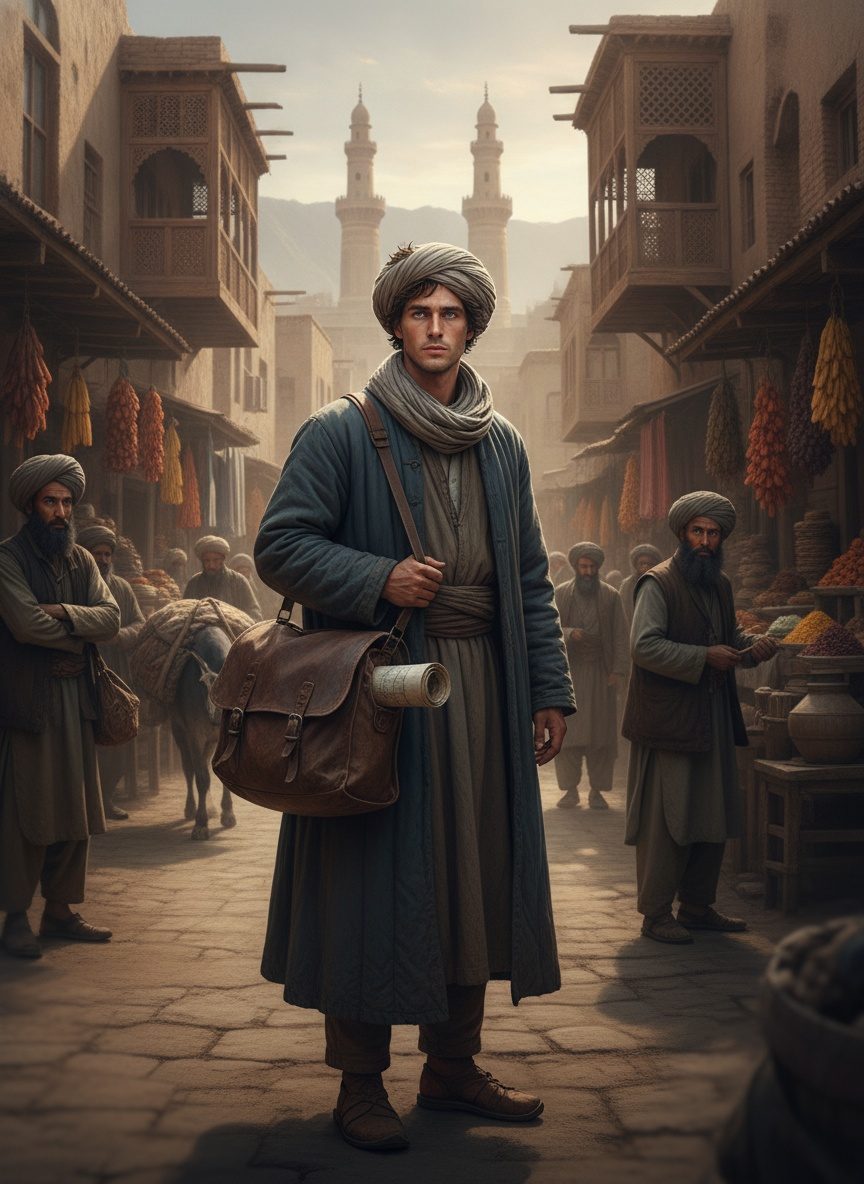
The sharp winds of the Hindu Kush grazed his cheeks as Alexander Burnes, clad in the loose garb of a Persian merchant, approached the bustling heart of Kabul. His eyes, as blue and vast as the skies above, scanned the horizon with dogged determination. Echoes of murmured Persian dialects and Hindustani chants weaved through the marketplace, wrapping around him like a cloak of anonymity. At twenty-six, Burnes had the poise of a man seasoned by challenge, yet the thrill of his mission sent ripples of adrenaline surging through his veins. Alone, without the comfort of an escort or British military armor, Burnes traversed a tapestry of mountains and intrigue, with nothing but his wits to rely on.
A Gambler's Play
In a world dominated by empires, where the mere scent of another's ambition could spark conflict, Burnes's daring journeyman approach was more than audacious—it was the gamble of a lifetime. Set against the backdrop of the Great Game, a shadowy dance between the Russian and British empires over control in Central Asia, Burnes forged a path bound for the unknown. Disguises were not mere costumes but keys to survival, allowing a young Scotsman from Montrose to slip under the radar of suspicion and walk the streets of Kabul as anything but an imperial emissary.
The market was a labyrinth of vibrant stalls overflowing with exotic spices, shimmering silks, and wares far beyond Burnes's homeland. Here, he was no longer a soldier but a humble tradesman. Astonishingly, before he could pursue his intelligence mission, he first had to earn the trust of the city's many eyes, a task he achieved by charming merchants with his ease in local languages and voracious curiosity. Each conversation added to his mental map, a living document of Kabul's intricate landscape.
Charms and Danger
As whispers of this peculiar merchant reached the ruler of Kabul, a defining moment emerged. Alexander Burnes stood before the Amir himself, a figure both majestic and shrewd. With words as calculated as chess moves, Burnes presented himself not as a threat but as a bearer of camaraderie—foreshadowing future diplomatic entreaties rather than military conquest. His fluency in Hindustani and Persian became the means by which he wove intricacies of kinship and trust.
Danger lurked like shadows along Kabul's narrow alleys, where any misstep could reveal Burnes's true identity and shift his fate irreversibly. Yet his capacity for balance, like a tightrope walker above roiling waters, shielded him. He moved effortlessly across cultural divides, absorbing the pulse of Kabul, cataloging its defenses, and most crucially, the nature of its leaders. His audacity was as much a shield as it was a weapon, and it was this boldness that kept him vital among many who would have otherwise seen him vanish into the dust of forgotten ambition.
The Map Unveiled
Burnes's intelligence gathering went beyond the immediacy of newfound allies. It was a cerebral exercise in cartography, an exercise unmatched by any European before him. As he stepped through Kabul's streets, he imprinted geographical and cultural landmarks onto his mind's canvas. Each observation was carefully notated until he emerged from the city's embrace with an envisioned map valuable beyond measure.
Back in the sanctum of empire, Burnes's revelations were met with intrigue and, ironically, deaf ears. The intel—fathomed with painstaking care and strategic foresight—was filed away, valuable yet untouched, much like a painting seen but never acknowledged for the treasure it represented. The ignorance of his findings would soon echo across history.
The Road Ignored
Despite his groundbreaking intelligence work, Burnes's endeavors were eclipsed by Britain's ignorance, a lapse in judgment with dire consequences. The window of opportunism grew smaller as the climate of Central Asia shifted, and ironclad solutions outweighed the wise words of an intrepid envoy. A decade later, in one of history's cruel ironies, Britain set its sights on Afghanistan in a move that led to the notorious Anglo-Afghan Wars. The Empire would pay dearly for overlooking the riches of Burnes's insights—tattered maps foretold were not the defeat, but the oversight in employing the gift of foresight offered.
Lessons Writ Large
Alexander Burnes's walk into Kabul was no mere footnote into imperial chronicles; it was a testament to the triumphs and perils that accompany the ambitious pursuits of human endeavor. In traversing dangerous lands under guise, Burnes not only mapped a city but also scrawled a lesson across the broader tableau of geopolitical strategy: understanding the lay of a land unparalleled by maps must be coupled with the wisdom to act on such profound knowledge. His story of bravery, intellect, and cultural fluency underlines an enduring lesson of empire-building and the silent power of seeing what others choose to ignore. In Burnes's footsteps lies a challenge—to not only walk boldly but to hear and to heed the whispers of history's unsung paths.