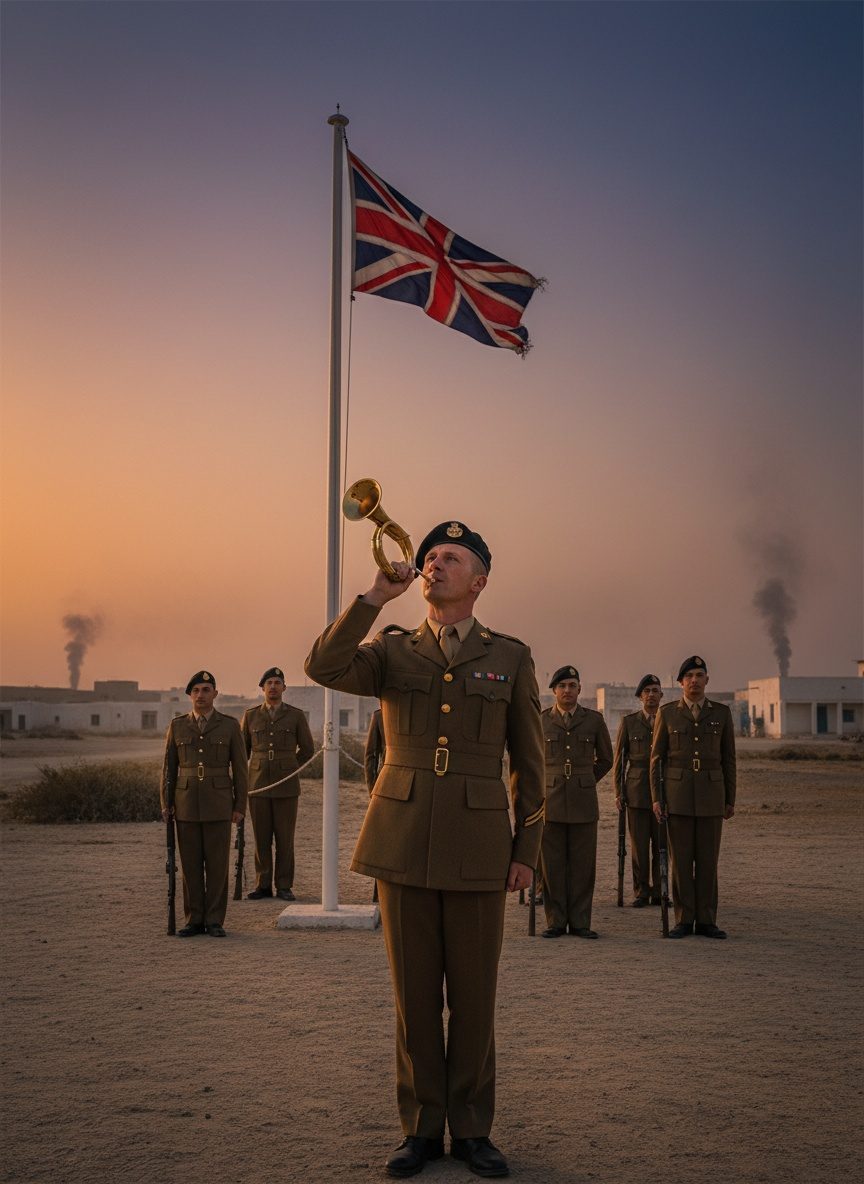
He was twenty-three years old. He had never played the bugle in combat before that night. Yet, as Private Thomas Dexter lifted his bugle to his lips in the inky darkness of November 1967, he was about to signal the end of an era that had lasted 128 tumultuous years.
Aden, a port city perched on the southern tip of the Arabian Peninsula, had long been a jewel in Britain's colonial crown. Now, it lay smoldering and unforgiving, a victim of nationalist fervor and waning imperial power. British withdrawal from the Protectorate of Aden was the only imperial handover conducted under ongoing combat operations. The decision was as brash as it was desperate. The streets of Crater and Sheikh Othman had become perilous, haunted by rebels determined to carve their future from the crumbling edifice of empire.
The final days in Aden were riven with chaotic scenes. British forces, reduced in strength and constantly targeted, maneuvered their way through a city that had been their home but would soon belong to others. It was amid this peril that Dexter, a member of the elite Argyll and Sutherland Highlanders, stood ready to perform an act both solemn and symbolic. His role was not simply to play a military tune; he was there to echo across the ages the end of Britain's presence in southern Arabia.
Dexter's unit had the unenviable task of covering the final hours of evacuation, a duty that required courage as much as tactical precision. When his commanding officer turned to him with a nod, the young bugler knew his moment had come. The haunting notes of the "Last Post," a melody seared into the memory of every British soldier, unfurled into the night. It was a sound meant for the living and the dead, a tribute and a farewell wrapped in one.
Beyond the battlements, the hills of Jebel Shamsan held their breath. Just moments earlier, those hills had resounded with the sharp cracks of sniper fire—an ever-present reminder of why the British withdrawal had been so fraught. As each note cascaded into the cold November air, there was a palpable shift in the atmosphere—a rare moment of truce, however ephemeral, between the departing forces and the land they had occupied for generations.
The towering volcano that cradles Aden has witnessed much—waves of empires, conquests, and the consequential march of time. But this was different. Beneath the canopy of stars in the Aden sky, history's relentless churn paused to absorb the magnitude of Britain's final bow. As the last notes of the bugle faded, silence unfurled its blanket over the city, a vast, engulfing quiet that spoke louder than any fury of war.
For Private Dexter and his comrades, there was no jubilation, only a somber recognition of a chapter closing. Their boots fell heavily on the ramp of the waiting ships, and as Aden's dusty shores receded into memory, British might seemed ever more like a mirage, an empire that had radiated authority but now diminished with nowhere left to retreat. The flag was folded with reverence—a piece of cloth that, only moments before, had flown as high as ambition, now reduced to a keepsake, a relic of past imperiousness.
The ghosts of empire lingered—devoid of form yet weighted with consequences, they merged into the tepid Arabian Sea as the British flotilla departed. It was an ending witnessed by few yet felt by many, marking a watershed in colonial history. This wasn't merely a localized political transition but a global acknowledgement of changing tides, a stark realization that imperialism, as an ideology and practice, was meeting its dusk.
Minutes after Dexter's poignant performance, the streets of Aden resumed their anxious tales. The echo of his bugle remained, a spectral anthem mingling with the future's uncertainties and the past's echoes. The land, once a strategic British outpost, was caressed anew by its native son—Yemen. But the legacy of the departing empire lingered, invisible yet profound, an estranged ally now in the shadows of history.
Remembering Aden's last bugler offers more than a glimpse into the practicalities of an imperial retreat. It unfolds a human vignette entwined with the grand narratives of power and politics. As Britain withdrew, leaving behind an empty driveway where authority had once resided, it wasn't merely soldiers or guns that were abandoned. It was the weight of an epoch's end, poignant in its quietude, haunting in its implications. And with that, a cornerstone of empire had vanished into the annals of legend, its bittersweet goodbye eternally crystallized in the memory of a single bugle call.