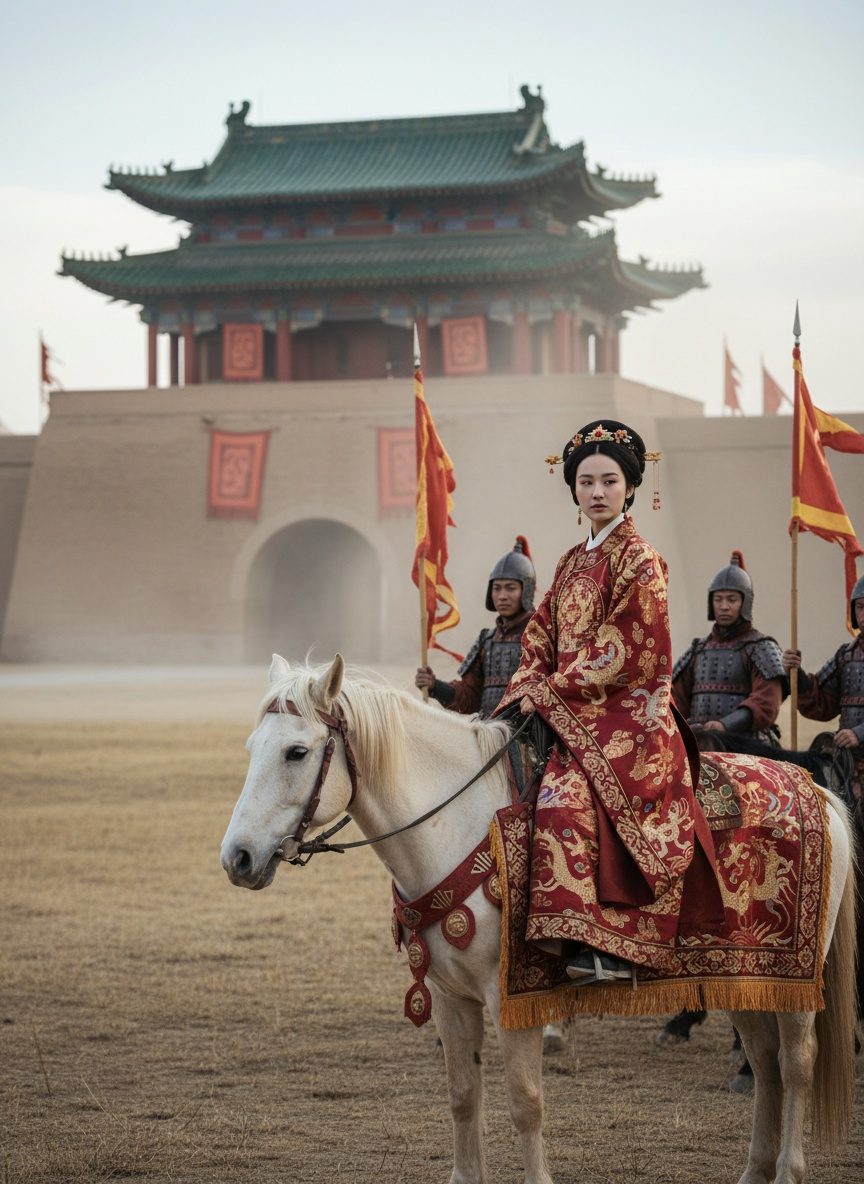
The evening sky stretched endlessly over the northern steppe, its vastness reflected in the cool blue shadows creeping across the sandy plains. The wind sighed as it skimmed over low grasses, carrying with it the wistful sounds of a distant horse's hooves. In 33 BC, far from the bustling heart of the Han Empire, a woman faced this boundless horizon. Her journey was more than physical; it was a bridge across cultures, a venture into the unknown that held the balance of peace in its delicate hands.
Farewells at the Forbidden Palace
Deep within the palatial confines of the Han Emperor's court, the air was thick with uncertainty. The Xiongnu, formidable nomadic tribes who roamed north of China, had been a constant thorn in the empire’s side, their conflicts relentless and costly. The Emperor sought peace through a marriage alliance, a strategic union that would quell the threat and foster tranquillity. It was here, amidst the intricate tiles and ornate archways, that Wang Zhaojun, one among the numerous handmaidens, chose a path few would dare.
Wang Zhaojun was not just a figure in the background; she was known for her beauty and intellect, qualities that had not gone unnoticed. Yet, the annals of history suggest that an artist's unflattering portrait kept her from the Emperor’s favor, a mistake that inadvertently set her on a path destined for greatness. With the courage that legends are made of, she volunteered to leave behind the safety of royal life for a harsh and foreign land. Her decision was not merely an act of sacrifice but a testament to the power of individual agency against imperial ambitions.
A Journey into the Heart of the Steppe
As Wang Zhaojun rode away from the life she knew, the warm hues of the Chinese plains gave way to the stark beauty of the northern wilderness. The journey was arduous, a tireless trek through inhospitable terrain under skies that knew neither boundaries nor mercy. Each dawn brought new challenges—howling winds, sudden storms—but also unraveled vistas that stretched endlessly, whispering tales of untamed freedom.
Her destination was the camp of the Xiongnu chieftain, a place where customs clashed and languages melded in a rough symphony of diplomacy. The tribes lived on horseback, their livelihoods inseparable from the creatures that carried them across the expansive steppe. For Wang Zhaojun, this was an introduction to a life of strenuous simplicity, where survival and elegance danced uneasily together.
Empire's Unseen Hero
The alliance Wang Zhaojun forged was not an immediate miracle cure for decades of animosity, but it planted seeds of peace that transcended memories of war. Her presence among the Xiongnu represents a profound blend of cultures, a mingling of two worlds that once viewed each other through the lens of enmity. The marriage brought a much-needed cessation in hostilities, a breathing space for the Han Empire to strengthen its borders and redirect its resources.
Yet, this newfound peace was not merely the result of political maneuvering. Wang Zhaojun became an icon of harmony—a human embodiment of the possibilities born when understanding trumps conflict. China's sorrowful gratitude towards her decision to embrace such a life speaks volumes of her contribution, an emotional bond tethering the might of an empire to one woman's courage.
Memory Etched in Legend
Over time, Wang Zhaojun's story became enshrined in Chinese culture, her life transcending historical accounts to nestle into the comfort of legend. Stories are still told of the beauty who changed the course of history, broadening the canvas on which Chinese culture is painted. Songs and poems over generations have highlighted her sacrifice, turning her narrative into a poignant reminder of the personal costs of political decisions.
Yet, amidst these artistic tributes lies a question that has intrigued historians and dreamers alike: what was life truly like for Wang Zhaojun on the steppe? Did she weave her melodies into the howling winds, or find solace beneath ancient stars? These questions, left unanswered, add an enigmatic cloak to her tale, one that stirs the imagination and echoes through time.
The Threads of Peace and Legacy
Wang Zhaojun's narrative is more than a historical footnote; it is a tapestry of human resilience and the indomitable spirit that shapes destiny. Her journey is a mirror held up to our own world, showing the timeless dance between power and peace, choice and consequence. In a civilization that has weathered millennia of change, her tale remains a beacon of individual strength amid collective struggle, a legend that continues to inspire as China’s dynamic story unfolds.
As we reflect on the courage of a lone woman who chose to embrace the unfamiliar for the sake of peace, we are reminded of the unending ripple effects that stem from acts of bravery. Wang Zhaojun's legacy invites us to consider the costs of division and the boundless potential when we forge new paths, guided by hope and the unwavering belief in a future where harmony is within reach.