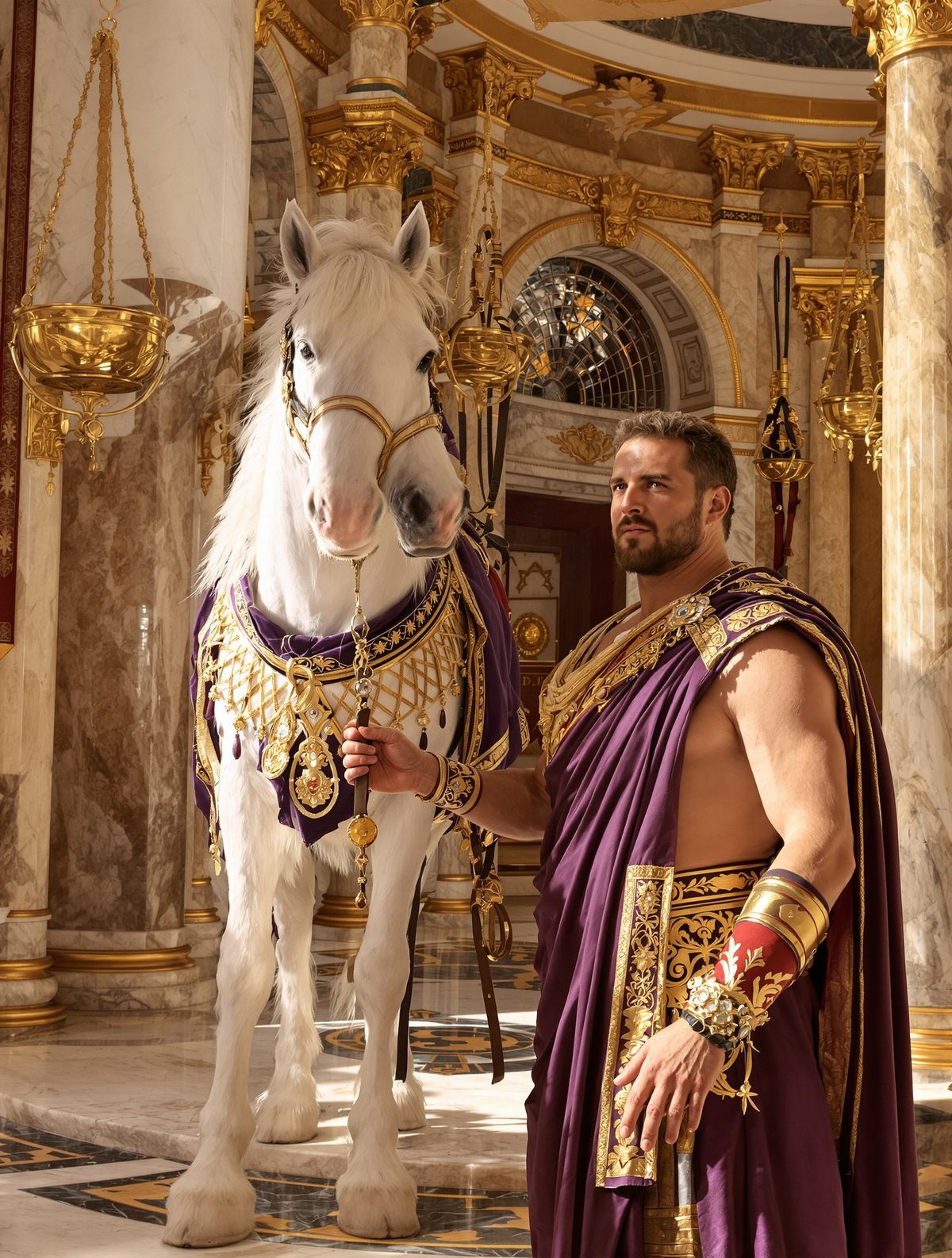
Picture this: Julius Caesar, the most brilliant military mind in Roman history, trapped behind his own walls with winter approaching and his army starving. Outside those walls, 250,000 Gallic warriors bay for Roman blood. This wasn't how the conquest of Gaul was supposed to end. Yet here Caesar sat in 52 BC, facing the greatest military crisis of his career—all because of one young Gallic chieftain who had accomplished the impossible.
His name was Vercingetorix, and he had done what no leader before him could manage: unite every warring tribe in Gaul against Rome. What followed was a rebellion so fierce and a siege so desperate that it nearly ended Caesar's career before it truly began. The story of how a 30-year-old barbarian king brought the future dictator of Rome to his knees is one they definitely didn't teach you in school.
The Young Wolf Who Defied Rome
Vercingetorix wasn't born to be a unifier. The son of Celtillus, chieftain of the powerful Arverni tribe, he grew up in a Gaul already bleeding from Caesar's "pacification" campaigns. By 58 BC, Caesar had been carving through Gallic territories with methodical brutality, playing tribes against each other with the calculating precision of a chess master. The Romans had perfected the art of divide and conquer, and Gaul's fractured tribal politics made them easy prey.
But Vercingetorix had watched and learned. While other chieftains bickered over cattle raids and territorial disputes, this young warrior studied Roman tactics. He understood something his elders couldn't grasp: as long as the tribes fought separately, they would fall separately. The Romans called him Vercingetorix—"Great King of Warriors"—and by 52 BC, he would prove that title wasn't just ceremonial.
The spark came when Caesar left Gaul for winter quarters in northern Italy, leaving his legions scattered across the conquered territories. It was exactly the opening Vercingetorix had been waiting for. In a series of lightning-fast diplomatic missions, he achieved what historians still consider miraculous: he convinced the fiercely independent Gallic tribes to set aside generations of blood feuds and unite under his banner.
The Sequani, the Parisii, the Bituriges, the Carnutes—one by one, they answered his call. Even tribes that had previously allied with Rome abandoned their Roman patrons. Vercingetorix had created the largest military coalition in Gallic history, and Caesar was about to walk straight into it.
The Art of Gallic Warfare
When Caesar rushed back to Gaul in early 52 BC, he expected to face the same disorganized tribal warfare he'd been exploiting for six years. Instead, he found himself fighting a completely different enemy. Vercingetorix had revolutionized Gallic military strategy, abandoning the wild charges and individual heroics that Romans expected from "barbarians."
The new Gallic strategy was devastatingly effective: scorched earth warfare combined with hit-and-run tactics. Instead of meeting Roman legions in pitched battles where their superior discipline and equipment gave them every advantage, Vercingetorix ordered his people to burn their own towns and crops. If the Romans wanted Gaul, they would find only ash and empty granaries.
Meanwhile, Gallic cavalry—widely acknowledged as the finest in the world—harassed Roman supply lines relentlessly. These weren't undisciplined raids; they were coordinated strikes that left Caesar's legions hungry, isolated, and increasingly demoralized. For the first time in his Gallic campaigns, Caesar found himself reacting instead of dictating the terms of engagement.
The psychological impact was enormous. Roman soldiers, accustomed to terrorizing their enemies into submission, now jumped at shadows in the forests. Every path could hide an ambush. Every burning town was a reminder that they were deep in hostile territory with supply lines stretched to the breaking point.
Victory at Gergovia: David Bloodying Goliath
Caesar's first major test came at Gergovia, Vercingetorix's heavily fortified stronghold built on a plateau in the heart of Arverni territory. Here, the young Gallic leader would prove that his revolution in tactics could translate into actual victory against Rome's most celebrated general.
The siege began in spring 52 BC with Caesar confident in his abilities to crack another barbarian fortress. He had, after all, been breaking Gallic strongholds for years. But Gergovia was different. Perched on steep cliffs and defended by warriors who fought with the desperate courage of men protecting their homeland, it proved nearly impregnable.
For weeks, Caesar's legions threw themselves against the fortifications. Each assault was met with withering fire from Gallic slingers and fierce hand-to-hand combat that left Roman bodies piled at the base of the walls. Meanwhile, Vercingetorix's cavalry continued to strangle Roman supply lines, turning the siege into a race against starvation.
The climax came when Caesar, growing desperate, ordered a massive frontal assault that he hoped would break Gallic morale once and for all. It was a catastrophic miscalculation. The Romans suffered over 700 casualties, including 46 centurions—the backbone of any legion. For comparison, Caesar had lost fewer officers in some of his entire previous campaigns.
As spring turned to summer, Caesar did something he had never done before in Gaul: he retreated. The sight of Roman eagles withdrawing from a barbarian stronghold sent shockwaves throughout the region. Suddenly, Vercingetorix wasn't just another tribal chieftain—he was the man who had made Julius Caesar blink.
The Trap at Alesia: When Hunters Become Hunted
Flushed with victory, Vercingetorix made the one decision that would ultimately doom his rebellion. Instead of continuing his successful guerrilla campaign, he chose to gather his entire army—an estimated 80,000 warriors—in the fortress city of Alesia. His logic seemed sound: force Caesar into another siege, bleed the Romans white against impregnable walls, and finish what Gergovia had started.
But Caesar had learned from his defeat. When he arrived at Alesia in late summer 52 BC, he brought something new to the siege: a plan so audacious that even his own officers questioned his sanity. Instead of simply surrounding the city and starving it out, Caesar would build not one, but two complete sets of fortifications.
The inner wall, called the circumvallation, surrounded Alesia itself—standard siege procedure. But then Caesar's legions began building a second wall facing outward, the contravallation. Roman scouts had reported that a massive Gallic relief army was approaching—some sources claim 250,000 warriors, though this is likely exaggerated. When they arrived, they would find Caesar's forces protected behind their own fortifications.
The engineering feat was staggering. In just three weeks, eight Roman legions constructed over 20 miles of walls, complete with ditches, spikes, and even concealed traps that the Romans grimly nicknamed "wolf holes." Caesar had essentially built a fortress around a fortress, with his own army sitting in the middle.
The psychological warfare was just as important as the physical barriers. Vercingetorix could watch from Alesia's walls as his own successful tactics were turned against him. The Romans were now the ones using fortifications and patience instead of brute force. The hunters had become the hunted.
The Final Gamble: Three Armies, One Battlefield
When the Gallic relief army finally arrived in October 52 BC, the stage was set for one of the most extraordinary battles in ancient history. Three separate armies faced off in the shadow of Alesia: Vercingetorix's garrison trapped in the city, the massive relief force outside Caesar's walls, and Caesar's legions caught between them.
For three days, the battle raged across multiple fronts simultaneously. Gallic warriors threw themselves against Roman fortifications while Caesar's engineers frantically reinforced weak points in their lines. The Romans were outnumbered by at least four to one, fighting on all sides with their backs literally against the wall.
The climax came when Gallic forces finally discovered a weak point in the Roman defenses and launched a coordinated assault from three directions at once. Caesar himself grabbed a shield and led a desperate cavalry charge to break the attack—the kind of personal heroics usually reserved for epic poetry, not sober military history.
But the Romans held. More importantly, they counterattacked. Caesar's cavalry smashed into the rear of the Gallic relief army just as his legions surged out from behind their walls. The psychological impact was devastating: seeing Caesar's eagles charging toward them when they thought victory was assured broke the Gauls' will to fight. The relief army scattered, abandoning Vercingetorix and his warriors to their fate.
The Price of Unity: A Lesson for the Ages
On a crisp October morning in 52 BC, the gates of Alesia opened. Vercingetorix emerged alone, dressed in his finest armor, and threw down his weapons at Caesar's feet. The man who had united all of Gaul surrendered himself to save his people from a final massacre. Caesar would keep him alive for six years as a trophy, parading him through Rome in chains during his triumph before finally having him strangled in the traditional Roman manner.
The rebellion died with its leader. Within months, Gaul's tribal alliances collapsed back into their traditional feuds and rivalries. Caesar's victory at Alesia didn't just end a rebellion—it demonstrated the brutal effectiveness of Roman divide-and-conquer tactics. The tribes that had briefly stood together as equals returned to being subjects who survived by betraying their neighbors.
Yet Vercingetorix's legacy endures in ways that might surprise us. His rebellion proved that even Rome's greatest generals were not invincible, that unity could challenge empire, and that sometimes the greatest victories come not from winning, but from forcing your enemy to fight on your terms. In an age when political division seems more natural than cooperation, the young Gaul who convinced ancient enemies to stand together offers a lesson worth remembering: the impossible becomes inevitable when people choose to fight for something larger than themselves.
Caesar conquered Gaul, but Vercingetorix conquered something far more enduring—the imagination of everyone who has ever faced impossible odds and refused to surrender.