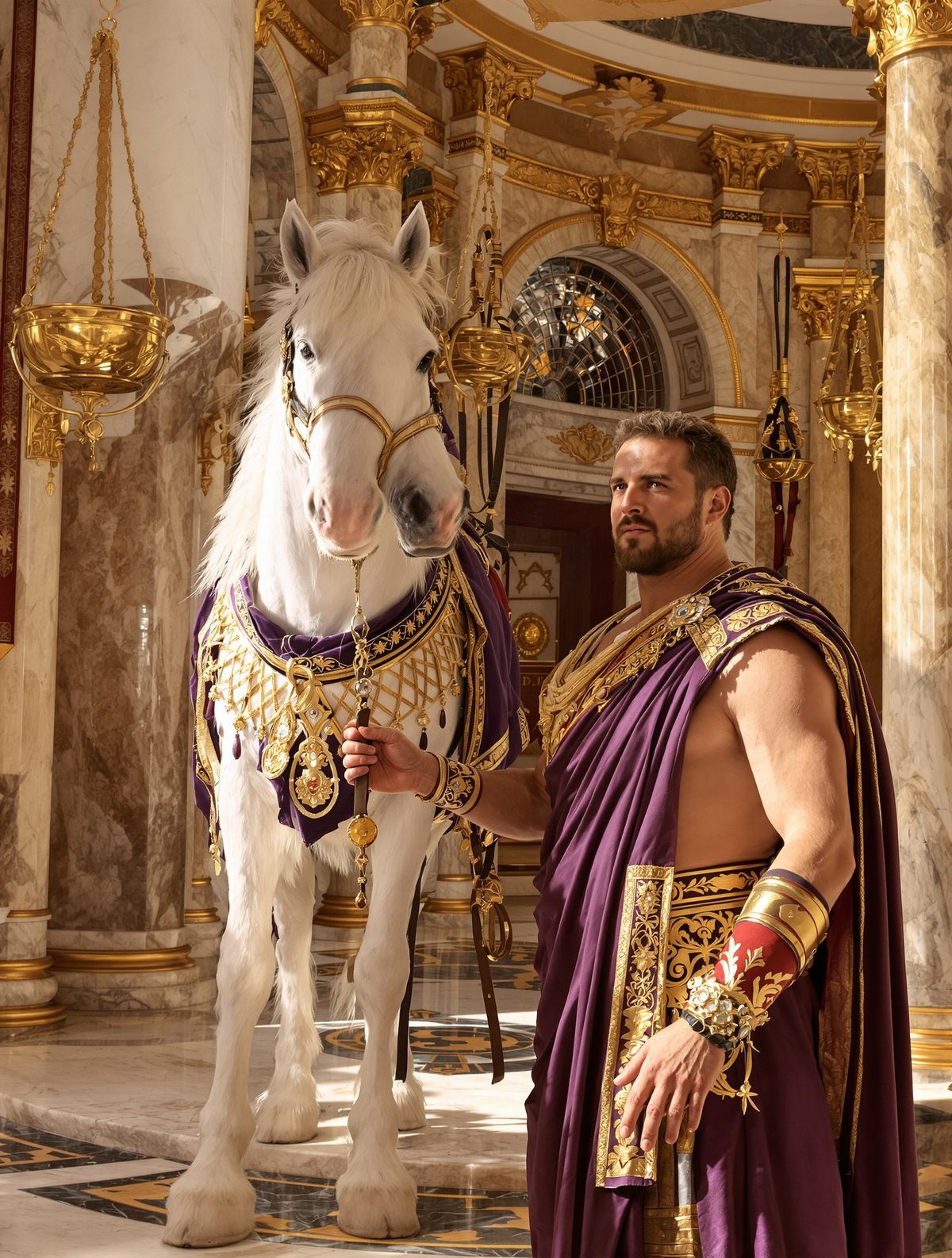
The golden sunlight of ancient Egypt fell across the royal palace as Queen Hatshepsut approached the most audacious moment of her life. In her hands, she held the sacred crook and flail—symbols of divine pharaonic power that no woman had dared claim in over a thousand years. But it was the object fastened to her chin that would have sent shockwaves through the kingdom: a ceremonial false beard, woven from gold and precious stones, marking her transformation from queen regent to king of Egypt.
With this single act of political theater, Hatshepsut didn't just break the glass ceiling—she shattered it with a golden sledgehammer and ruled the ancient world's greatest superpower for 22 years. Her story reads like something from a modern political thriller, except it unfolded along the banks of the Nile over 3,500 years ago.
The Widow Who Refused to Step Aside
When Thutmose II died around 1479 BC, the succession should have been straightforward. His heir, Thutmose III, was the rightful pharaoh. There was just one problem: the boy was likely no older than ten, possibly even younger. Someone needed to serve as regent until he came of age, and that someone was his stepmother, Hatshepsut.
But Hatshepsut had other plans. Born into the royal bloodline as the daughter of Thutmose I, she possessed something that gave her unprecedented legitimacy—she was actually more royal than her deceased husband. While Thutmose II had been the son of a minor wife, Hatshepsut was the daughter of the Great Royal Wife, making her bloodline arguably purer.
What happened next was a masterclass in ancient political maneuvering. Instead of quietly managing affairs until young Thutmose III reached adulthood, Hatshepsut began appearing in royal reliefs wearing the traditional pharaoh's kilt. Then came the false beard—not because she was trying to convince anyone she was actually male, but because the beard was an essential symbol of divine kingship that even some goddesses wore in Egyptian art.
By approximately 1473 BC, just six years into her regency, Hatshepsut had declared herself pharaoh. The woman who was supposed to keep the throne warm had claimed it entirely.
The Propaganda Machine of Ancient Egypt
Hatshepsut understood that ruling as a female pharaoh required more than just political cunning—it demanded a complete reimagining of her public image. She embarked on what might be history's first systematic propaganda campaign, commissioning hundreds of statues and reliefs that depicted her with the traditional pharaonic false beard and masculine royal regalia.
But here's where it gets fascinating: she didn't completely erase her feminine identity. Many of her statues show a distinctly female body shape beneath the male pharaonic costume, and inscriptions sometimes refer to her with feminine pronouns even while calling her "king." She wasn't trying to fool anyone into thinking she was male—she was creating an entirely new category of ruler.
Perhaps most remarkably, she claimed divine mandate through an elaborate birth myth carved into the walls of her mortuary temple. According to these inscriptions, the god Amun himself had chosen her before birth to rule Egypt. The reliefs show Amun declaring: "This daughter, who I have placed in thy body, Hatshepsut... she shall exercise the excellent kingship in this whole land."
It was ancient Egypt's version of divine right, but with a revolutionary twist: the chosen ruler happened to be female.
The Builder Queen's Golden Age
While many pharaohs are remembered for their military conquests, Hatshepsut's reign was marked by unprecedented prosperity and architectural achievement. She understood that sometimes the most powerful display of strength isn't invasion—it's showing the world that your kingdom is so stable and wealthy that you can afford to build monuments for the ages.
Her crowning architectural achievement was her mortuary temple at Deir el-Bahri, a stunning complex carved directly into limestone cliffs that still takes visitors' breath away today. But perhaps her most audacious project involved two massive granite obelisks, each weighing approximately 320 tons, which she erected at Karnak Temple. The inscriptions boast that these monuments were completed in just seven months—a feat that would be impressive even with modern equipment.
Hatshepsut also launched one of history's most successful trade expeditions to the mysterious land of Punt (likely modern-day Somalia or Ethiopia). The expedition returned with frankincense, myrrh, gold, ivory, and even live trees that were transplanted to Egyptian soil. The economic boost from this venture helped fund her ambitious building projects and demonstrated Egypt's reach across the known world.
Under her rule, Egypt experienced what historians call a "Pax Aegyptiaca"—an Egyptian peace that allowed arts, culture, and commerce to flourish like never before.
The Mystery of the Missing Pharaoh
After 22 years of rule, Hatshepsut simply vanishes from the historical record around 1458 BC. No ancient text describes her death, no tomb inscription mourns her passing, and for centuries afterward, it seemed as though Egypt's most successful female pharaoh had been systematically erased from history.
The mystery deepened when archaeologists discovered that many of Hatshepsut's monuments had been deliberately defaced, her cartouches chiseled away and replaced with those of Thutmose I, II, or III. For decades, scholars assumed this was the work of a vindictive Thutmose III, finally getting revenge on his stepmother who had "stolen" his throne.
But recent research suggests a more complex story. The defacement didn't begin immediately after Hatshepsut's death—Thutmose III waited nearly twenty years before ordering the systematic removal of her images and names. This wasn't petty revenge; it was likely a calculated political move designed to smooth the succession for his own son by eliminating the precedent of a female pharaoh.
In 2007, archaeologist Zahi Hawass identified what he believes to be Hatshepsut's mummy—a middle-aged woman found in an undecorated tomb in the Valley of the Kings. DNA analysis and a tooth found in a canopic jar bearing her name provided compelling evidence, though some scholars remain skeptical.
The Woman Who Rewrote the Rules
Hatshepsut's erasure from Egyptian records was so thorough that when the ancient Greek historian Herodotus wrote about Egypt's pharaohs around 450 BC, he made no mention of her. It wasn't until the 19th century that archaeologists began piecing together her story from surviving fragments, gradually reconstructing the reign of one of history's most successful rulers.
What makes Hatshepsut's story even more remarkable is that she governed during Egypt's New Kingdom period, when the country was at its absolute peak of power and influence. She didn't inherit a struggling nation and prove that a woman could manage it—she took control of the ancient world's greatest superpower and made it even greater.
Her innovations extended beyond politics and architecture. She appears to have been one of the first rulers to understand the power of economic diplomacy over military conquest, preferring trade expeditions to expensive wars. Her reign saw no major military campaigns, yet Egypt's influence and wealth grew substantially.
Perhaps most importantly, Hatshepsut proved that effective leadership had nothing to do with gender. While she adopted masculine symbols of power, she never pretended to be anything other than what she was: a brilliant, ambitious woman who refused to let convention limit her potential.
Today, as societies around the world continue grappling with questions of gender, power, and leadership, Hatshepsut's story feels remarkably contemporary. She faced the same challenges that female leaders encounter now—the need to project authority in systems designed for men, the pressure to prove themselves more capable than their male counterparts, and the risk of being written out of history by those who prefer more traditional narratives.
The false beard may have been ceremonial, but Hatshepsut's legacy is undeniably real. In a world that told her to step aside, she stepped forward instead, wearing the symbols of power with such skill that it took archaeologists millennia to rediscover her story. She reminds us that sometimes the most revolutionary act is simply refusing to accept the limitations others place on our potential.