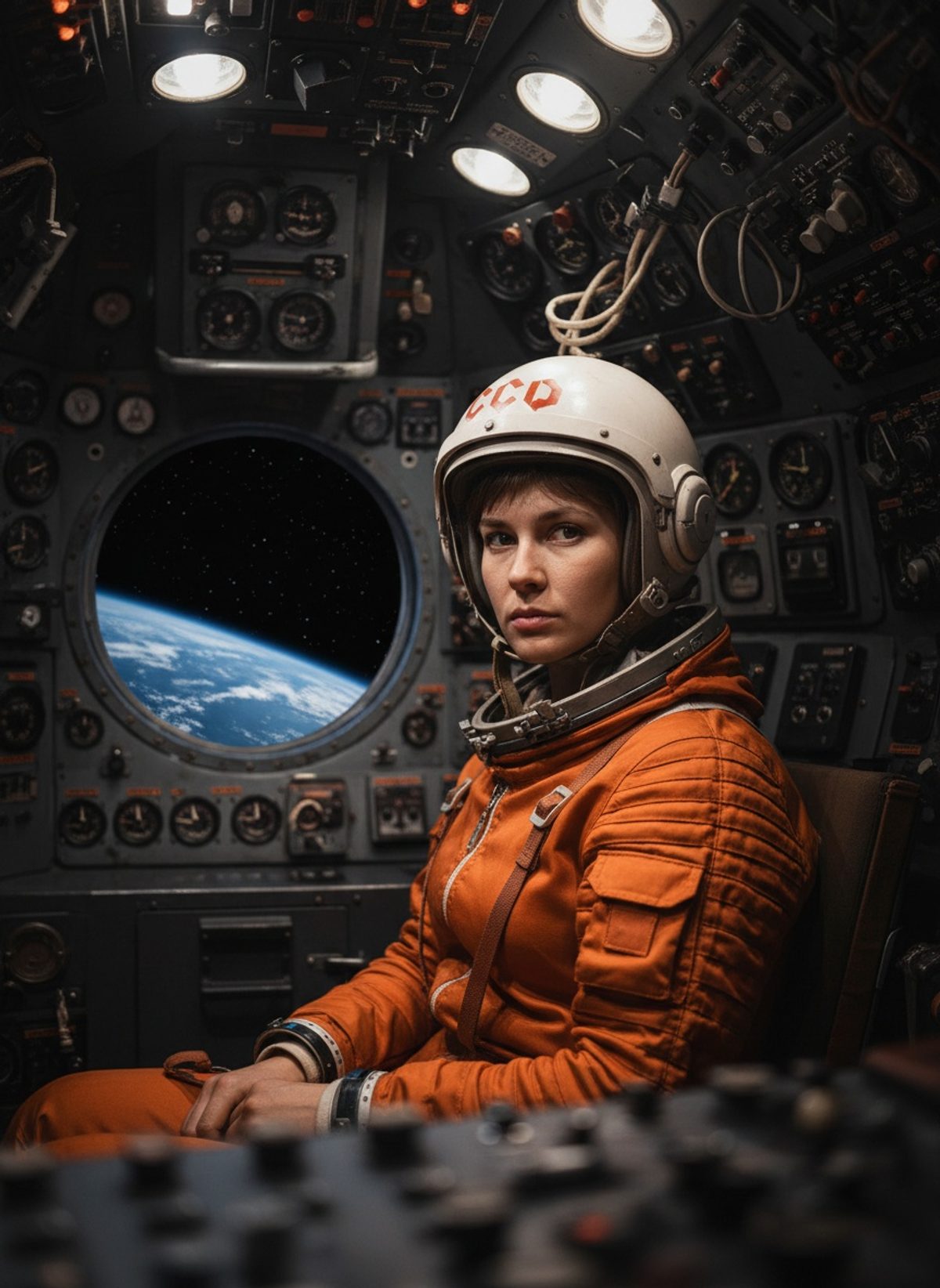
She was a 26-year-old textile worker from Yaroslavl. Valentina Tereshkova had never parachuted in her life.
An Ordinary Hero
In the dawn of the 1960s, the world was in the thrall of the Space Race, a fervent competition between superpowers that promised glimpses of the final frontier. Amidst this cosmic scramble, nobody could have expected that a young woman, whose life had been defined by the rhythms of a heavy loom in a cotton factory, would become the face of the Soviet Union's triumph. Yet, Valentina Tereshkova was not just a testament to human ingenuity, but a reminder of the unexpected paths history sometimes takes.
Chosen for her ordinariness, Tereshkova's rise did not follow the usual trajectory of a spacefarer. The Soviet leadership, driven by a desire to demonstrate their commitment to gender equality, embarked on selecting a female cosmonaut. Unlike her male counterparts, who often came from military backgrounds with extensive aviation experience, Tereshkova had only a taste of amateur skydiving as her connection to the skies. It was this leap into the unknown that would eventually propel her far beyond Earth's atmosphere.
Untrained Yet Undaunted
Parachuting, under normal circumstances, would be an essential skill for cosmonauts, particularly since the Vostok capsule re-entered the earth's atmosphere with such velocity that the cosmonaut would eject out to parachute to safety. Despite this critical gap in training, Tereshkova was undeterred. After her selection, she endured intense training that included isolation tests, centrifuge training to simulate the intense forces of space travel, and rocket theory, all the while keeping her resolute focus on the mission at hand.
What makes Tereshkova's journey even more extraordinary is not just the physical endurance it demanded, but the psychological fortitude as well. Imagine the sheer isolation, floating alone in a tiny capsule with the vastness of space stretching infinitely in every direction. In June 1963, Tereshkova embarked on such a journey, becoming the first woman to orbit the planet in Vostok 6. Over three days, she circled Earth 48 times, experiencing day and night nearly every 90 minutes, a testament to both her own and humankind's resilience.
A Singular Achievement
The flight of Vostok 6 was not just a scientific success but a landmark in gender equality. Before Tereshkova, no woman had ventured so far, with none daring to follow in her cosmic footsteps for nearly two decades afterward. Her mission gathered data on the female body's reaction to space travel, an undertaking charged with significance in a time when space exploration was overwhelmingly male-dominated.
Back on Earth, Tereshkova's accomplishment was met with a triumphant reception. She became a Soviet hero, an enduring symbol of the possibilities that awaited women's participation in all fields. Yet, despite this extraordinary feat, the world seemed ready to move on. While her mission highlighted the Soviet Union's ideological stance on gender equality, it was another 19 years before Svetlana Savitskaya would follow her path into space, illustrating the complexities and challenges women continued to face even after shattering one of the highest of ceilings.
A Journey Beyond the Stars
Valentina Tereshkova's journey is more than a portrait of personal courage; it illuminates the power of unexpected narratives in shaping history. Her ordinariness, juxtaposed with the extraordinary nature of her achievement, offers a poignant reflection on societal potential and the progress that can arise when barriers are broken. Her story reminds us that sometimes it is those who seem least likely who accomplish the unimaginable.
In a world grappling with issues of representation and equality, Tereshkova’s narrative from a textile worker to a space pioneer challenges us to reimagine limits. Her legacy endures not just in the annals of space exploration, but as an inspiring chapter in the ongoing story of human possibility. The path blazed by the young woman from Yaroslavl is a testament that, sometimes, the stars align perfectly to propel the seemingly ordinary into the realm of the extraordinary.