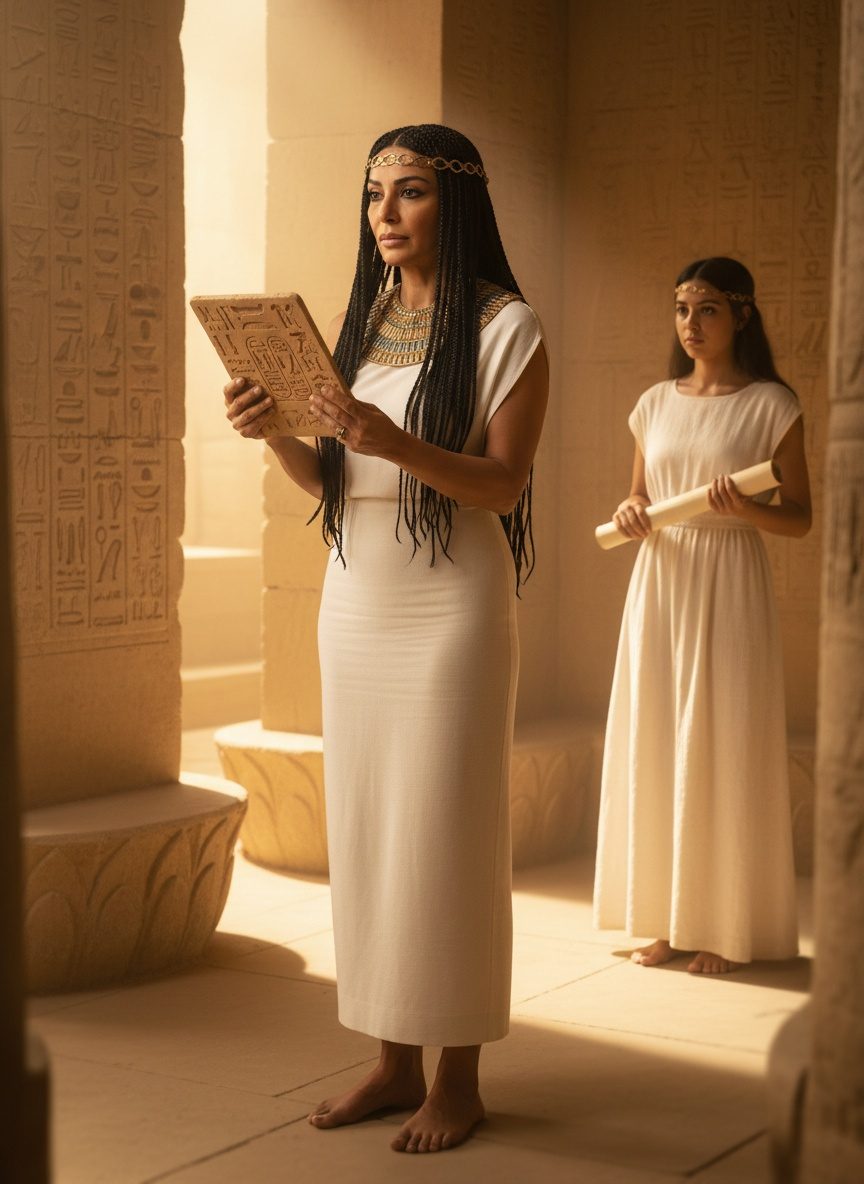
She was a pioneer in a world dominated by men. Her name has endured for over four millennia, engraved in stone. This remarkable woman was Peseshet, an ancient Egyptian who defied societal norms to become a leader in the field of medicine. At a time when women’s roles were largely confined to the domestic sphere, Peseshet shattered the proverbial glass ceiling by ascending to a position of remarkable influence: Chief of the Female Physicians. She left an indelible mark on history that would have otherwise been forgotten, save for the stones that whispered her name across the ages.
Rising Through the Ranks in Ancient Egypt
In the heart of Ancient Egypt, under the rule of the Old Kingdom around 2400 BC, society thrived on a highly structured framework where social roles were rigid yet all-important. The professional world, especially domains like medicine, was largely male-dominated. Yet, amidst these constraints, Peseshet carved a niche for herself. Her title, now translated as the "Lady Overseer of the Lady Physicians," signifies a significant departure from the gender norms of her time and highlights her integral role in healthcare.
Understanding Peseshet's influence requires delving into the backdrop of Ancient Egyptian medicine. At the time, medicine was deeply intertwined with religion. Physicians revered gods linked to health and healing, such as Sekhmet and Thoth, and relied on both spiritual and empirical methods. Against this backdrop, Peseshet's position was not just one of administrative excellence but also of great spiritual and intellectual responsibility. Her leadership in an era that produced one of the earliest known medical treatises, the "Edwin Smith Papyrus," suggests that she may have even helped shape early medical practices.
While detailed records of her training and specific contributions are lost to time, Peseshet's leadership role suggests she was instrumental in educating future generations of physicians. It is likely that her influence extended far beyond overseeing practical medical procedures. By training others and managing resources, she would have directly impacted the well-being of her society. Her work continues to intrigue historians who endeavor to piece together the daily realities and challenges of life in ancient Egypt, offering insight into a world where science, spirituality, and governance converged in the halls of medical practice.
The Legacy Written in Stone
In an age without modern record-keeping, physical relics were often the only method of preserving one's legacy. Peseshet's name and title were discovered inscribed in tombs alongside those of significant male figures. This inclusion points to her standing within society and the respect she commanded. One of these was the tomb of Akhethetep, where she was featured not as a mere attendant but as a peer or superior. Such inscriptions have become invaluable to historians seeking to understand the otherwise undocumented influence of women in ancient times.
The precise depiction of Peseshet in the stone relief highlights not just her role but also the societal norms she transcended. Often, women in ancient Egypt were depicted in domestic scenes, yet Peseshet is listed in association with a professional field. Her representation in these engravings is a tribute to her contributions and an affirmation of her status—a rare acknowledgment of a woman's professional achievements in ancient art.
Peseshet's identity as a trailblazer in medicine challenges assumptions about roles prescribed to women 4,500 years ago. While it is difficult to gauge the exact scope of her impact without written documents like we have today, her enduring presence in hieroglyphs suggests that her contemporaries indeed valued her work. She was both a figure of authority overseeing medical practitioners and a symbol of potential—proof that even in a stratified society, women could attain positions of influence and respect in fields dominated by men.
The Timeless Resonance of Peseshet's Achievement
The story of Peseshet extends far beyond her own civilization. Her life epitomizes the ability of women to break through societal constraints, even in the most ancient times. As we study her legacy, we uncover a narrative of female empowerment that echoes into the present day, offering inspiration to continue challenging gender norms. Her achievements, albeit sparsely recorded, ignite questions about the many other unsung heroes without stone memorials to recount their tales.
Peseshet reminds us that history is filled with untold stories—narratives lost to tragedy or neglect. They challenge the modern reader to pry open the past's dusty pages and recognize that influence and excellence transcend generations, cultures, and engraved tablets. In rediscovering her, we engage in the universal act of honoring those who have paved the way for future generations, a timely reminder that progress as we know it is built upon the sturdy foundations laid by those who came before.
Through the chiseling of names like Peseshet's into stone, ancient artisans ensured that a woman whose work helped shape the future of medicine would not be forgotten. In an era when few women could dream of such achievements, her story becomes an eternal testament to the potential within and the legacies built by transcending expectations—lessons as enduring as the Egyptian pyramids themselves.