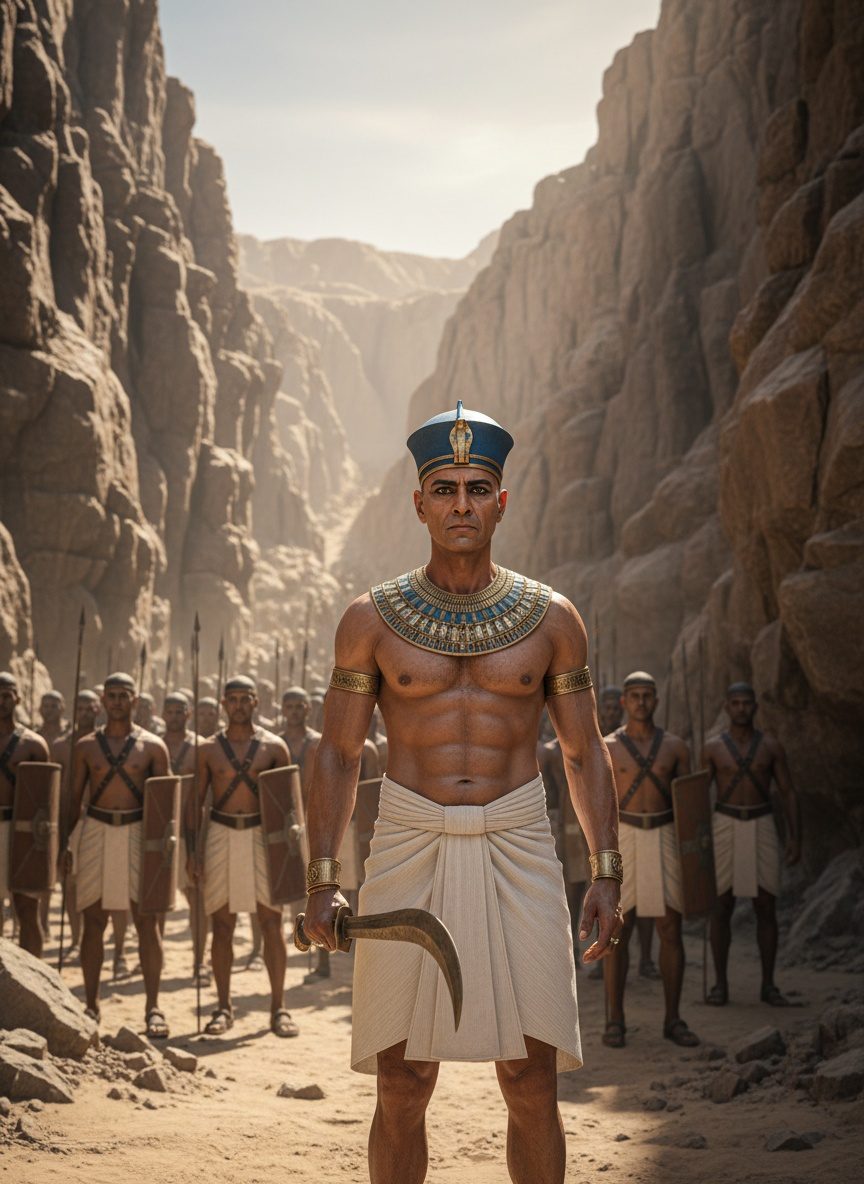
The sun beat mercilessly on the barren valley, its heat shimmering off the stones that cluttered the landscape. Thutmose III, Pharaoh of Egypt, stood unwavering at the entrance of the narrow Aruna Pass, flanked by the towering peaks of Mount Carmel. His generals hovered behind him, eyes wide with trepidation as they exchanged furtive glances, their voices hushed in urgent whispers. "Take the longer route," they pleaded, their concern palpable against the rumbling tension of the army's anticipation. But Thutmose, his gaze fixed defiantly on the constricted opening, dismissed their counsel, the shadow of his determination cast as long as the obelisks in Thebes.
The path ahead was perilous, a narrow defile that twisted through the hills, barely wide enough for a single chariot to trundle through. It would take hours for an army to traverse, exposing them to potential ambushes by the enemy forces entrenched at Megiddo. Reluctance simmered among his officers, who preferred the safer road to the south, even if it meant a longer march. Yet, Thutmose’s vision soared beyond their apprehensions. He was not merely a commander in this campaign; he was a ruler determined to restore Egypt’s supremacy.
With a quiet but commanding gesture, Thutmose stepped into the pass, his resolve becoming the courage upon which the entire army leaned. One by one, shields clinking, the soldiers followed, a serpentine column of Egyptian might snaking its way toward the city of Megiddo, where over three hundred princes had assembled against them.
Thutmose III had ascended to the throne at a time when Egypt’s crown had lost much of its luster. His illustrious aunt, Hatshepsut, had ruled peacefully, focusing on economics and impressive architectural endeavors, but in doing so, she had left Egyptian dominance over Canaan and Syria in a precarious state. Thutmose emerged from years of stewardship under her reign, imbued with a vision of conquest that outstripped the pacifism of his predecessors.
This struggle, however, was not forged in mere ambition but in keen awareness of historical necessities. He had been trained in the art of warfare, watching closely as military commanders, under his stepmother's reign, managed Egypt’s borders with vigilance rather than aggression. But Thutmose harbored no such restraint.
The Battle of Megiddo, occurring in 1457 BC, would not just be a victory; it would signal to the known world that the lion of Egypt had awoken. Thutmose's troops descended through the pass with the nimbleness of a panther, exploiting the element of surprise in military precision. The enemy, expecting a brazen advance along the more open routes, was caught aghast as the Egyptian forces erupted from the pass, their disciplined ranks swelling over the plains in a surge of chariots and infantry.
The battlefield became a tableau of chaos and chariots, with Thutmose at the helm, leading not from the rear but at the spear’s edge. His audacity and shrewdness were rewarded—a strategic masterstroke that forced the coalition of the Canaanite princes to scatter, their defenses crumbling like the dust under the hooves of Thutmose’s warhorses. It was as though Amun himself had guided the pharaoh, fortifying his heart and hands.
In the aftermath of the historic clash, it was not merely the physical spoils that mattered. Thutmose imposed a rigorous siege on Megiddo, a process painstakingly recorded by scribes who etched in hieroglyphic relief the horrors for those within and the dogged perseverance of those without. Though it took a grueling seven months to starve out the city, his triumph sealed Thutmose III's reputation as a military genius, and Megiddo’s subjugation became a lesson in patience and strategic dominance across the ages.
Megiddo was but the beginning. Over the course of seventeen subsequent campaigns, each meticulously orchestrated, Thutmose would reinforce and extend Egyptian control—from the Euphrates to Nubia, stamping down insurgencies with a mixture of brute force and diplomatic deftness. He traced paths of conquest both afar and near, entwining his path with the silk and spice routes that enriched his treasury and expanded his sphere of influence.
For a ruler who had basked in the decisiveness and blood of battle, Thutmose eventually grew weary of counting his victories. His campaigns were not just fights for dominion but a reimagining of what Egyptian power could convey, leaving it unmatched for generations. The stately temples erected during his long reign, decorated with the spoils of conquest, attested to this remarkable synthesis of militaristic genius and administrative prowess.
Beneath his reign’s achievements lay a more substantial resonance with the Egyptian psyche. Thutmose III restored a pride that had been dimmed. As the sun set over the Nile at the brink of his rule, its rays caught the resplendent glory of a horizon only widened by his campaigns, a backdrop to a civilization learnings from its past to forge the future.
In Thutmose III’s biography, we uncover a narrative often omitted from the annals of casual history—a tale not only of a warrior-king but of a unity forged by ambition, wisdom, and enlightenment. His legacy endures, a testament to the transformative power of leadership that can expand a kingdom, not merely with the sharpened blade but with the foresight of a grand strategist who stops counting victories once meaningful, lasting change is secured. His conquests illuminated the paths that future Pharaohs would follow, deepening Egypt's footsteps onto the sands of time, and reminding the modern world that sometimes, the greatest leaders are those who dare to walk in front alone, while history patiently waits to follow.