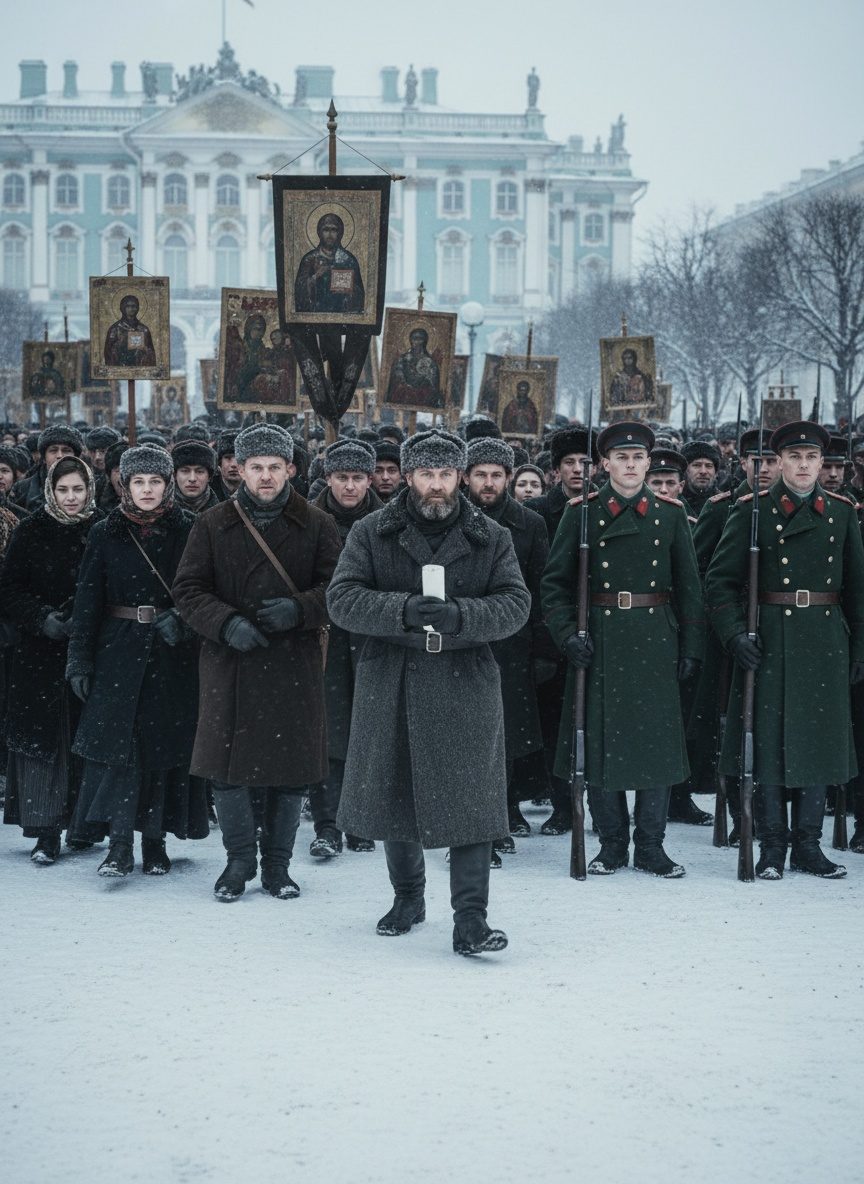
The icy wind whipped through the crowd, chilling the bones of the 150,000 workers gathered in the streets of St. Petersburg. Their breaths rose as mist into the frigid January air, mingling with the ethereal chants of hymns and the metallic clang of distant church bells. Hopeful faces, hardened by years of toil and suffering, peered beneath the iconic onion domes of the city. Arms raised mementos of faith—crosses and icons clutched tightly against the ravages of winter. Father Georgy Gapon, a man whose own eyes held more fire than the bitter morning, moved among them like a beacon, promising that God’s anointed would listen. They marched, resolute in their faith that Tsar Nicholas II, the "Little Father," would meet their petition with the compassion of a benevolent ruler.
The Gathering Storm
The days leading up to that fateful January 22nd, 1905, were steeped in a pervasive sense of both desperation and hope. The workers, many of whom had been drawn to St. Petersburg by the promises of factory jobs, found themselves trapped in a city of grinding poverty, backbreaking labor, and ruthless oppression. Wages were meager, working conditions hazardous, and the reign of Tsar Nicholas II seemed indifferent to their plight. The spark of protest ignited amid these dire conditions, as workers organized to demand not merely a few crumbs more from their labor but recognition as humans deserving of dignity.
Father Gapon, a charismatic priest with a passionate belief in peaceful reform, emerged as a central figure in these mounting tensions. His parishioners trusted him implicitly, and he collected signatures for a petition that sought, among other things, an eight-hour workday, improved working conditions, wage increases, and universal suffrage. But perhaps most crucially, it pleaded directly with the Tsar as a last, fervent hope that he would intervene on behalf of the masses. Gapon planned the march to the Winter Palace, envisioning the moment when hundreds of thousands of voices would infiltrate the heart of imperial power, carried across the icy Neva to reach the ears of their sovereign.
A Day Ruined by Blood
As the first rays of January sun strained to cast light over the Neva River, the procession moved steadily toward the imposing silhouette of the Winter Palace. Hope mingled with the crisp air, carried with each hymn and every prayerful murmur. They walked, unarmed and resolute, knowing that church and monarch were intrinsically bound in the Russian ideal. Alongside icons and banners, few could have foreseen the violence to come.
At the heart of this grand avenue, the mood darkened. The Tsar had not been in residence; instead, orders awaited the Imperial Guard to quell any breach of peace. As workers flowed into Palace Square, the figures of armed soldiers loomed like grim sentinels. The air was heavy with the whinnying of the horses and the mechanical click of rifles, a dissonant symphony against the solemnity of the crowd.
A barrage broke out, bullets tearing through the cold. Screams shattered the Sunday tranquility. Chaos erupted, hymns morphing into cries of anguish. Historians later estimated that hundreds fell that day, a tapestry of snow dyed red beneath a gunmetal sky. Those who could fled, slipping on the ice, the horror of this betrayal shredding their belief in the Tsar’s paternal care. This unexpected tempest of violence became etched into history as "Bloody Sunday," a pivotal rupture roiling the heart of the Russian Empire.
The Fuse of Revolution
The events of Bloody Sunday reverberated throughout the empire like a seismic wave. Hope, once fertile in the souls of the Russian masses, became hardened into resolve. The strikes and protests spread beyond the borders of St. Petersburg, fanning the flames of anger that had been simmering beneath the surface of the autocratic state. In factories and fields, on the streets and in homes, conversations shifted to revolutionary tones.
What transpired that single day did not merely question the legitimacy of the Tsar but eroded the foundational trust that had sustained generations of imperial rule. Nicholas II, isolated from the throes of his people, found himself increasingly besieged by demands from all directions. The discontent that bled across Russia held in its grip not just workers, but students, intellectuals, and even sections of the bourgeoisie. The chain of unrest triggered by Bloody Sunday cracked the facade of an unshakable empire and sowed the seeds that would, less than two decades later, be harvested in revolution.
For Father Gapon, the aftermath was equally transformative—he fled to exile, disillusioned and convicted by the naïveté of his beliefs. The world he had envisioned, one where the Tsar could be a compassionate patriarch, died in the echoes of those first gunshots. Gapon’s disillusionment mirrored that of his compatriots, amplifying calls for substantive reformation or radical overhaul of the Russian state.
The Unheeded Cry
Bloody Sunday was not merely a massacre; it was a seismic juncture in Russian history, an allegory of betrayal that echoed through the corridors of power and into the streets of the common folk. Ironically, it was the unwavering faith in the Tsar’s benevolence that became the undoing of that very belief, unraveling the threads of autocracy one tragic stitch at a time. The images of that January day, etched in the memories of those who survived, became rallying cries for change that transcended the initial cries of despair.
Looking back on that frozen day in 1905, the paradox that the Tsar’s troops answered hymns with gunfire underscores the volatile unpredictability of power and its capacity to both inspire and destroy. No barricade could withstand the onslaught, not of troops, but of a populace awakened. History softly records that the empire did not topple in a day, but there is no denying that the tremors of Bloody Sunday set the stage for seismic shifts that shaped the modern world.
This grim chapter serves as a poignant reminder of the complexities inherent in the dance between the governed and those who govern. A tragic confluence of hope and violence, it remains a visceral testament to the enduring struggle for human dignity and justice—a harsh lesson not easily learned, nor quickly forgotten.