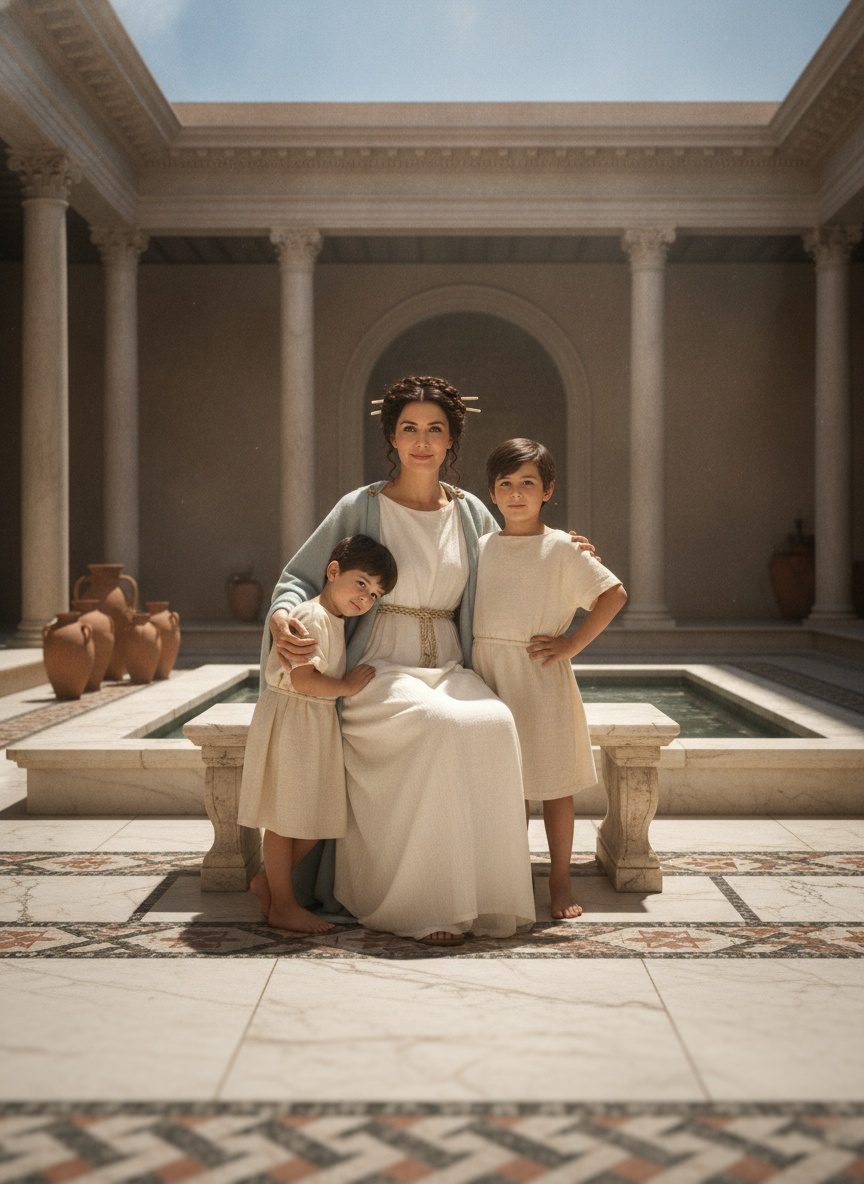
The air was tense with anticipation as Cornelia Africana stood in her courtyard, sunlight casting long shadows over the Roman villa. Her hands, weathered yet graceful, rested firmly on the shoulders of her two sons. Her eyes, burning with resolve, met those of the Egyptian envoy. "I am flattered," she began, with a voice steady as marble, "but my answer is no." In that moment, surrounded by the tremors of Roman politics and whispers of imperial power, Cornelia defined not only her own destiny, but also the destiny of Rome itself.
The Daughter of Carthage's Conqueror
Cornelia Africana was no ordinary woman. Born into the illustrious Scipio family, her lineage was both a burden and a badge of honor. Her father, Scipio Africanus, had brought Carthage to its knees, etching his name into the annals of Roman glory. This legacy of triumph and leadership shadowed Cornelia from birth. Expectations burned like torches at every corner of her life. Yet, she carved her own path through the dense thickets of Roman patriarchal society.
Despite societal norms that relegated women to the background, Cornelia emerged as a beacon of Roman virtue. She wed Tiberius Gracchus, a man whose vigor and political prowess matched her own illustrious heritage. However, her life took a dramatic turn upon his untimely death. Left a widow with young children, Cornelia defied expectations, resolutely pledging herself to motherhood over remarrying, especially of such a tempting and powerful offer as a royal marriage proposal.
A Crown Rejected
It was not just any king who sought Cornelia's hand—it was the Pharaoh of Egypt, a ruler whose wealth and opulence were whispered of in the corridors of power throughout the Roman Republic. The match would have secured her a throne, a life adorned in perpetual luxury and influence far beyond the Roman sphere. Yet, Cornelia's response was resolute and unwavering. She gestured to her children, declaring, "These are my jewels," embodying the Roman virtues of familial duty and moral integrity.
This decision to remain in Rome was more than a simple rejection of power—it was a statement of purpose. Cornelia chose to dedicate herself to her sons' upbringing, believing their potential for reform and greatness outweighed any personal ambition or comfort she could secure for herself. Her foresight was uncanny, as the values and teachings she instilled in her sons would soon resurge into the fabric of Roman society.
The Making of Reformers
Under their mother's tutelage, Tiberius and Gaius Gracchus grew to embody the ideals she so cherished. Cornelia educated them not only in rhetoric and philosophy but in the stoic virtues of courage, justice, and civic responsibility. Her nurturing molded her sons into figures who would become instrumental in championing the rights of Rome’s disenfranchised.
Tiberius Gracchus eventually rose to become a tribune, daring to push for agrarian reforms that sought to redistribute wealth and land to the lower classes. His vision threatened the established order, sparking intense controversy and political strife. Tragically, his boldness led to his demise, a victim of the political maelstrom he sought to calm. His brother Gaius followed in his footsteps, furthering their shared cause amidst equally perilous circumstances. Though neither lived to see their reforms wholly realized, their actions ignited a powerful dialogue on citizenship and equality that rippled through Roman history.
The Mother and Her Legacy
Cornelia Africana's legacy transcends her time. She chose to cultivate strength, integrity, and reform within the Roman Republic through her dedication to her children. Her rejection of Egyptian luxury in favor of nurturing two young reformers reflects a rare dedication to civic virtue over personal gain. She turned motherhood into an immortal influence, her wisdom shaping not only her sons but the course of Roman history.
In a society where women so often remained voiceless, Cornelia's actions spoke louder than words. Her decision ripples through time as a testament to the profound impact of maternal influence on the public sphere. As we reflect on her life, we recognize that the paths we do not take often illuminate the ones that define our legacy. Cornelia's choice was not just for her sons, but for Rome itself—a decision that history has never forgotten.