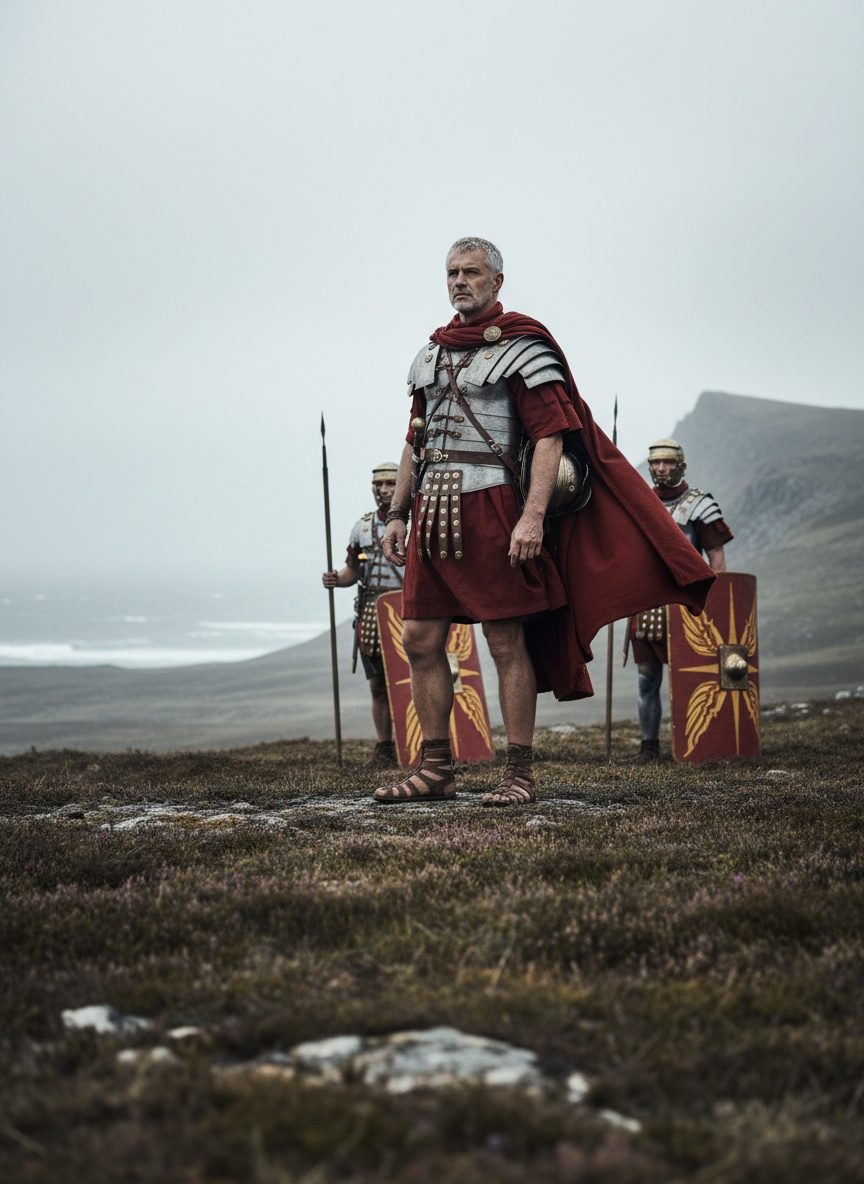
Gnaeus Julius Agricola was 40 years old when he first set foot in Britannia. He wore the toga of a seasoned Roman senator as comfortably as his armor. Yet, it was neither his political acumen nor his military might that immortalized his name; it was his pen.
The Limitless Ambition of Rome
In 43 AD, when Rome first turned its imperial gaze towards the mist-draped isles of Britannia, it wasn't just about conquering a new land. It was about expanding the boundaries of civilization itself. Over the following decades, Roman legions slowly clawed their way northward, each step representing a blend of military conquest and cultural imposition. Roads, fortresses, and towns stamped Roman authority onto the wild and rugged landscape.
Gnaeus Julius Agricola arrived in 77 AD, appointed as governor of Britannia. Tasked with expanding the frontier to its utmost edge, he found himself facing not just geographical but cultural boundaries. Agricola was no typical conqueror; he understood the virtues of assimilation and saw the potential in Romanizing the tribes as much as subjugating them. His methods were a tapestry of diplomacy and force, blending the Roman way of life with the local customs to win both hearts and battles.
Under Agricola’s command, the legions pushed further into the unknown, reaching what was considered the end of the world. It was a place where even the Roman gods seemed distant, where the Cruden Bay and the Grampian Mountains whispered of ancient secrets. Here, Agricola faced the formidable Caledonian tribes, fierce warriors whose lives had been shaped by the harsh Northern landscape. His strategy combined tactical genius and psychological warfare, culminating in the Battle of Mons Graupius. Though the victory was staggering, it came at a cost; the land beyond was too wild, too resistant to Rome’s yoke.
The Lost Conquest
In 84 AD, standing atop the cliffs at the northernmost reach of Roman control, Agricola gazed across the churning waters towards an unknown horizon. What lay beyond was mystery, a sweep of ocean punctuated only by tales of lands populated by creatures of legend. Here, history teetered on the brink of uncharted territories. Yet, with the distant waves crashing against the rocky shores, Agricola made a fateful decision. He turned his back on the tempting unknown, choosing instead to secure what was already in Roman grasp.
As Agricola returned southward, the world left behind began its journey into legend. The boundaries of the Roman Empire would never again stretch so far into the northern wilderness. Yet, despite the success and stability Agricola had brought, a sense of unfulfillment shadowed his legacy. The power struggles of Roman politics would see him recalled from Britain, his achievements glossed over in the annals of time.
The campaign in Britannia might have vanished into obscurity but for the keen eye of Tacitus, Agricola's son-in-law. A historian of great acumen, Tacitus chronicled the life and deeds of Agricola in his biography, a rare example of first-century autobiographical history. His writings transported readers back to the edge of the Roman world, preserving the memory of what might otherwise have been forgotten. Tacitus' records speak not only of conquests and battles but also reveal the nuances of Agricola’s character, offering a glimpse into the man behind the military campaigns.
A Tale Carried Through Time
The stories of conquest and the spirit of exploration captured by Tacitus were as much a monument to Agricola as any statue or inscription. His detailed account left an indelible mark on the Roman historical narrative, highlighting a rare blend of military prowess and administrative acumen. Agricola’s tale is preserved not by the stones of Rome but by the careful, deliberate strokes of his son-in-law's quill. Tacitus held a pen where Agricola wielded a sword, and together they carved a legacy into the fabric of time.
Today, remote and rugged as they were two millennia ago, the Scottish highlands bear the quiet memory of a campaign that was both triumphant and restrained. The Roman roads ended abruptly where nature refused assimilation, and the antique footprints of legions have long since vanished beneath turf and heather. The story of Agricola and his bold push northward reminds us of the transient nature of civilizaion's grasp and the enduring power of the human spirit to confront the unknown.
This story resonates beyond its temporal confines, a testament to human ambition and the ever-present tension between exploration and restraint. The end of the world was not a limit imposed by land or sea but by the choice of a man who understood the significance of turning back. Agricola's legacy, defiantly preserved by Tacitus, whispers across time; it invites us to consider how history is remembered and who gets to write its pages.