The air was thick with humidity as John Lloyd Stephens hacked another tendril out of his path. With every step forward, the dense canopy of the Yucatán jungle seemed to close in, a living, breathing entity that enveloped him and his companion, Frederick Catherwood. They were not the first to tread this lush maze, but they were, perhaps, among the most determined to pierce its verdant mystery. The reward came as a hush settled over the ancient ruins—a silence so profound it felt as if even the forest paused in reverence.
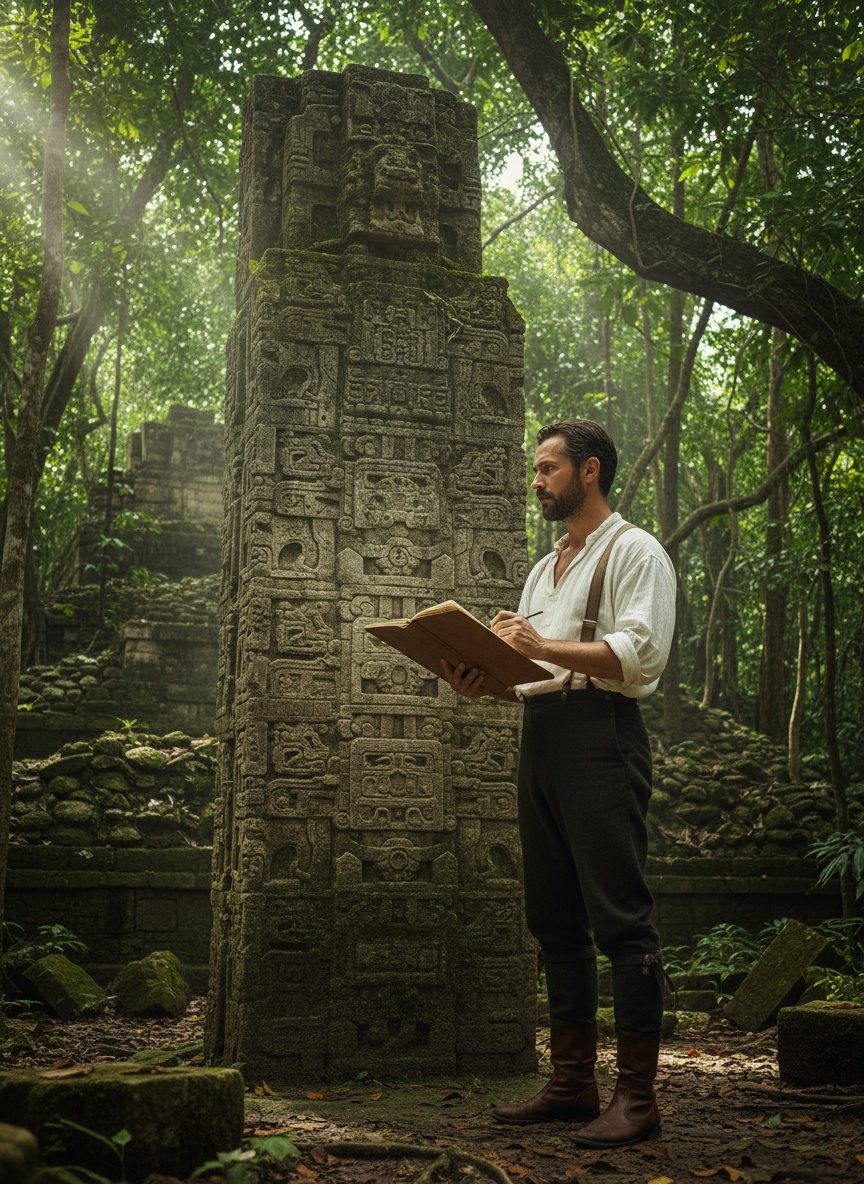
There it stood, a towering Maya temple, its stones entwined with vines, yet undeniably magnificent. The structure defied time, each weathered block whispering tales of a civilization that had once pulsated with life. Stephens stood before a carved stone altar, solemn and respectful, conscious of stepping into a world that Europe had long consigned to fantasy. As a diplomat, his pen was his weapon of choice; he pulled out his notebook, eager to record every detail, every nuance of this encounter with history's shadow.
Beside him, Catherwood, a masterful artist from the north of England, began to sketch. His hand moved with precision, tracing the lines of the altar, capturing the ethereal grandeur with more than just academic intent. His drawings would bring clarity to blurred understandings, dispelling myths and misconceptions that Europe held about the Maya people. Where words struggled to convey the sheer scale and artistry, his images spoke volumes.
It had been a journey instigated by curiosity and guided by tales brought back from the colonies—a notion that there existed cities lost in the jungles of Central America, teeming with secrets yet to be unlocked. The Maya, whispered of in drawing rooms and formal salons, were often relegated to the realms of legend, their achievements footnotes in the grand tapestry woven by European conquest. Stephens and Catherwood, however, were compelled by something greater—a commitment to bringing these stories into the light.
The path had not been easy. The two men battled not only the elements but the skepticism that greeted their endeavor. Victorian Britain, a society enamored with its own advancements in chronology and civilization, had a preconceived notion of the world and mankind's place within it. Yet as Stephens carefully documented each stone sculpture, and as Catherwood rendered each face and form with an artist's eye, a new narrative began to emerge from the heart of the Americas.
The significance of their discovery did not reside solely in the aesthetics of grand temples and intricately carved stelae. These artifacts spoke of a people whose achievements in mathematics, astronomy, and architecture paralleled those that Europe itself extolled. The Mayan calendar, the complexity of which confounded scholars and enthusiasts alike, emerged as a remarkable testament to this civilization's quest to reconcile time, space, and the divine.
Catherwood's detailed illustrations found their way to the printing presses of London, sparking a fervor among a public hungry for tales of adventure and mystery. His drawings, printed alongside Stephens's carefully crafted prose, challenged the entrenched biases of the era. The intricate glyphs, painstakingly etched by minds capable of perceiving the celestial dance of planets and stars, told of cities whose precision and purpose echoed the grandeur of ancient Rome and Egypt.
The reaction was electric. In parlors across Britain, the implications of these revelations unfurled like threads weaving through the fabric of societal consciousness. Were the Maya, in their apparent isolation, merely an anomaly in the grand scheme? Or had Europe overlooked something intrinsic to the human experience, a commonality that transcended the oceans and miles between hemispheres?
As the dim glow of a Yucatán sunset painted the ruins in hues of amber and rust, Stephens and Catherwood understood the weight of their undertaking. It was not simply about unearthing forgotten stones; it was an invitation for dialogue between past and present, across the expanse of history. They were harbingers of a new way of seeing—a call to recognize the threads connecting disparate cultures, and to honor the creative impulse shared across humanity.
In the stillness of that jungle evening, with the forest closing once more upon the path they had carved, the echoes of the Maya spoke clearly to those willing to listen. Their journey had breathed life into a silent world, punctuating it with voices both ancient and enduring. The Maya spoke again, and in doing so, reminded a burgeoning industrial age in Victoriana of the eternal dance of creation and knowledge, forever woven into the story of humanity.