Egill Skallagrímsson was a dead man. Yet, he walked away with nothing but his life and a poem.
In 948 AD, the city of York was a restless hub of power struggles and cutthroat politics, where Norse warlords vied for control. Egill Skallagrímsson, a formidable Norse warrior and skald—poet—found himself shackled and doomed to face the wrath of Eiríkr Bloodaxe. This was no ordinary adversary; Eiríkr, infamous for his treacherous rule and fratricidal tendencies, had recently taken the title of King of Northumbria. Egill's fate seemed sealed as he stood before the gallows, the dawn's light ready to mark his final moments.
The enmity between Egill and Eiríkr was as deep as the darkest fjords of their native lands. Egill had not only slain allies of the king but had also defiled a sacred truce, an unpardonable act that demanded the swiftest of executions. Captured, Egill found himself once again at the mercy of a king whose heart was seemingly made of stone. This was a man who had killed his own brothers to secure his throne; mercy seemed a foreign concept to him.
Yet it was not with sword or shield that Egill prepared to meet his death, but with the only weapon he had left: his words. As the night thickened, cloaking the city in an eerie silence, Egill set to work. He had one night to craft verse that might pierce through Eiríkr’s hardened exterior, a composition so compelling it could eclipse the thirst for vengeance. Thus, under flickering torchlight, Egill summoned the muse of poetry to weave together a tapestry of words strong enough to unfasten the chains that bound his life to that of a traitor.
What kind of man could stand poised on the precipice of death and find the presence of mind to compose verses? Egill Skallagrímsson was far from ordinary. He belonged to a lineage where fierce warriors and master poets often converged; his grandfather Kveld-Úlfr was a formidable berserker, and his father Skallagrímr had carved out a life in the newly colonized lands of Iceland. Egill himself had witnessed over sixty years of life, surviving countless battles. The legend of his ferocious strength was only paralleled by his wit and eloquence in verse, an art held in high esteem among the Norse.
Throughout that long night, Egill poured his soul into the poem. This was to be no ordinary skaldic piece. Each stanza was crafted carefully, honoring Eiríkr's lineage, extolling virtues often unspoken, and subtly weaving in a reminder of traditions that elevated honor above all else. By morning, he had composed *Höfuðlausn*, "The Head Ransom," a masterpiece that would resonate with his captor and save his own neck from the rope.
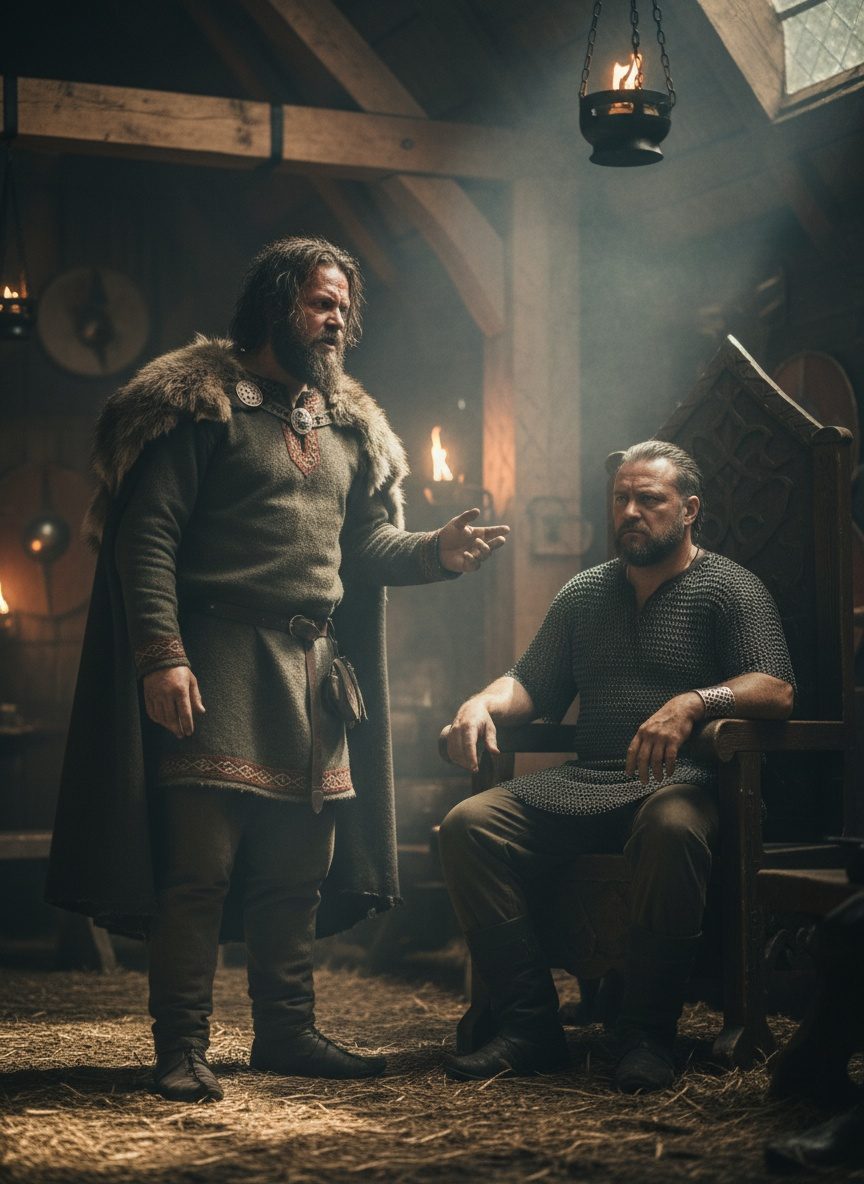
As the first rays of dawn struggled against the gloom of the English skies, Egill was brought before Eiríkr. The courtyard was eerily quiet, the watchers hovering between anticipation and muted sorrow, for none expected mercy from Eiríkr Bloodaxe. Yet there, with a ferocity matching the northern gales that had once carried his ancestors to these foreign shores, Egill recited his poem. His voice, steady and unwavering, crafted rhythm and rhyme that danced in the cold morning air, captivating his captor, his enemy, and those gathered.
What followed was a silence as vast and uncertain as the seas. Eiríkr, notorious for his brutality, stood unmoved for what seemed an eternity before he finally spoke. Perhaps it was the invocation of heritage, the shimmering words that evoked shared values and battles fought long before; something within the poem had touched a chord. Witnesses to this day argue whether it was admiration, pride, or a rare moment of clemency that prompted Eiríkr’s decision. Regardless, he spared Egill’s life, allowing him to walk free—a remarkable testament not just to Egill's prowess as a poet, but to the power of words themselves.
Egill’s tale of survival through poetic genius was more than a historical footnote; it was an illustration of how culture and tradition could transcend the brutal political machinations of the Viking Age. The Vikings were often perceived—incorrectly—as merely brutal warriors, yet they also nurtured a profound respect for art, language, and legacy. A man’s reputation and skill could hold as much weight as his sword arm, and in the Norse societal hierarchy, the skald had the unique capacity to rise above the smoke of battle with verses that could immortalize, persuade, and redeem.
The episode between Egill and Eiríkr echoes through the ages, illustrating how the soft power of language could bend even the hardest of hearts. The composition of *Höfuðlausn* was not just an artistic triumph but a subtle strategy rooted in the interwoven cultural fabric of the Norse world. Egill’s ability to navigate through words should teach us all about the enduring potency of cultural expression, the capacity of storytelling to save and transform lives, even as the swords of history hung ominously above.
In a modern world where communication often prioritizes speed over substance, Egill’s story is a reminder of the depth and resonance that comes with truly knowing one's craft. His verse, born under duress, did not only save his head but also left a legacy that reigns far beyond his mortal coil. It speaks to the elemental nature of poetry and song within human society, as relevant in the Viking halls of yore as they are today, continuing to remind us of what it means to be human: the ability to create, to express, and, sometimes, to persuade even the most ruthless leaders that words, indeed, hold power beyond any blade.