On a fateful summer day in 1939, the mist-enveloped fields of Suffolk were about to reveal a secret hidden for thirteen centuries. Beneath an unassuming mound lay remnants of a world forgotten — a discovery that rewrote history and rekindled the spirit of early medieval Britain. As diggers' shovels carved into the earth, a wooden ship emerged, its hollow silhouette speaking volumes of the grandeur that once sailed the waters of East Anglia. Welcome to the story of Sutton Hoo, where a widow’s curiosity unearthed a king’s legacy.
A Widow’s Hunch
Imagine standing on a breezy hill overlooking the River Deben. The year is 1939, and you are Edith Pretty, a discerning and curious widow who owns the Sutton Hoo estate. For years, tales and whispers of ancient halls buried beneath the mounds have stirred your imagination. You decide to act. Charged with a sense of purpose, you summon Basil Brown, a local self-taught archaeologist, to unearth what secrets lie beneath. Guided by instinct and a smattering of local lore, you watch as Brown digs into the largest mound. What follows is nothing short of breathtaking.
In May, as the war clouds gather over Europe, the first hint of something extraordinary appears: rivets and fragile wood impressions, initially mistaken for debris. Brown soon grasps what he has uncovered — the ghostly imprint of a 27-meter-long burial ship, resembling an inverted ark of time. The ship becomes more than a burial vessel; it is a harbinger of forgotten magnificence, hinting at a civilization far from the darkness once presumed.
The King’s Silent Treasure
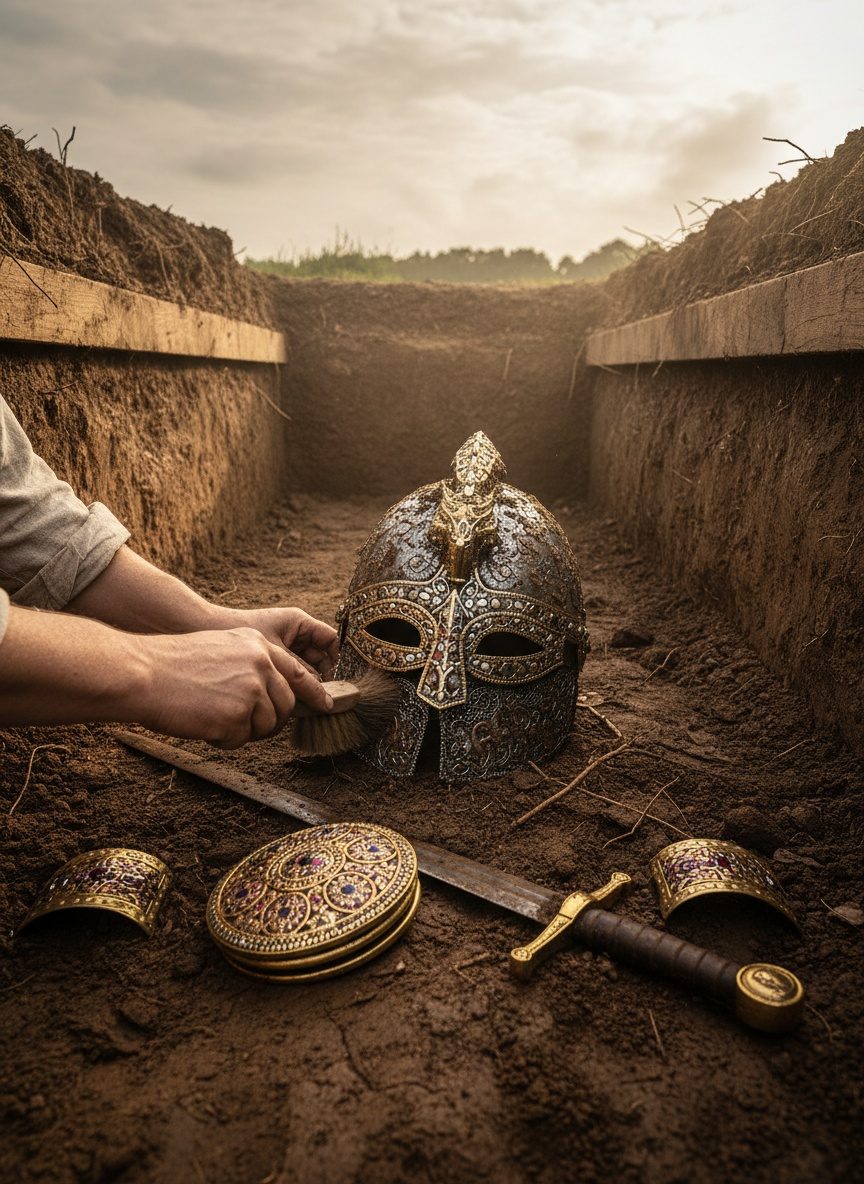
As the ship’s silhouette breaks through the soil, an avalanche of treasure follows, casting light on the so-called Dark Ages that, in reality, were anything but. Gold buckles weighing nearly five pounds, ornately engraved with unimaginable artistry, speak of a sophisticated culture. Silver bowls from Byzantium, garnet-studded fittings, and even a lyre, whose music once graced royal halls, emerge from their earthly slumber.
The pièce de résistance is a single warrior’s helmet, its haunting visage a mosaic of iron and precious metal, intricately decorated with images of mythical beasts and warriors in combat. This isn’t just any helmet; it whispers secrets of royalty and leadership. Experts would later associate this opulent hoard with Rædwald, the king of East Anglia and pivotal player in the early English kingdoms' shifting dynamic. However, the lack of a body casts a shadow of mystery. Was the ship grave a cenotaph, or did time and earth consume the remains of the once-great king?
Sifting Through Time
The Sutton Hoo discovery not only piqued England's collective imagination but also engaged scholars and the public alike in a different dialogue about early medieval Britain. Prior to this astounding find, the period following Roman rule was characterized by historians as the “Dark Ages” — an era shrouded in shadows and barbarism. Sutton Hoo unequivocally overturned that notion, revealing a culture of sophisticated trade networks and artisanship.
Connecting the dots, the presence of items like Syrian glass and Mediterranean silver underlines the extensive trade routes Anglo-Saxons navigated, long before such connectivity was recognized. These fragments of a vast network sketch a map of interactions that stretched from the Byzantine Empire to Scandinavia, showing that East Anglia was, in its time, a cosmopolitan hub of influence and wealth.
Surprising Echoes from the Past
As experts continue to scrutinize every artifact, new layers of intrigue surface. Recent technological advances have allowed for deeper analysis, applying techniques like X-ray fluorescence to uncover traces of vanished paints and gilding, bringing us ever closer to understanding the vivid reality these relics once represented. The Sutton Hoo site, still rich in untapped potential, remains a focus of active scholarly passion.
However, tales of ghostly apparitions haunt the more esoteric corners of the excavation site. Local legends tell of spectral figures, capped in glittering crowns, wandering through mists. Though dismissed by rational minds, the enchantment of such narratives endures, suggesting how deeply the finds resonate with local and national identity. Each piece, however small, contributes to a mosaic of national folklore, setting the scene for endless reinterpretations of early medieval life.
Legacy of Memory and Majesty
Sutton Hoo’s legacy is not just in its treasures but in its enduring capacity to captivate. This incredible discovery demonstrated beyond doubt the complexity and cultural sophistication of early English societies. What began with one woman’s curiosity unearthed an enduring testament to the majesty of a time once thought silent.
The artifacts now reside at the British Museum, tempting millions each year to ponder the lives behind the metal and gold. Yet, the dig’s timing was fortuitous. As Europe plunged into conflict during World War II, Sutton Hoo stood as a beacon of what had once been achieved and what might still be aspired to amidst uncertainty.
In conclusion, Sutton Hoo reminds us today of the endless potential for discovery and reinvention. These relics challenge the historical narrative, proving that greatness is not just what is known but also what is yet to emerge from the veil of time. As we look back, we are urged to see history not as a simple sequence of events but as a rich tapestry interwoven with mysteries that await illumination by inquisitive minds.