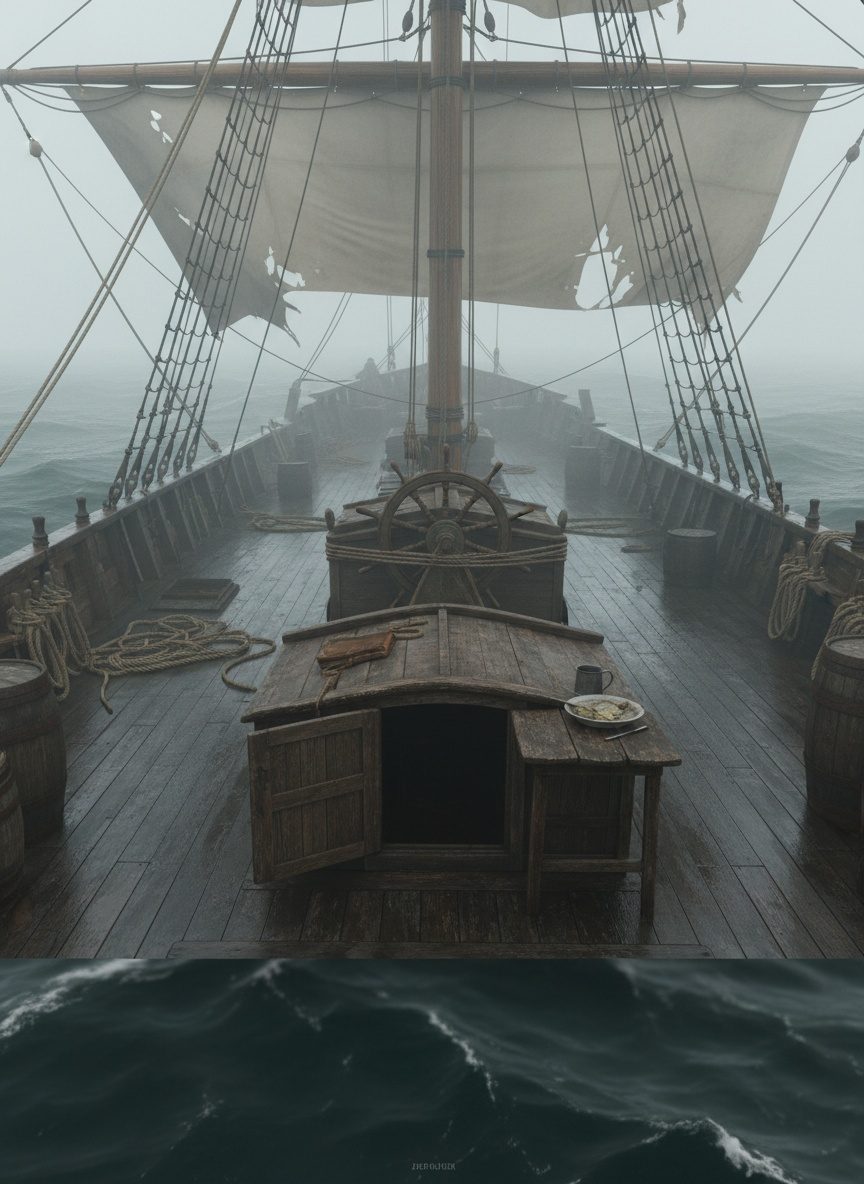
December 1872. The ocean swelled gently beneath a lonely ship.
The Day of Discovery
The Dei Gratia, a sturdy British merchant vessel, sailed gracefully through the chilly waters between the Azores and the Portuguese coast. Its journey, like many before it, might have been just another footnote in the grand tapestry of maritime history were it not for what lay in its path that day. For through the spyglass, its crew spotted a ship adrift on the horizon. As they drew near, it became clear: this was the Mary Celeste, a ship that should have been bustling with activity. Instead, it listed eerily, sails set, but no human life in sight.
Boarding the Mary Celeste, the crew of the Dei Gratia made a perplexing discovery. No soul came forward to greet them—not the captain, not a single crew member. Baffling silence drenched the decks. Below, chambers lay in quiet disarray. The captain's log was last dated ten days prior, indicating a typical Atlantic crossing. Yet now, the ship was unmanned, the crew's fate a silent riddle.
The condition of the Mary Celeste belied any suggestion of struggle or piracy. Eight of the ship's cargo tanks brimmed untouched with alcohol, a potent temptation for any potential looter. Strange is the sight of resilience amidst abandonment—the crew’s possessions undisturbed, a child's toy still resting by a bunk. As the Mary Celeste drifted, her sails caught the wind, a derelict ghost holding secrets nobody could fathom.
Theories and Ghost Ships
News of the vessel’s apparition spread like fire across Britain and beyond, capturing public imagination with the allure of the unexplained. A slew of theories, each more tantalizing than the last, flooded newspapers and taverns alike. Was it mutiny, murder, or madness that claimed the souls aboard the Mary Celeste? Virtually nothing was off-limits as an explanation.
One hypothesis pointed to foul weather. Yet, with her sturdy build and capable crew, how could a storm displace ten people into oblivion without leaving a mark upon her hull? Another possibility hinted at treachery from within, a mutiny where crew members perhaps turned upon each other. Yet, absence of violence contested such thoughts, leaving the theory adrift like the ship itself.
Then, the whispers of the supernatural—a phantom ship, some claimed, cursed by forces invisible. In an era infatuated with the spiritual, where séances and spirits lingered at the edges of Victorian consciousness, such tales found fertile ground. Seafaring lore, rich with the specter of ghost ships, breathed further life into these stories. Yet, for all the narratives spun, the tangible evidence remained as elusive as the wind.
The Mystery Persists
As the Mary Celeste was towed and examined in Gibraltar, British authorities sought precipitously to untangle the mystery. Salvage hearings delved into the captain’s character, the crew's competence, and even the vessel's past voyages. But what came forth was a paltry feast of inconclusive findings. The Mary Celeste served no easy answers, its enigma a wound that resisted closure.
In the decades following its discovery, the vessel became more than a ship; it was a story etched in maritime folklore, a touchstone for the uncanny. Fiction took liberties, embellishing the Mary Celeste's tale to add spice to the sourness of its mystery, ensuring its berth in pop culture and public discourse alike.
The fate of the Mary Celeste mattered not just to mariners and the curious minds of its era but serves as a reminder today of the capricious nature of sea travel and human endeavor. The tale remains a mirror to our fascination and fear of the unknown, the gulf between reality and imagination unfathomable as the depths themselves. Such ghost stories reflect both our desire to comprehend mysteries and our acceptance that some corners of history, like the Mary Celeste’s lost crew, may remain forever uncharted.