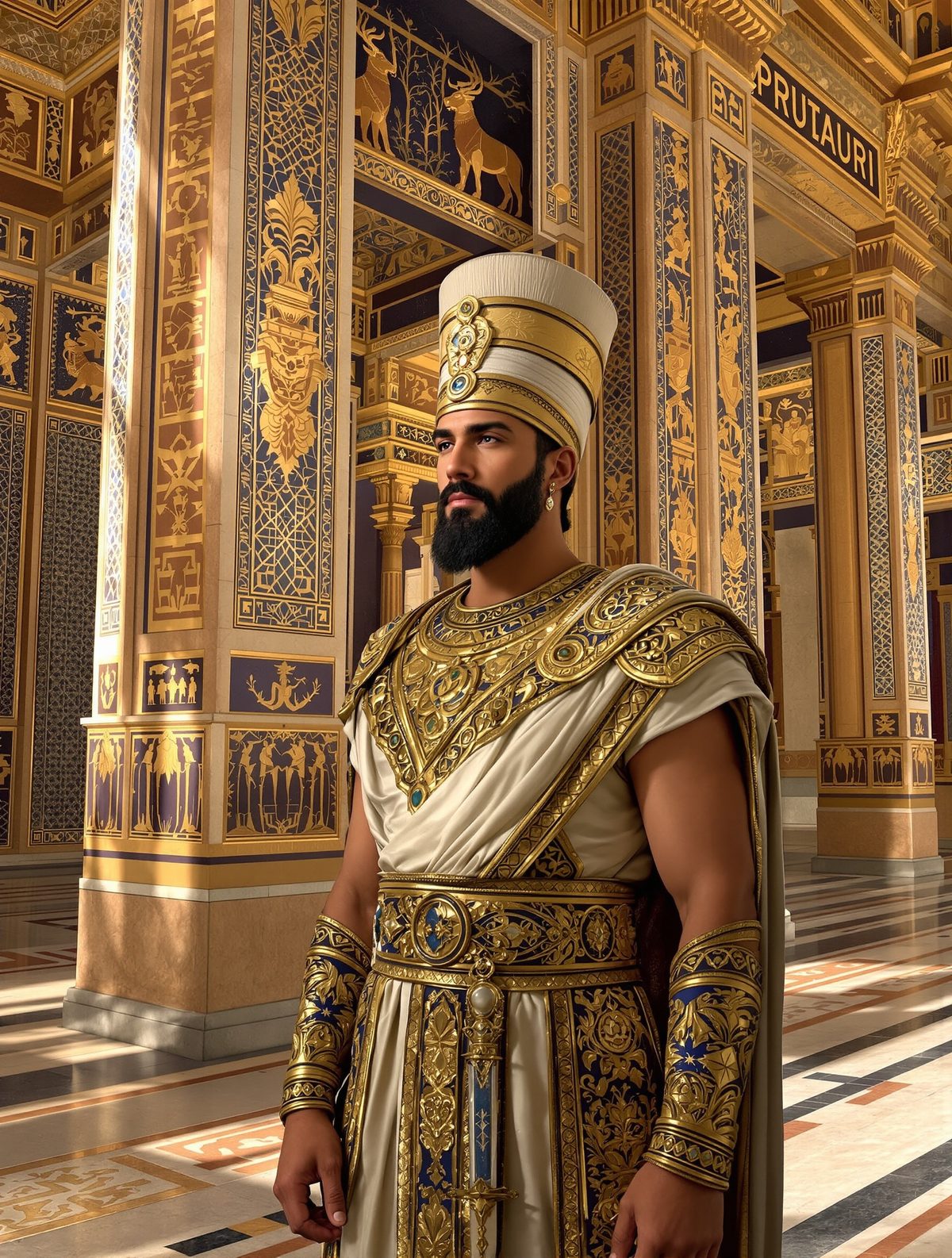
The clay tablet cracked under the pressure of the stylus, but Brahmagupta didn't notice. Sweat beaded on his forehead as he worked by flickering oil lamp light in his observatory at Ujjain, the mathematical capital of 7th-century India. For months, he'd been wrestling with a problem that had confounded the greatest minds across civilizations: how do you calculate with nothing? How do you give mathematical meaning to the absence of everything?
Then, in a moment that would echo through eternity, he pressed his reed into the soft clay and carved a small, elegant circle. Zero. Not just empty space or a placeholder, but a number. With that simple symbol, scratched into clay on a humid night in 628 AD, Brahmagupta unleashed a mathematical revolution that would make modern civilization possible.
The World Before Nothing
To understand the magnitude of Brahmagupta's breakthrough, imagine trying to do mathematics without zero. The Romans, masters of engineering who built aqueducts and conquered empires, had no symbol for nothing. Their numerical system went directly from I to II, with no concept for the absence of quantity. Try multiplying MCMLIV by nothing in Roman numerals – it's impossible, because nothing didn't exist in their mathematical universe.
The Babylonians came closest to the idea, using empty spaces as placeholders in their base-60 system around 300 BC. But these gaps were just that – gaps, not numbers. The Greeks, despite their geometric brilliance, philosophically rejected zero. To them, nothingness couldn't be something. It was a paradox that violated the very essence of existence.
Even in India, where the concept would ultimately flourish, earlier mathematicians like Aryabhata treated zero as kha – literally meaning "void" or "sky" – a placeholder that helped distinguish between numbers like 105 and 15, but not a number that could be manipulated mathematically. It was Brahmagupta who dared to ask the forbidden question: what if nothing was something?
The Genius of Ujjain
Brahmagupta wasn't just any scholar – he was the head astronomer at Ujjain, the Greenwich of ancient India. This thriving city, located at the intersection of two major trade routes, buzzed with merchants calculating profits, astronomers tracking celestial movements, and mathematicians pushing the boundaries of human knowledge. The Tropic of Cancer passed directly through Ujjain, making it an ideal location for astronomical observations that demanded precise calculations.
Born around 598 AD, Brahmagupta inherited a rich mathematical tradition. Indian mathematicians had already developed a sophisticated decimal system and were using a symbol for zero as a placeholder. But in his masterwork, the Brahmasphutasiddhanta ("The Opening of the Universe"), completed in 628 AD when he was just 30 years old, Brahmagupta did something revolutionary: he gave zero a personality.
In Sanskrit verses that read like mathematical poetry, he wrote: "When zero is added to a number or subtracted from a number, the number remains unchanged. A number multiplied by zero is zero." These weren't just observations – they were the world's first formal rules for arithmetic with zero. For the first time in human history, nothing became a first-class citizen in the realm of numbers.
The Revolutionary Rules
What made Brahmagupta's work so groundbreaking wasn't just recognizing zero as a number, but systematically working out how it behaved. His rules seem obvious to us now, but in 628 AD, they were mind-bending concepts that challenged fundamental assumptions about reality.
He established that any number minus itself equals zero – creating zero through subtraction. He showed that zero plus any number equals that number, and zero times any number equals zero. But here's where it gets fascinating: Brahmagupta also grappled with division by zero, ultimately concluding that a number divided by zero would be infinite – a concept that wouldn't be formally explored by Western mathematics for another thousand years.
Perhaps most remarkably, Brahmagupta worked with negative numbers, calling them "debts" and positive numbers "fortunes." He showed how zero served as the boundary between positive and negative, the mathematical equator that separated two infinite realms. This was radical thinking – European mathematicians wouldn't fully accept negative numbers until the Renaissance.
The implications were staggering. Suddenly, algebraic equations that had been unsolvable became manageable. Astronomical calculations that had required cumbersome workarounds became elegant. The mathematical universe had expanded to include the infinite in both directions from a central point of nothingness.
The Symbol That Conquered the World
While Brahmagupta created the mathematical foundation for zero, the symbol itself tells its own story. The small circle that represents zero today likely evolved from the Sanskrit word śūnya, meaning empty or void. Indian mathematicians would draw a dot or small circle to represent this emptiness, and over centuries, the symbol standardized into the familiar oval we know today.
The journey of zero from Ujjain to the world stage reads like an epic adventure. Arab scholars encountered Indian mathematics through trade and conquest, translating Sanskrit texts into Arabic in the great libraries of Baghdad during the 8th and 9th centuries. The Persian mathematician Al-Khwarizmi, working in the House of Wisdom around 820 AD, helped transmit Indian numerals – including zero – throughout the Islamic world.
The Arabs called zero sifr, from which we get our word "cipher." When these texts reached medieval Europe through Spain and the Crusades, sifr became "zephyrum" in Latin, eventually evolving into "zero" in English. But European adoption wasn't immediate or universal – the Catholic Church initially viewed zero with suspicion, seeing dangerous philosophical implications in a number that represented nothingness.
The Hidden Impact of Nothing
Here's what they never taught you in school: without Brahmagupta's zero, Leonardo Fibonacci couldn't have introduced Arabic numerals to Europe in 1202. Without zero, double-entry bookkeeping – the foundation of modern commerce – would be impossible. The Renaissance, with its explosion of art, science, and exploration, depended on mathematical advances that zero made possible.
Every digital device you use today operates on binary code – strings of ones and zeros. The computer you're reading this on, the satellite that delivered your GPS coordinates, the algorithms that power the internet – all of these depend on Brahmagupta's insight that nothing could be something mathematically meaningful.
Even more mind-blowing: Einstein's theory of relativity, which revealed that space and time are relative rather than absolute, builds on mathematical concepts that require zero as a reference point. Quantum mechanics, which governs the behavior of subatomic particles, uses equations where zero plays a crucial role in describing probability waves and energy states.
The Eternal Echo
Picture that night in 628 AD again: Brahmagupta, alone with his thoughts in ancient Ujjain, making marks on clay that would ripple across fourteen centuries. He couldn't have imagined that his symbol for nothingness would become essential to everything – from the smartphone in your pocket to the rockets that carry humans to space.
In a world before printing presses, before universities, before even the concept of peer review, one mathematician's insight about the nature of nothing transformed human civilization. Brahmagupta gave us more than a number – he gave us a new way of thinking about existence itself, where absence could be as powerful as presence, where emptiness could be full of meaning.
Today, as we grapple with artificial intelligence, quantum computing, and the mathematics of infinity, we're still building on the foundation that Brahmagupta laid in his candle-lit observatory. Every equation that describes the expansion of the universe, every algorithm that learns from data, every calculation that helps us understand reality itself – all of it traces back to that revolutionary moment when a curious scholar in ancient India decided that nothing deserved to be something.
The next time you see the number zero, remember: you're looking at one of humanity's greatest intellectual achievements, born from the mind of a mathematician who dared to give meaning to emptiness and, in doing so, gave us the mathematical tools to reach for infinity itself.