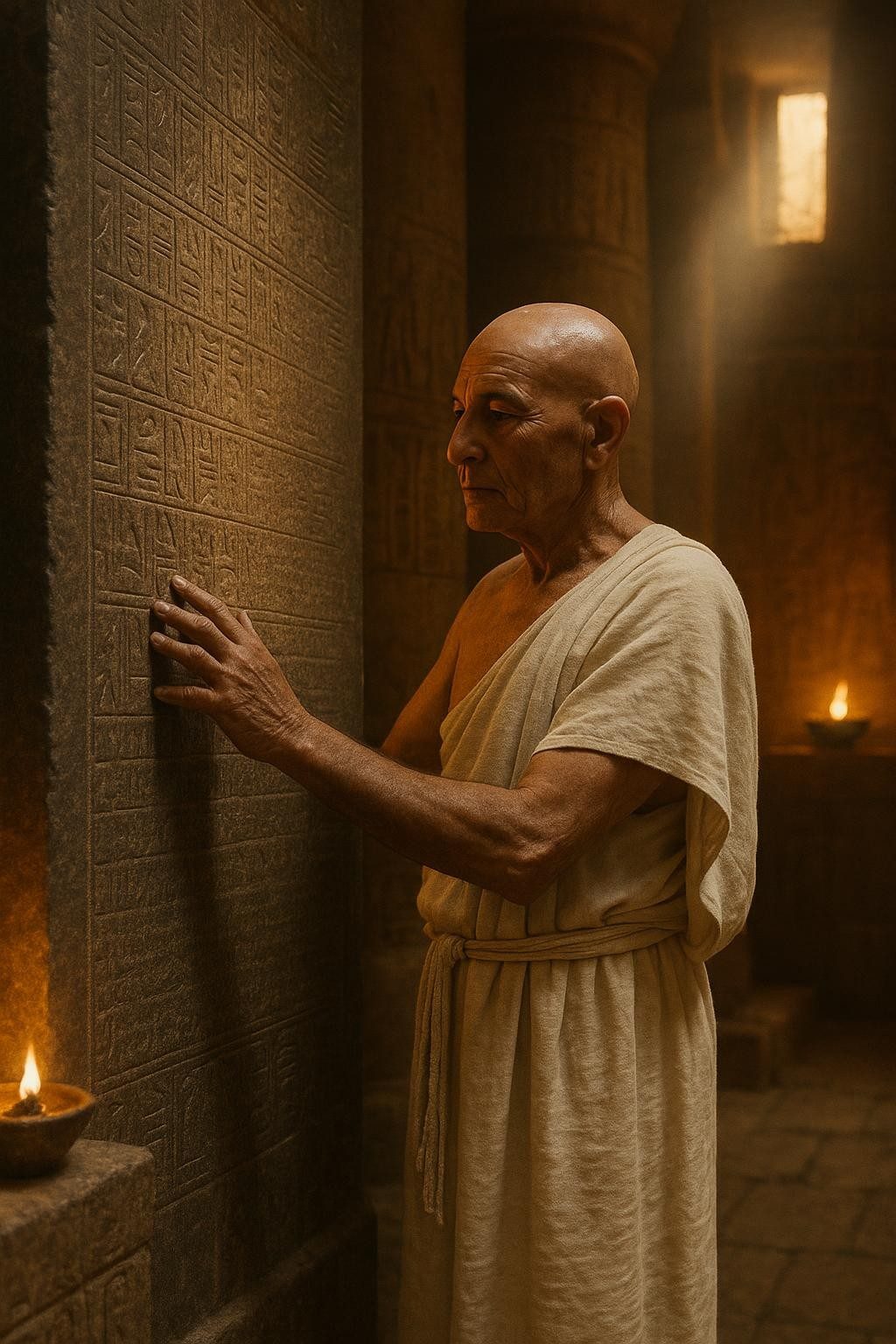
The chisel scraped against stone, releasing a reverberating sound that echoed through the thick air as ancient priests diligently carved words into the polished rock. Emerald and golden sands mixed beneath their feet, a testament to both the Nile’s bounty and the desert’s proximity. But the language etched upon this imposing slab was not just for the whims of the gods; it was a message for the generations, words that would form a bridge across time itself. Little did they know that someday this stone, buried beneath centuries of sand and civilization, would become a beacon for the forgotten land of pharaohs.
The Stone Adrift in Time
In 196 BCE, amid the vibrant world of the Ptolemaic Kingdom of Egypt, a decree was passed — a harmonious symphony of political appeasement and religious decree, an order for the priests to carve the king’s gratitude for the gods into stone. Anchored in the bustling life of that era, languages intertwined — Greek for the conquerors, Demotic for the administration, Hieroglyphics for the gods. The Rosetta Stone was born, its destiny to lie hidden for nearly a millennium and a half, waiting in the shadows as empires rose and fell.
Though the stone lay buried, the world above it continued to evolve. Egypt, once a shimmering titan steeped in lore and legend, became a muted whisper under centuries of conquest and cultural metamorphosis. The hieroglyphs, once vibrant with life on every temple wall, fell silent, their secrets shrouded in time. The grand narratives and minutiae of Egyptian existence locked in undeciphered symbols, waiting for their herald to awaken them from their enchanted slumber.
Years turned to centuries, and the vibrant tales of kings and gods faded into the mystical fog of antiquity. The Rosetta Stone waited; its patiently etched texts still bore witness to an age where language danced with divinity. And then, by the fortuity of military pursuit, the light of understanding would once again shine upon Egypt’s ancient script.
A Soldier’s Discovery
The year was 1799, and France was striding across the sands of Egypt, driven by ambition and dreams of empire. Amid the cacophony of conquest and construction, in the small, unassuming town of Rosetta (modern-day Rashid), French soldiers paused, their shovels striking something unexpected — something solid and mysterious. As the dirt was brushed away, the distinctive ebony surface of a stone slab emerged, etched with an intricate tapestry of texts. Napoleon's men had unwittingly unearthed a legend.
The soldiers, out from their imperial ventures, might not have comprehended the true gravity of their find as they stood amidst the excavated sands, but the academics who accompanied Napoleon knew there was a treasure beyond compare. A stone inscribed with three scripts — each mirroring the other — gathered the curious eyes of linguists and scholars alike, each eager to unzip the dense linguistic tapestry of ancient Egypt.
Gleaming under the Egyptian sun, the Rosetta Stone bore the weight of 14 centuries of lost history. It promised secrets known to no living soul, a time capsule waiting to unfold its story to the modern world. The stone transitioned from a mere slab to an object of reverence, entrusted with the monumental task of bridging an unspoken chasm between ancient knowledge and modern curiosity.
Unlocking Egypt’s Silent Poetry
The road to decipherment was arduous, weaving through years of fervent study, intellectual rivalries, and linguistic breakthroughs. For scholars like Thomas Young and Jean-François Champollion, it was an alchemical journey, turning the mundane script into transformative understanding. But it was Champollion who, with a mind aflame with insight, deciphered the hieroglyphs’ graphical grace, unveiling Egypt’s ancient tales, deeds, and dreams, layer by layer.
In 1822, the fruits of his labor were made tangible. The Rosetta Stone echoed its first whisper since antiquity, its mirrored texts finally offering clarity with the determination of the human spirit. What was once an indecipherable world of gods and kings sprang to life, filling scrolls and chronicles, allowing voices once mute behind stone to sing across the century-hardened void.
The Rosetta Stone became more than an artifact; it was a Rosetta key, a passport to Egypt’s storied past. Temples stirred with stories anew, walls adorned with hieroglyphic art bore names, dates, and histories. It sparked a renewal of Egyptian scholarship, enabling a deeper understanding of a civilization that laid the cultural groundworks of humanity’s past journey.
Today, the Rosetta Stone remains a profound testament to the enduring power of human ingenuity and the unyielding curiosity that drives each generation to explore, understand, and connect with the echoes of the past. The stone serves as a reminder of the countless unsolved mysteries lying beneath our feet, waiting to be discovered, waiting to speak. Amidst the cradle of civilization, silent walls still await the imprint of a priest's timeless hand, waiting patiently for their voice to once again break the silence. As history shows, when we listen closely, the past engages us in a conversation that continues to shape our present and future. The priest read the walls, and Egypt fell silent no more.