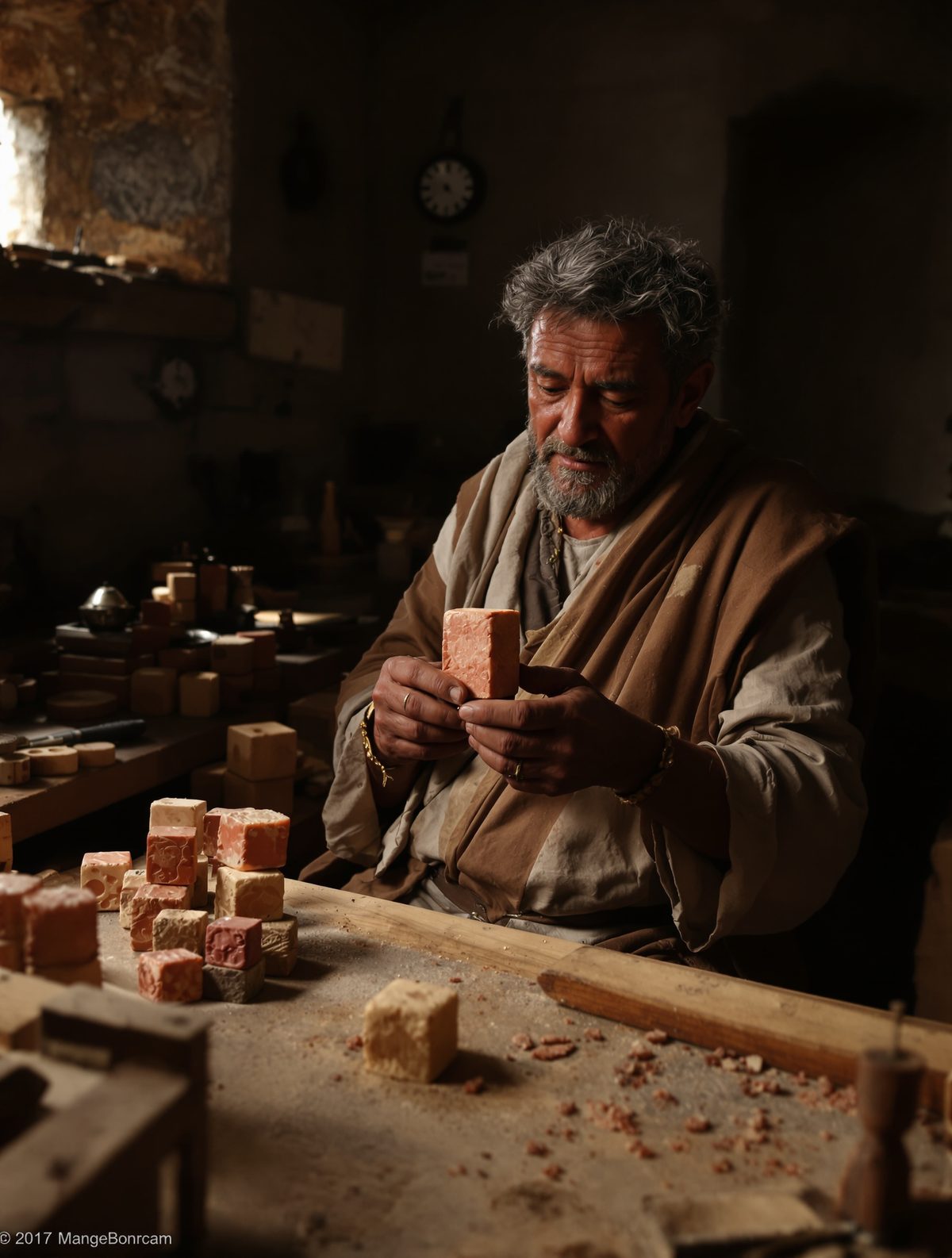
Deep in the emerald shadows of what is now southern Mexico, a master craftsman named Itzel knelt beside a boulder that dwarfed him like a mountain. The year was 1230 BC, and this single block of volcanic basalt weighed forty tons—more than thirty modern cars stacked together. Yet somehow, this one man would transform it into a monument that would outlast empires, puzzle archaeologists, and whisper secrets across three millennia.
What Itzel didn't know, as he raised his stone chisel for the first strike, was that he was about to create one of history's most haunting mysteries. Over the next three decades, he would carve seventeen colossal heads in the Mexican rainforest, each one a masterpiece of impossible engineering. But it was his final creation—the one that bore his own face—that would leave investigators speechless and spawn theories that challenge everything we thought we knew about ancient America.
The Phantom Civilization That Came Before
Before the Maya built their towering pyramids, before the Aztecs ruled their vast empire, there was another civilization that thrived in the humid lowlands of Mexico's Gulf Coast. The Olmecs, often called the "mother culture" of Mesoamerica, flourished from roughly 1400 to 400 BC, yet they remain tantalizingly mysterious.
These weren't primitive hunter-gatherers scraping by in the jungle. The Olmecs developed sophisticated urban centers like La Venta and San Lorenzo, complete with massive pyramid complexes, intricate drainage systems, and ceremonial plazas that could hold thousands of people. They invented the Long Count calendar later adopted by the Maya, pioneered the concept of zero in mathematics, and created the first known writing system in the Americas.
But perhaps their most astounding achievement was their mastery of monumental sculpture. Without wheels, without beasts of burden, without metal tools stronger than copper, they somehow quarried, transported, and carved stones that modern machinery would struggle to move. At the heart of this impossible feat was a single master sculptor whose name has been lost to time—but whose story archaeologists have painstakingly reconstructed through decades of detective work.
The Man Who Moved Mountains
The evidence suggests that one individual—let's call him Itzel, meaning "rainbow" in the ancient Mayan tongue—was responsible for the majority of Olmec colossal heads found at San Lorenzo. Carbon dating of organic materials found embedded in the sculptures places their creation between 1200 and 900 BC. But here's where it gets truly remarkable: microscopic analysis of tool marks reveals identical patterns across multiple heads, suggesting they were carved by the same hands.
Itzel didn't work with convenient local stone. The basalt he preferred came from the Tuxtla Mountains, over sixty miles away through dense rainforest, across rivers, and over terrain that would challenge modern all-terrain vehicles. Each boulder he selected weighed between twenty and fifty tons. To put this in perspective, the Statue of Liberty weighs just 225 tons, and it took massive cranes and ships to install.
How did one man orchestrate the movement of such massive stones? Recent experiments by archaeologist Ann Cyphers suggest the Olmecs may have used a combination of techniques: wooden rollers made from the abundant tropical hardwoods, earthen ramps, and teams of hundreds of workers pulling with rope made from twisted plant fibers. But the precision required to navigate these behemoths through the jungle without damaging them speaks to an engineering genius that modern scholars are only beginning to appreciate.
The Faces That Defy Explanation
Each of Itzel's creations was unique, yet unmistakably part of the same artistic vision. The heads ranged from six to eleven feet in height, with some weighing up to fifty tons. But it wasn't their size that made them extraordinary—it was their uncanny realism and mysterious diversity.
The faces depicted in these sculptures have sparked decades of controversy. Some show distinctly African features—broad noses, full lips, and what appear to be braided hairstyles or helmets with intricate patterns. Others display characteristics that seem more typical of indigenous American populations. A few possess features that don't clearly match any known ethnic group.
This diversity has led to wild theories about ancient trans-oceanic contact. Did African explorers somehow reach the Americas thousands of years before Columbus? The mainstream archaeological community remains skeptical, pointing out that human features vary widely within populations and that the "helmets" might simply be elaborate headdresses denoting different social ranks or spiritual roles.
But here's what makes Itzel's work truly extraordinary: each head bears subtle differences in carving technique that suggest they were created over many years, showing the evolution of a master craftsman's skill. The earliest heads, while impressive, show slight asymmetries and rougher finishes. The later ones display an almost photographic realism that rivals the greatest sculptures of classical Greece—except they were created fifteen hundred years earlier.
The Final Masterpiece and a Chilling Discovery
In 1994, archaeologists working at San Lorenzo made a discovery that sent shockwaves through the academic world. Buried beneath centuries of jungle growth and volcanic ash, they uncovered an eighteenth colossal head—one that had somehow escaped the attention of earlier expeditions.
This final head was different from all the others. While the previous seventeen showed idealized faces of what were presumably rulers or gods, this one was intensely personal. The features were more detailed, more human, more vulnerable. Tool marks around the sculpture suggested it had been carved in secret, away from the ceremonial center where the others had been displayed.
But the most shocking discovery came when archaeologists found Itzel's workshop nearby. Scattered around the site were his tools: carefully shaped hammerstones, copper chisels worn smooth by decades of use, and wooden handles so perfectly balanced they felt natural in the hand. Carbon dating confirmed what researchers suspected—the tools had been abandoned around 900 BC, just when the archaeological record showed the creation of colossal heads suddenly stopped.
The final head, researchers realized, was a self-portrait. Microscopic analysis revealed that it had been carved by the same hands that created the others, but the face looking back at them wasn't that of a god-king. It was the weathered, determined face of an artist who had spent thirty years pursuing an impossible dream.
The Vanishing That Haunts History
What happened to Itzel after he completed his self-portrait remains one of archaeology's most intriguing mysteries. His tools were found exactly where he had left them, as if he had simply set them down one day and walked into the jungle, never to return. There were no signs of struggle, no evidence of illness or injury. He had simply vanished.
Some researchers believe Itzel may have been a spiritual figure whose disappearance was part of a religious ritual. Others suggest he may have fallen out of favor with Olmec rulers and fled to avoid punishment. A few romantic scholars imagine he simply grew tired of carving monuments to others and decided to seek a new life elsewhere.
But the most haunting theory comes from studying the final head itself. Unlike the others, which face various directions, this self-portrait looks directly east—toward the sunrise, toward the Atlantic Ocean, toward unknown lands beyond the horizon. Some researchers believe Itzel may have been planning or participating in an oceanic voyage, possibly explaining both his disappearance and the mysterious diversity of features in his earlier work.
Whatever the truth, Itzel's vanishing marked the end of an era. No more colossal heads were ever created by the Olmecs. The tradition died with its master practitioner, leaving behind only these silent stone witnesses to one man's extraordinary dedication and skill.
Why This Forgotten Genius Matters Today
In our age of power tools and computer-aided design, it's easy to forget that human hands once created wonders that still leave us breathless. Itzel's story reminds us that individual creativity and determination can achieve what seems impossible, even with the most basic tools and techniques.
His colossal heads also challenge our assumptions about ancient America. For too long, the narrative of pre-Columbian civilizations has been one of isolation and primitive simplicity. But the sophistication of Olmec sculpture, the possible diversity of their subjects, and the sheer audacity of projects like moving forty-ton boulders through dense jungle suggest a far more complex and connected ancient world than most textbooks acknowledge.
Perhaps most importantly, Itzel's final act—carving his own face among the gods and kings—speaks to something deeply human that transcends time and culture. After three decades of immortalizing others in stone, he claimed his own place in history. His self-portrait stands as one of humanity's earliest artistic signatures, a declaration that the creator matters as much as the created.
Today, when artificial intelligence can generate art in seconds and 3D printers can replicate any form, there's something profoundly moving about a man who spent thirty years with simple stone tools, creating beauty that has survived three millennia. Itzel's legacy reminds us that true artistry isn't about the sophistication of our tools—it's about the depth of our vision and the persistence of our commitment to making that vision real.