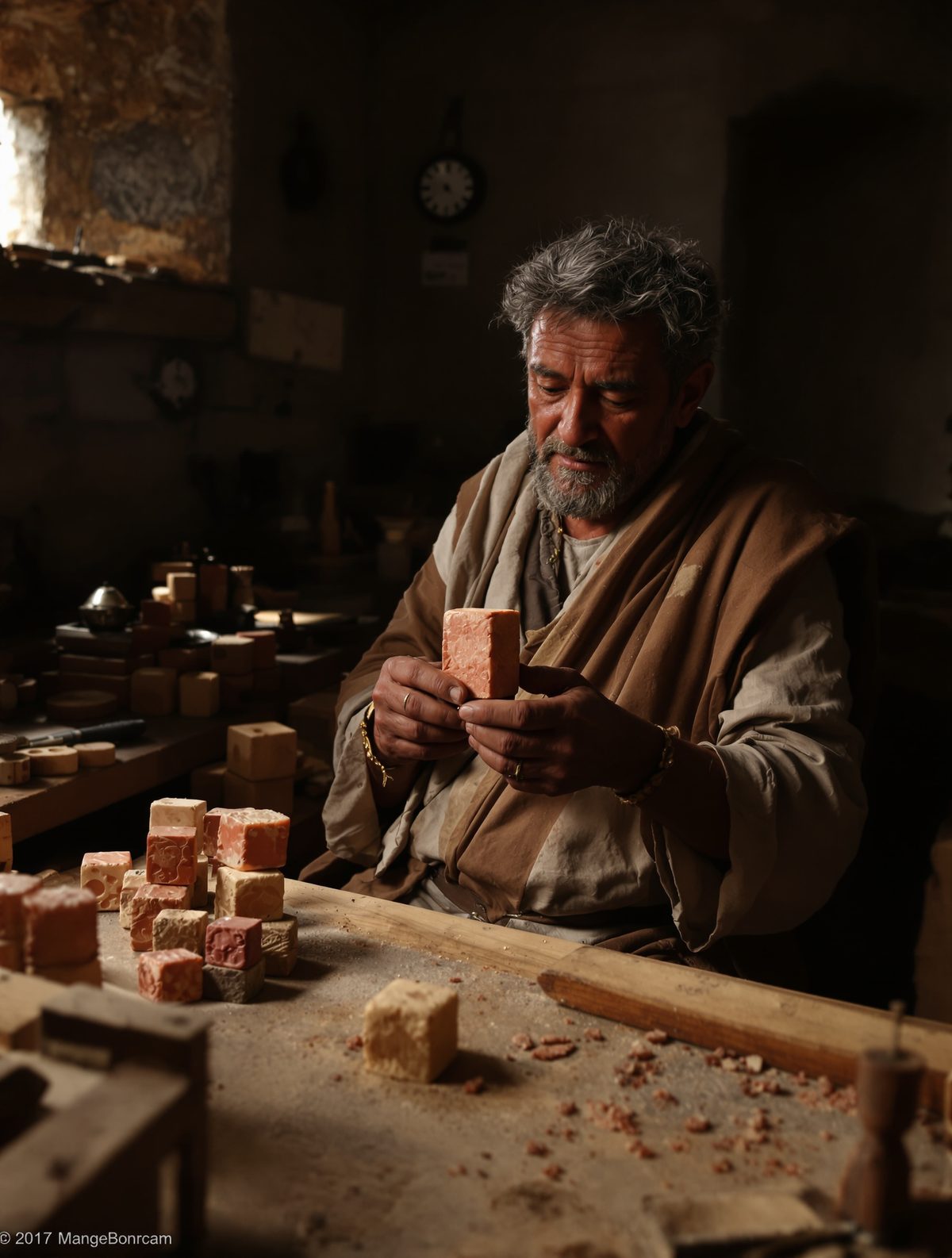
The heavy bronze door hadn't moved in three days. Workers at the merchant quarter of Harappa pressed their ears against the cold metal, hearing nothing but silence from within. Kesh-Ra, the city's wealthiest copper trader, had sealed himself inside his private vault for what should have been a routine counting of his fortune. Now, as the scorching sun of the Indus Valley beat down on the ancient city's brick walls, his workers faced an impossible choice: break down the door of the man who paid their wages, or let him die behind it.
When they finally shattered the bronze hinges with sledgehammers on that sweltering afternoon in 2487 BC, they discovered a scene that would haunt the collective memory of Harappa for generations. There sat Kesh-Ra, cross-legged on the vault floor, his counting stick still gripped in his right hand, surrounded by 40,000 copper coins arranged in perfect stacks of exactly 100 each. He had died doing what he loved most: counting his own wealth, one coin at a time.
The Merchant Prince of the Ancient World
To understand the magnitude of what the workers found that day, you need to grasp just how extraordinary Kesh-Ra was in the context of his time. The Indus Valley Civilization, also known as the Harappan Civilization, was arguably the most advanced society on Earth in 2500 BC. While the rest of the world struggled with basic agriculture, the Harappans had created something unprecedented: the world's first urban planning system, complete with sophisticated drainage, standardized weights and measures, and a thriving merchant class.
Kesh-Ra wasn't just wealthy—he was impossibly wealthy. His 40,000 copper coins represented roughly the equivalent of what 2,000 skilled craftsmen would earn in an entire year. To put this in perspective, archaeologists estimate that the average Harappan family lived comfortably on about 20 copper coins per month. Kesh-Ra's vault contained enough wealth to support 167 families for a decade.
But here's what makes his story truly remarkable: every single one of those 40,000 coins bore his personal merchant's seal, indicating he had personally verified each one's weight and purity. In a civilization obsessed with precision—where bricks were manufactured to exact specifications and weights were standardized across thousands of miles—Kesh-Ra had taken perfectionism to a deadly extreme.
The Vault That Became a Tomb
Kesh-Ra's treasure vault was an engineering marvel in its own right, carved directly into the bedrock beneath his three-story mansion in Harappa's prestigious merchant quarter. The chamber measured exactly 12 by 12 Harappan cubits (roughly 16 by 16 feet), with walls lined in perfectly fitted stone blocks. The bronze door, weighing nearly 500 pounds, could only be opened from the inside—a security measure that would prove fatal.
The vault's design revealed the sophisticated understanding of metallurgy and engineering that made the Harappan civilization so remarkable. Bronze hinges, copper-lined walls to prevent moisture damage, and an intricate ventilation system that should have provided adequate airflow—except when completely sealed for extended periods. The Harappans were master engineers, but even they couldn't overcome the basic physics of human respiration in an enclosed space.
When workers finally broke through, they found evidence of Kesh-Ra's methodical counting process. Clay tablets scattered around the chamber showed his progress: "Day 1: 15,000 coins verified." "Day 2: 28,000 coins verified." The final tablet, found clutched in his left hand, simply read: "Day 3: All counted. All perfect. All mine."
A Civilization Built on Commerce
Kesh-Ra's obsession with his wealth wasn't just personal quirk—it reflected the values of a civilization built entirely on trade and commerce. The Harappans were history's first truly global merchants, with trade networks stretching from Afghanistan to Gujarat, and evidence suggests they even traded with Mesopotamian cities over 1,000 miles away.
Unlike other ancient civilizations that built monuments to gods or kings, the Harappans built monuments to efficiency. Their cities featured standardized brick sizes, uniform street widths, and sophisticated sewage systems that wouldn't be matched in Europe for another 3,000 years. They created the world's first known system of weights and measures, with perfectly calibrated stone cubes used from the Arabian Sea to the Himalayas.
In this context, Kesh-Ra's 40,000 coins represented something unprecedented in human history: portable wealth accumulated through commerce rather than conquest. Each coin was stamped with intricate seals showing his personal symbol—a one-horned bull standing before a ritual brazier—along with Harappan script that archaeologists still can't fully decipher. What we do know is that these seals served as ancient credit cards, allowing merchants to conduct business across vast distances based purely on reputation and trust.
The Mystery of the Perfect Stacks
Perhaps the most haunting aspect of the discovery was the meticulous arrangement of the coins themselves. Despite facing certain death from oxygen deprivation, Kesh-Ra had continued counting and stacking with mechanical precision. Archaeologists found 400 perfect stacks of exactly 100 coins each, arranged in concentric circles around where his body was discovered.
The physical evidence suggests he spent his final hours in an almost trance-like state of counting and recounting. Copper dust on his fingertips indicated he had handled each coin multiple times. More remarkably, analysis of the coin arrangements revealed that he had organized them not just by quantity, but by the purity of the copper—the highest-grade coins formed the inner circles, with quality decreasing toward the outer rings.
This obsessive organization reflects a broader Harappan cultural trait: their absolute devotion to precision and standardization. These were people who manufactured millions of bricks to identical specifications, who created measuring systems so accurate that modern archaeologists use them as benchmarks, who built cities so well-planned that the street grids remain visible from space today.
The Last Merchant of Harappa
Kesh-Ra's death marked more than just personal tragedy—it symbolized the beginning of the end for Harappan civilization itself. Within decades of his death, the great cities began their mysterious decline. Rivers changed course, trade networks collapsed, and the world's first urban civilization slowly vanished into legend.
Archaeological evidence suggests that Kesh-Ra's family attempted to continue his business, but without his personal relationships and trade networks, the enterprise crumbled. His vault was sealed permanently, and his mansion was eventually abandoned like so much of Harappa. When British archaeologists rediscovered the site in 1921, they found his skeleton exactly as his workers had left it 4,400 years earlier—still surrounded by his perfectly arranged fortune.
The Harappan script found on his coins remains one of history's great unsolved puzzles. Despite decades of research and the discovery of over 4,000 inscriptions, no one has successfully deciphered the language that Kesh-Ra used to conduct business across half of Asia. His story speaks to us across millennia, but his own words remain forever silent.
A Mirror to Our Modern Obsessions
Kesh-Ra's death forces us to confront uncomfortable questions about wealth, success, and what we value most in life. Here was a man who had achieved everything his sophisticated civilization considered important: vast wealth, global trade networks, and the respect of his peers. Yet he died alone, surrounded by the very riches that defined his worth.
In our modern world of digital fortunes and global markets, Kesh-Ra's story resonates with surprising relevance. Like today's tech billionaires obsessively tracking their net worth, or day traders glued to screens showing fluctuating numbers, Kesh-Ra represents the eternal human struggle between accumulating wealth and actually living life.
The Harappan civilization disappeared so completely that it took 4,000 years for archaeologists to rediscover it. Despite their remarkable achievements in urban planning, engineering, and commerce, they left behind no great literature, no monumental art, no stories of heroes or gods—only the practical remains of a society devoted entirely to efficiency and profit. Perhaps Kesh-Ra, dying alone with his fortune, represents the logical endpoint of a civilization that valued wealth above all else.
The next time you check your bank account or investment portfolio, remember the merchant of Harappa, still clutching his counting stick in the darkness of his sealed vault, surrounded by everything he thought mattered and nothing that actually did.