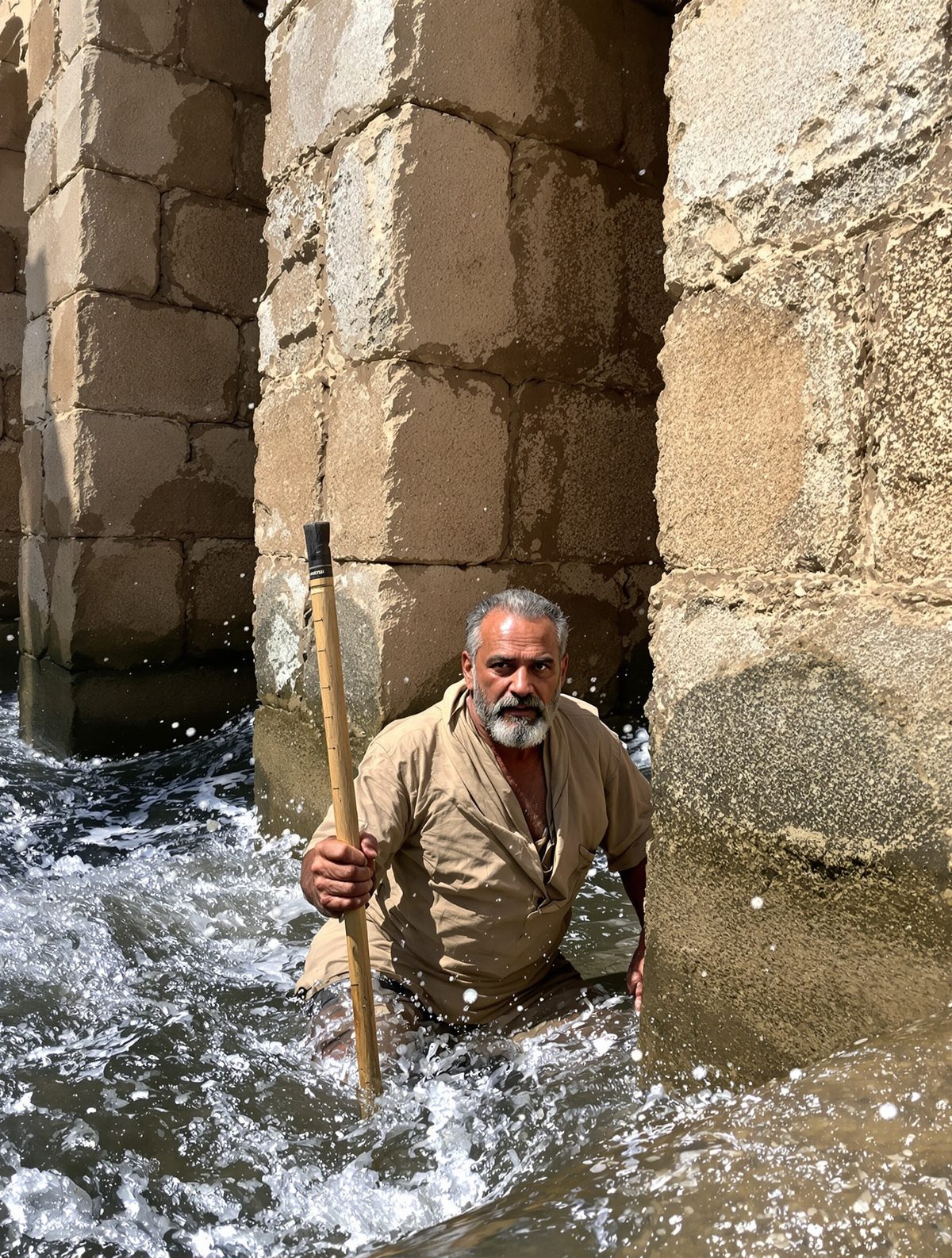
The rhythmic tap-tap-tap of stone against stone echoed through the narrow streets of Harappa on a sweltering morning in 2600 BC. In a modest workshop near the city's great granary, an unnamed craftsman bent over his workbench, carefully chipping away at a cube of red carnelian. His calloused fingers turned the stone with practiced precision, checking each face against a master template. One chip too many, and months of work would be ruined. One chip too few, and merchants across the known world would be cheated.
This anonymous artisan had no idea he was about to change the course of human civilization. With each perfectly measured strike of his bronze chisel, he was creating something that had never existed before: the world's first standardized weights. While other ancient peoples still haggled over handfuls of grain and rough guesses at quantity, he was crafting the building blocks of fair trade, scientific measurement, and economic trust.
Four and a half millennia later, archaeologists would uncover his work buried in the ruins of the Indus Valley. What they found would revolutionize our understanding of ancient commerce and reveal a civilization far more sophisticated than anyone had imagined.
The Mystery of Perfect Precision
When Sir John Marshall's team first excavated Harappa and Mohenjo-daro in the 1920s, they expected to find the usual assortment of ancient artifacts: pottery shards, crude tools, maybe some jewelry. What they discovered instead defied explanation. Scattered throughout the ruins were hundreds of small stone cubes, each one carved with mathematical precision that wouldn't look out of place in a modern laboratory.
These weren't random decorative objects. Every single cube was crafted to exacting specifications, with the smallest weighing exactly 0.856 grams—roughly the weight of a large paperclip. But here's where it gets truly remarkable: every other weight was precisely double, quadruple, or eight times that base unit. The Harappans had created a binary system of measurement 4,600 years before the invention of computers.
Dr. Kenoyer, one of the world's leading experts on Indus Valley civilization, examined over 8,000 of these weights and found something that sent chills down his spine. Despite being created across different cities, different workshops, and potentially different centuries, the margin of error between weights was less than 2%. To put that in perspective, many modern bathroom scales aren't that accurate.
The Workshop That Changed the World
Picture our master craftsman's workshop in ancient Harappa. Sunlight streams through carefully positioned windows, illuminating shelves lined with finished weights in various sizes. The largest specimens—polished cubes of limestone weighing nearly 11 kilograms—sit like monuments to precision beside delicate carnelian pieces no bigger than dice.
But the real treasures lie in his toolkit. Archaeological evidence reveals that Harappan weight-makers used bronze scales so sensitive they could detect differences of less than a gram. They possessed mathematical knowledge that allowed them to calculate ratios and proportions with stunning accuracy. Most remarkably, they had somehow developed quality control standards that ensured uniformity across an area larger than modern Pakistan and northwest India combined.
The process of creating these weights was painstakingly complex. First, the craftsman would select the stone—usually carnelian for smaller weights, limestone or chert for larger ones. The stone would be roughly shaped, then gradually refined using increasingly fine tools. Bronze chisels gave way to bone scrapers, which gave way to polishing stones that could smooth the surface to a mirror finish.
Throughout this process, the weight was constantly checked against master standards. One workshop in Lothal contained what appears to be the ancient equivalent of a quality control laboratory, complete with precision balances and reference weights that never left the building.
A Trade Revolution Carved in Stone
The impact of standardized weights rippled across the ancient world like a commercial tsunami. Before the Harappans, trade was a chaotic affair of rough estimates and constant disputes. Imagine trying to buy grain when every merchant used a different-sized container, or attempting to trade precious stones when "large," "medium," and "small" were the only categories available.
The Harappan system changed everything. For the first time in human history, a merchant in the coastal city of Lothal could send goods inland to Harappa with complete confidence that the buyer would measure them fairly. A bead-maker could craft jewelry knowing that customers 500 miles away would recognize the quality and value of each piece.
Evidence of this revolutionary system has been found from Afghanistan to Gujarat—a trading network spanning over 1.5 million square kilometers. Harappan weights have been discovered in Mesopotamian sites, suggesting that even the Sumerians and Babylonians recognized the superiority of the Indus Valley measurement standards.
But perhaps most remarkably, this system worked for over 700 years. Archaeological layers show that Harappan weights maintained their precision and standardization from approximately 2600 BC to 1900 BC—longer than the entire recorded history of the United States.
The Genius Hidden in Plain Sight
What makes the Harappan achievement even more extraordinary is what archaeologists haven't found. There are no royal decrees mandating standard weights. No evidence of government inspectors ensuring compliance. No centralized authority issuing official measurements.
Instead, the uniformity appears to have emerged organically from a culture that valued fairness and precision above individual advantage. This suggests a level of social cooperation and trust that modern economists struggle to achieve even with extensive regulation and oversight.
The weights themselves reveal other secrets about their makers. Many bear intricate geometric patterns or miniature sculptures of animals—evidence that even the most functional objects were considered worthy of artistic attention. Some include tiny perforations that allowed them to be strung together for easy transport, showing that their creators understood the practical needs of traveling merchants.
Recent analysis using electron microscopy has revealed that some weights were adjusted after completion—tiny amounts of material carefully added or removed to achieve perfect accuracy. This level of quality control wouldn't be seen again until the Industrial Revolution.
The Legacy Written in Mathematics
The mathematical sophistication behind the Harappan weight system continues to astound researchers. The base unit of 0.856 grams wasn't chosen randomly—it represents a precise fraction of the weight of water in a cube with sides measuring one Harappan unit of length. In other words, they had created an integrated system where measurements of weight, volume, and distance were all mathematically related.
This interconnected approach influenced architecture as well. The famous "Great Bath" of Mohenjo-daro was built using brick dimensions that correlate exactly with the weight measurements. Streets were laid out in grids that reflect the same mathematical ratios found in the smallest carnelian cubes.
Even more impressive is the recent discovery that the Harappan system may have influenced weights and measures across the ancient world. The shekel, used throughout Mesopotamia, is suspiciously close to 16 times the basic Harappan unit. Egyptian weights from the Middle Kingdom show similar mathematical relationships.
The Craftsman's Eternal Gift
Our anonymous seal-maker in his Harappa workshop could never have imagined the long shadow his work would cast across human history. In creating those first standardized weights, he laid the foundation for fair trade, scientific measurement, and economic trust—concepts so fundamental to modern civilization that we take them for granted.
Every time you step on a scale, buy groceries, or trust that a medication contains exactly the dosage listed on the bottle, you're benefiting from principles first established in the Indus Valley 4,600 years ago. The next time you use a measuring cup or wonder how pharmaceutical companies ensure consistent pill weights, remember that it all began with one craftsman's obsession with precision, carved into red stone cubes in an ancient city beside the Ravi River.
In our age of global commerce and digital transactions, we might ask ourselves: have we maintained the Harappan commitment to fairness and accuracy? Or have we somehow lost touch with the simple but revolutionary idea that honest measurement is the foundation of honest civilization?