January 23, 1879. The scent of gunpowder and blood hung thick in the air.
As the first light of dawn crept over the shattered landscape of Isandlwana, the somber scene that unfolded was one few could have predicted merely a day before. Lord Chelmsford, having left a portion of his men behind as he scouted forward into Zululand, was heading back towards the site of what would become one of Britain's most infamous military defeats. The night had not been kind either to the survivors of the Isandlwana massacre or the Zulu impi, who were, by all accounts, equally ravaged by their own set of losses.
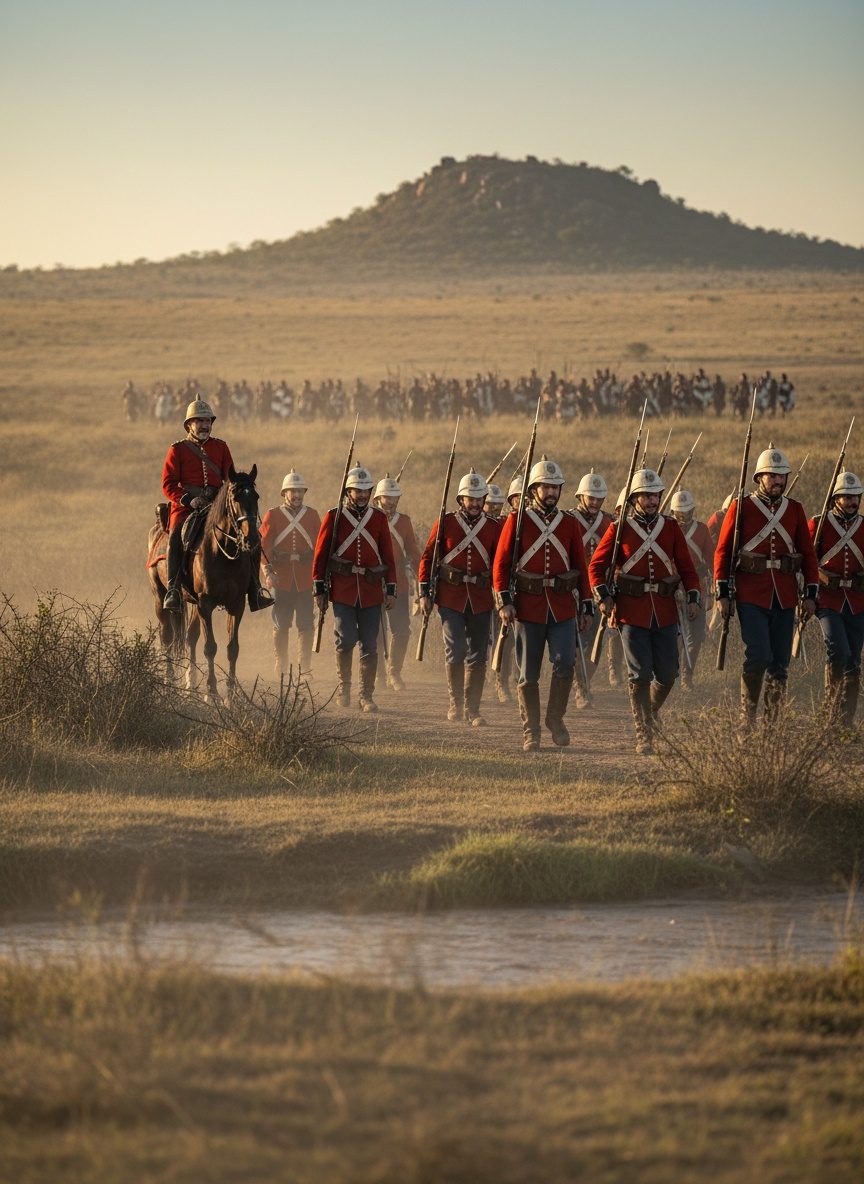
The sound of fatigued footfalls was all that could be heard as Chelmsford's column retraced its steps. The soldiers—those who had seemingly wandered into the annals of catastrophe—were exhausted, grimly clutching their rifles, their faces etched with the haunted expressions that signify the convergence of disbelief and mourning. Just hours earlier, they had been confident of their campaign, but the stark reality of warfare had delivered its verdict with unemotional precision.
Coming up the dusty track toward Isandlwana, Chelmsford's men were not yet aware of the full scale of the destruction. They had expected a battle, a fight prepared under the hastily assembled canvas of war, but what they found could only be described as a fragmented tapestry of chaos. Infantrymen lay strewn across the battlefield, remnants of their encampment blown apart by the mighty Zulu offense, an attack executed with unmatched vigor and strategic supremacy. The British encampment had been eviscerated, its soldiers overtaken by a force that had displayed one of the finest examples of tactical warfare.
Yet the novelty of the scene that morning was not solely the desolation left in the wake of battle, but rather the eerie meeting between Chelmsford's returning column and a Zulu force in full recoil. Neither side expected to meet the other, and yet, under the dawning South African sky, they did—both too drained and too ravaged to engage once more. The Zulus, having fought not only at Isandlwana but through the night at Rorke's Drift, were just as beleaguered as their counterparts. Their retreat from a failed but tenaciously fought night assault mirrored the withdrawal of Chelmsford's column post-encounter.
Here, on this precipice of history where adversaries met yet chose not to clash, was a rare acknowledgment of shared humanity amid conflict's crudeness. Neither side had much fight left, and in that quiet moment, it was almost as though there existed an unspoken truce. This halt was but a temporary standstill, an eye in the storm of a war that would continue to rage between two determined adversaries. For those few moments, though, the weary gazes exchanged perhaps spoke louder than rifles ever could—conveying the mutual comprehension that war spares no man its cruelty.
The Zulu, known for their tactical brilliance and fierce warrior spirit, were an opponent unlike any the British Empire had encountered. Their strategy at Isandlwana, which entailed a full encirclement modeled on the traditional “horns of the buffalo” formation, was executed with devastating effect, obliterating the unprepared British encampment with a force too swift and organized to be stopped. Mixed with no small measure of pride, their exhaustion told a story spun from the rigors of battle—a story that left its own indelible mark.
Walking amid the ruins, the sight of shattered wagons, scattered rifles, and the bodies of fallen comrades filled the soldiers' view. The morning chorus was replaced by the inanimate silence of defeat, broken only by the occasional crackle of a burning tent or the muffled groans of the wounded. Historians would later conclude that much of the British losses could be attributed to a series of fatal miscalculations and underestimations—errors compounded by the absence of key defensive tactics.
Chelmsford, despite the enormity of the tragedy, did not allow despondency to arrest his actions for long. By confronting the aftermath head-on, he sought clarity amidst the loss. While the Zulus receded into the hills with the same silent efficiency that characterized their attack, the British forces made hurried attempts to salvage not just the dignity of their fallen, but the vestiges of a campaign unresolved.
This peculiar intersection of exhaustion and respect marked a turning point in the Anglo-Zulu War, a strange détente amongst the ravages of conflict. It served as a testament to the incredible resilience of human spirit under duress, where neither side fired a shot, though both had the ammunition loaded. It was a silent agreement to differ, for the time being, to collect the broken pieces before re-engaging the chess game of imperial conquest.
The aftermath of Isandlwana changed the course of the war and awoke the British Empire to the reality of fighting on this distant frontier. It was a harsh learning curve, one that prompted a reassessment of military strategy and resources. Despite the shadow of defeat, it instilled a dogged resolve within the British ranks to regroup, reinforce, and reclaim the perceived honor that had slipped from their grasp.
In this quiescent morning's light, the stage was set for events yet to unfold, including the eventual triumphs and a conclusive British victory at the battle of Ulundi later that year. But the story of Isandlwana, shaped by the meeting of Chelmsford's battered column and the retreating Zulu warriors, remains a poignant reminder of the unpredictable nature of war. It is a reminder that in warfare, even the mightiest of empires can be humbled by audacity, and that sometimes in history, the momentary stillness between conflicts can be as telling as the battles themselves.