Aidan of Lindisfarne had nothing. What he built lit the north of England for centuries.
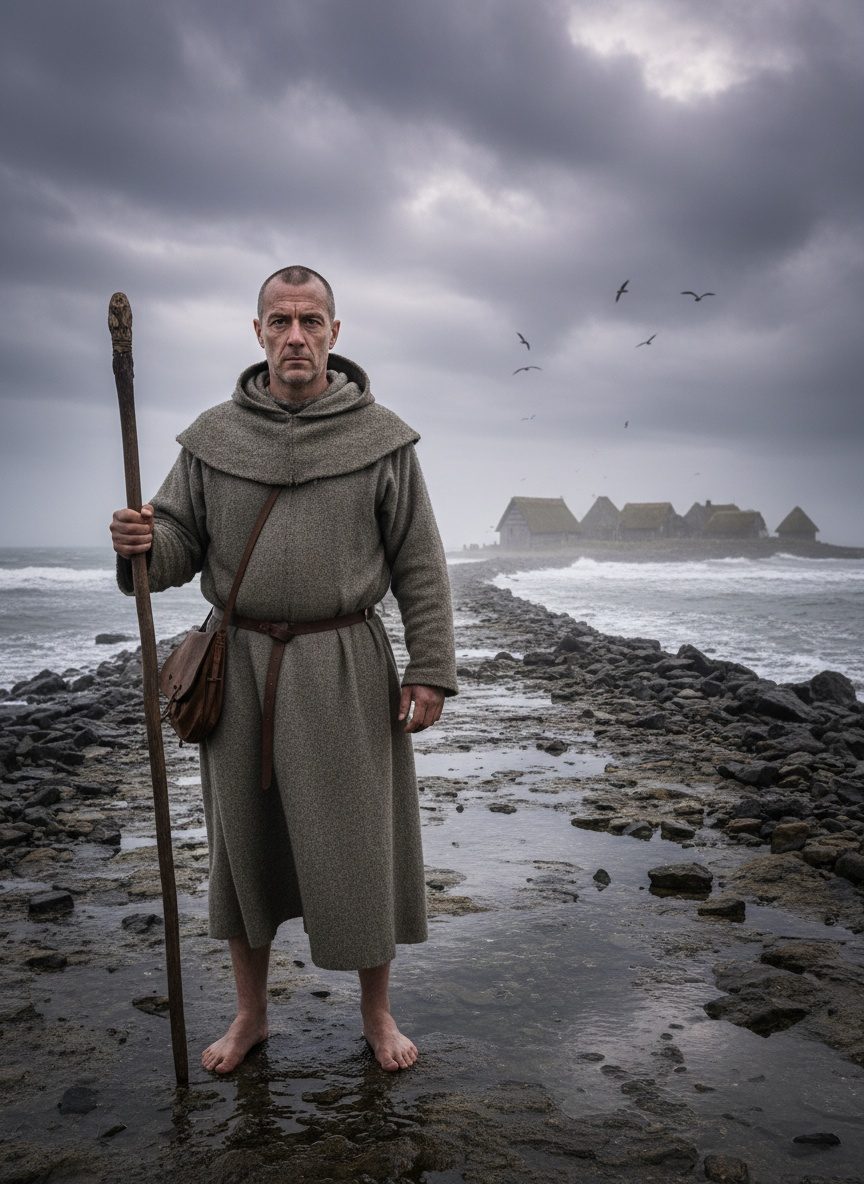
In 635 AD, as the waves of the North Sea crashed relentlessly against the jagged rocks of an island that nearly vanished with the rising tide, a lone figure emerged from a simple coracle. This was Holy Island, Lindisfarne — a desolate, labyrinthine outcrop off the Northumbrian coast where the air was as raw as the land was unforgiving. The man who disembarked was Aidan, a monk with no more than his faith and his mission, yet his arrival on this desolate shore would catalyze a transformation that rippled across the burgeoning kingdom of Northumbria and beyond.
Contrary to illusions of wealth and power, Aidan’s entry into the pagan stronghold of Northumbria was marked by humility and purpose. There was no army to herald him, no fortress to accommodate him, no riches to tempt him. Instead, he chose the remotest, tide-locked rock, clinging to its isolation as a foundation for his work. It was an island that appeared cut off from the world, yet Aidan saw its potential as a beacon of spiritual and educational prosperity. Here, the account of Christianity in the north would be inscribed, letter by letter, voice by voice.
Lindisfarne, in its stark seclusion, was paradoxically central to Aidan’s strategy. This tidal isle was not merely a retreat from the eyes of the pagan populace but a link between worlds — the temporal and the timeless. The selection of such a site was profound in its simplicity. It offered a reflective solitude, necessary for contemplation and study, yet retained proximity to the mainland’s centuries-old pathways, facilitating outreach and mission work. It was a home that breathed hesitancy into the hearts of invaders but espoused its arms wide to the travelers between worlds.
Supported by King Oswald of Northumbria, a Christian convert who recognized the potency of Aidan’s humble zeal, the monk established a monastery that became an epicenter of religious and cultural metamorphosis. From timber and stone, raised amidst the salty gales, the monastery stood not merely as refuge but as a crucible of enlightenment. Within its walls lay a scriptorium where the art of beautiful writing flourished, producing manuscripts that would one day carry the echoes of the island’s impact far beyond the crash of its surrounding waves.
Aidan’s mission was markedly different from those of the missionaries before him. He personified the virtues he preached — preferencing tranquility and kindness over domination and force. Roaming barefoot across the kingdom, he spoke directly with its citizens and soothed their fears, his gentle nature converting hearts where sword and flame had failed. His was an intimate evangelism; he learned the local tongue to better communicate with those whose souls he sought to save, a decision so profound in its respect that it disarmed pagan resistance with empathy.
The fabric of Northumbrian society began to shift as the monastery at Lindisfarne burgeoned. In its halls of learning, scribes painstakingly copied sacred manuscripts, blending the Celtic Christians’ artistry with the deep spirituality of their Latin texts. They fostered a scholastic tradition whose echoes would later mold institutions across the British Isles. Students flocked to Aidan’s educational haven, drawn by the light of wisdom and faith, and in turn, they carried this light into the darkness of misunderstanding and division prevalent in the age.
Particularly intriguing was the influence of Aidan's approach on the socio-political tapestry of the region. By fostering literacy and learning, he established a groundwork that later channeled into governance and rule, essentially reweaving the Northern tapestry to a tune more generous and enduring toward cooperative advancement. His missionaries, disciples trained in Lindisfarne, went on to found religious houses from which both pastoral care and cultural cultivation spread like veins through northern England and beyond.
Aidan's legacy is woven into the story of Lindisfarne itself — a place where spirituality met scholarship in a dance by candlelight. The illuminated manuscripts, such as the Lindisfarne Gospels, testify to a synthesis of Irish, Roman, and native artistry that transcended simple scriptural transmission to become illustrious vehicles of cultural integration. The creative prowess captured in each intricately drawn letter and ornamentation continues to astonish, a visual masterpiece echoing Aidan’s unseen influence across time, testifying to his enduring light.
Aidan's work in Lindisfarne lit a fuse that would burn long after his death with the spiritual flame carried from generation to generation. Whilst waves continue to wash the shores, etching nature's story into its sands, Aidan’s legacy ebbs less than their flow, imparting humanity’s story on the hearts it has touched. It is in these stories, the unsung and unearthed whispers nestled in the chapters of our forgotten past, that the true spirit of a people finds its roots and wings.
His narrative reminds us of the potency and endurance of disarming simplicity — a reminder that substantial, enduring change often stems not from epochs of power, but the solitary, oft-quiet acts of individuals. Thus, the tale of the monk who came with nothing ignites an understanding that faith, respect, and learning—in their humblest forms—remain amongst humanity’s most luminous instruments, capable of softening even the most ardent tides of time.