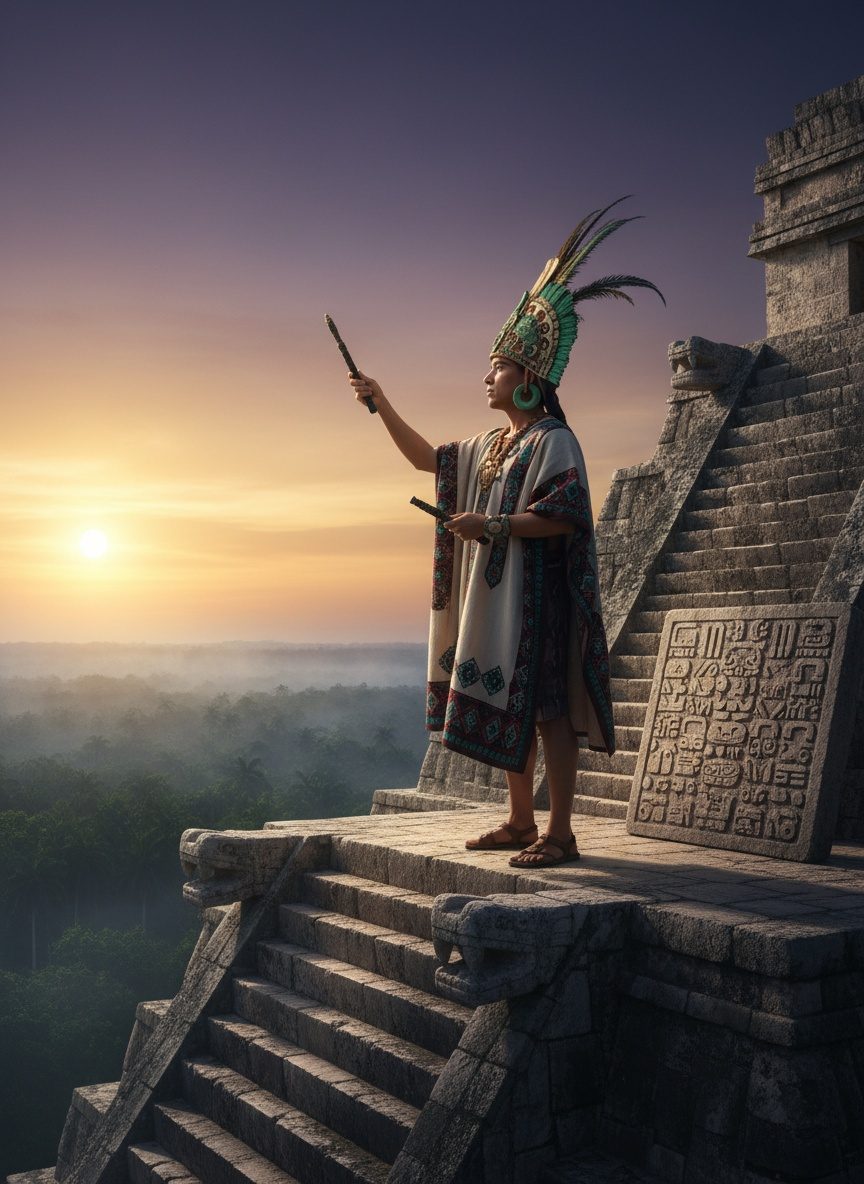
In the pre-dawn hush of an ancient world, as shadows enfolded the grand stone city of Chichen Itza, a solitary figure climbed his accustomed place atop a weathered stone tower. He was a priest, but more than that—a scientist of the stars, a seeker of celestial truths. As the chill of night relinquished its grip, the morning star, Venus, lifted itself into the sky, and the priest watched with reverence and calculation. With an intimacy borne of decades, he noted its position and movement, carving knowledge into stone, etching it into the weave of time. This was no ordinary gaze; it was the birth of an astronomy that would astound future ages.
The Vast City and Its Skyward Secrets
Located in the heart of the Yucatán peninsula, the city of Chichen Itza was a powerhouse of ingenuity and architectural marvel. Built by the Maya during the Classic Period (250–900 AD), this metropolis was not just a center of trade and power but also an arena of scientific and astronomical excellence. Here, amid temples and pyramids, stood the Caracol, an observatory that testified to the Maya's profound connection with the cosmos.
Without telescopes or advanced scientific instruments, Maya astronomers relied on the natural world around them. Their 'laboratory' was the sky, their 'tools' the unaided eye and stone markers perfectly aligned with celestial bodies. Even today, the precision of their constructions, aligned with solar and lunar cycles, reveals a deep understanding of the universe.
The Dance of the Morning Star
Among all the cosmic entities, Venus held a special place in Maya astronomy and mythology. Known as the 'Morning Star' when it rises before the Sun, and the 'Evening Star' when it follows the Sun, Venus was a significant celestial object for the Maya, symbolizing both creation and destruction. The Maya believed Venus influenced human warfare and the fate of kings and kingdoms, embedding it deeply within their cultural and spiritual consciousness.
The cycle of Venus lasts approximately 584 days, and without any modern equipment, Maya astronomers at Chichen Itza were able to track this cycle with staggering precision. By merely observing day after day, they calculated its cycle to within a fraction of a day—their Venus Tables in the Dresden Codex foretold its movements accurately for centuries. Incredibly, these observations predicted Venus's position with an accuracy that would not be matched in the Western world until the Renaissance.
The Legacy of the Astronomer Priest
Each morning, under the vast canopy of the pre-Columbian sky, the astronomer sacrificed the comfort of sleep to plumb the mysteries of the planet Venus. This dedicated priest worked tirelessly, recording risings and settings, creating a celestial map that was the envy of the ancient world. While history has not preserved his name, the legacy of his genius endures in the stone-carved texts and codices that survived the ravages of time and conquest.
The Dresden Codex, one of the few surviving books of pre-Colombian Maya civilization, contains the Venus Table—a testament to the mathematical and observational prowess of the Maya. This document, written on bark paper, encoded a sophisticated arithmetic and astronomic knowledge that dares the modern observer to reconsider the depth of ancient intellectual life.
The Unsung Genius of Maya Astronomy
It is remarkable to consider that, even without modern tools, the Maya had developed a concept of zero and a numeral system that enabled them to make such precise calculations. Their approach was methodical, involving repeated observations and calculations passed down through generations. They did not just track Venus; they understood its significance across temporal and cosmic scales, using it to set the timing of agrarian, ceremonial, and political events.
The ability to precisely predict the motions of Venus was not merely an intellectual exercise—it was a means of ensuring order in both the heavens and the earthly realm. This knowledge asserted the power and prestige of Maya rulers and priests who wielded it, cementing their roles as intermediaries between the divine and mortal realms.
The Cosmic Legacy and Modern Reflection
As we reflect on the achievements of the Maya, it is astounding to recognize how this ancient civilization, without the tools we consider essential, could grasp the intricacies of the stars. Their observations were not merely practical; they were intertwined with every aspect of life and society. The Maya astronomer priest, anonymous yet monumental in his contribution, stands as a figure of both mystery and inspiration.
In a world saturated with digital wonders and constant technological advancement, the story of the Maya astronomer who mapped Venus serves as a humbling testament to human curiosity, intellect, and perseverance. It reminds us of the relentless human pursuit of knowledge, driven as much by the challenge of the unknown as by the desire for discovery. The lessons of ancient Chichen Itza resonate today, urging us to look back at the wisdom of our ancestors even as we chart our path toward the stars.