He was a geographer, not a politician. Yet he navigated the complex world of medieval diplomacy with the precision of a sailor charting new waters.
The Royal Commission in a Turbulent World
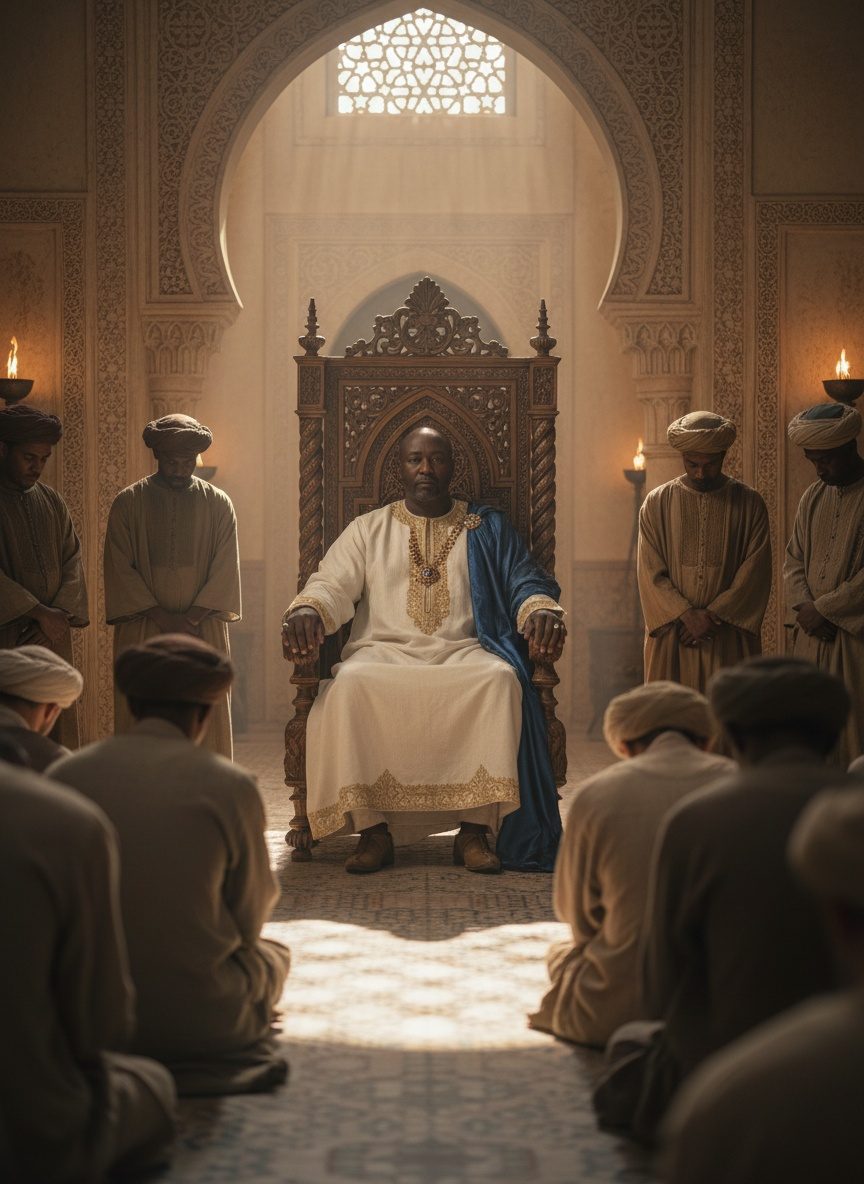
In the year 1138, a Norman king seated on the throne of a faraway island cast his gaze beyond his borders, across the vastness of the Mediterranean Sea. Roger II of Sicily, an ambitious ruler with a taste for the exotic, envisioned bridging the schism between East and West. The corridors of his palace in Palermo echoed with multilingual conversations, a testament to his diverse court inhabited by scholars, poets, and minds from the Islamic world. Among them walked a man named Muhammad al-Idrisi, the world's most revered geographer.
Young al-Idrisi hailed from the city of Ceuta, rich with cross-cultural exchanges, a place where the geographies of continents collided. He had seen the bustling ports where established trade routes mingled with tales of lands that lay beyond the horizon. Enlisting his talents, Roger tasked al-Idrisi with a monumental assignment: to map the world. Such a task called for decades of meticulous research and an understanding of history's most uncharted territories.
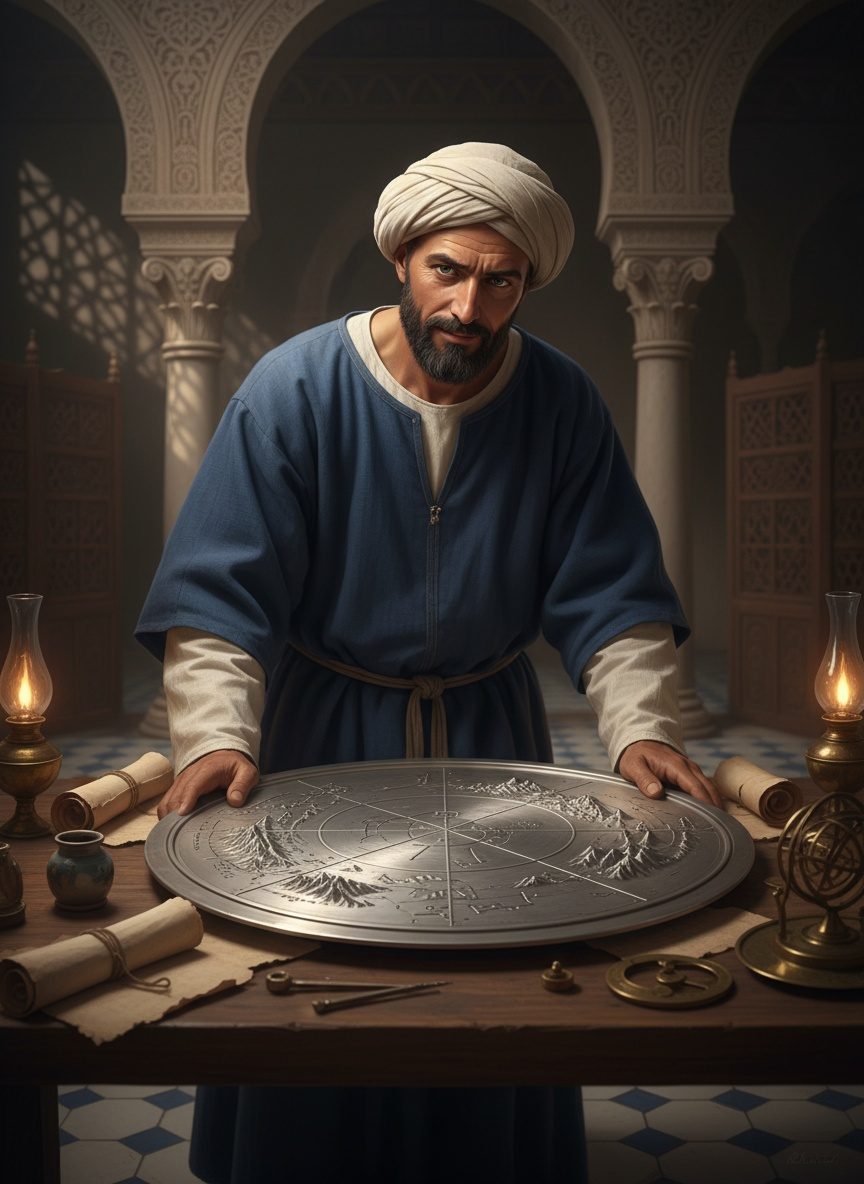
Creating the World in Silver
Al-Idrisi spent fifteen grueling years engraining himself in every detail of the world's geography, making Palermo the epicenter of cartographic innovation. His method was as revolutionary as it was exact; he drew from interviews with traders and voyagers, those whose life work was spent navigating the vast oceans and traversing perilous mountain passes. His pursuit of accuracy required questioning the narratives of mapmakers before him, daring to contradict them when necessary.
The end product was an exquisite 70-piece map, assembled like a vast puzzle, revealing the world in ways unseen before. Most notably, the map was oriented with south at the top—a perspective that reflected the advanced understanding of geography by Islamic scholars, who were not bound by the Eurocentric cartographies familiar to modern eyes. Al-Idrisi's map was engraved onto a disk of pure silver, a choice as much about ensuring the map's longevity as it was a symbol of its value to humanity.
A Library of Wisdom and a Key to the Future
The map became the centerpiece of Roger's opus, housed in the fabled "Tabula Rogeriana," a book of geographic knowledge that compiled al-Idrisi's expansive understanding. The library brought together texts and maps from across the continents, establishing Palermo as a beacon of wisdom during the Islamic Golden Age. Scholars flocked to Sicily to study the work, contributing further to a melting pot of intellectual exchange.
Al-Idrisi's map stood as a foundational text for nearly three centuries, influencing the travel routes of traders and explorers who sought to chart their journeys with unprecedented accuracy. The insights it contained foretold the potential for exploration that would later ignite the famed Age of Discovery, yet during his time, it reflected a peaceful era where knowledge served diplomatic pursuits rather than territorial conquest.
The Mysterious Disappearance
Despite its monumental impact, the map vanished, disappearing into the annals of history much like the civilizations whose stories it chronicled. Theories abound regarding its fate. Some suggest that during the political upheavals following Roger's reign, the map was lost or destroyed by conflict or neglect—much like the forgotten histories it sought to preserve. Others surmise it may have been stolen, hidden away in private collections, or destroyed in fires that consumed much of medieval Europe's accumulated knowledge.
Whatever its fate, the disappearance only adds to the map's enigmatic allure. While written accounts and reproductions of al-Idrisi's work survive, the original silver map's loss leaves a gaping void in historical records. The legends based around its disappearance echo the ambitions and anxieties of its era, capturing the fragility of human achievements.
The Legacy of a Lost Landmark
Today, al-Idrisi is remembered not solely for the precision of his map, but for the larger vision it represented. The task of mapping the world reached beyond mere geography to embrace a broader cultural understanding, urging humanity toward collaboration across divides. In an age where divisive walls were as common as the impassable mountains al-Idrisi mapped, it is a reminder of the pursuit of knowledge for the betterment of all, irrespective of creed or origin.
The story of al-Idrisi and his vanished map serves as a poignant metaphor—a testament to human curiosity and the eternal quest to understand our world. It encourages us to look beyond our present horizons and ask: What do we leave behind, and for whom are we mapping our modern world?