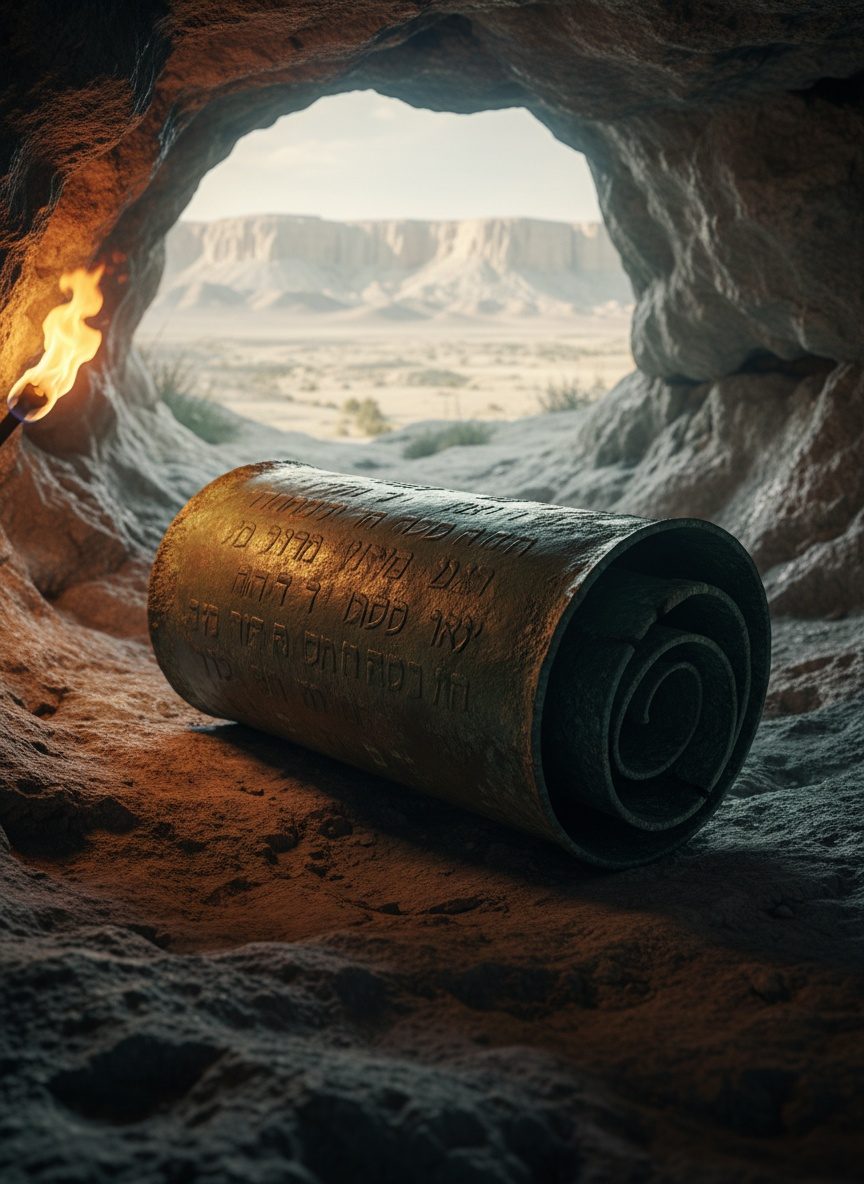
March 14, 1952. The sharp clink of metal against stone echoed through the dimly lit cavern.
The Unearthing of a Metal Mystery
Hidden away in the arid landscapes above the Dead Sea, a team of archaeologists made an extraordinary discovery on that distant March day in 1952. Among the thousands of parchment pieces known as the Dead Sea Scrolls, they discovered something unprecedented: a scroll crafted not from animal skins or papyrus but from the gleaming surface of hammered copper. Its surface was worn but legible and bore inscriptions that seemed to promise untold riches and sacred vessels waiting beneath the soil of ancient Judea.
The Copper Scroll, as it came to be known, was unlike its textual companions, which primarily contained religious manuscripts, tied intrinsically to the sect believed to have lived in the nearby settlement of Qumran. This unique artifact was far from theological. It was, to the shock and thrill of its discoverers, a meticulous list enumerating 64 locations where treasures of gold, silver, and sacred artifacts had been secreted away. Each location cryptically described but firmly rooted in reality, courting a mystery that has fascinated treasure hunters and scholars alike for over seventy years.
Decoding Ancient Clues
Comprised of two rolls of copper that once formed a single, large sheet, the artifact posed a challenge from the very moment of its discovery. Corroded and fragile, it required intricate and painstaking efforts in Manchester, England, to unroll and decipher the text without further damage. What they uncovered was a thrilling inventory of wealth: twenty-two talents of silver hidden under black stone, sixty-five gold pieces buried near Matia's courtyard, and other such tantalizing descriptions.
Yet the specificity of the Copper Scroll was both its allure and its enigma. The place names were real; they referenced locations within the heartland of Judea. But with two millennia passed since its creation, the ancient landscape had shifted; cities morphed, some swallowed by the sands of time. The precise coordinates of these treasures remain as elusive as the ultimate purpose of the Scroll itself.
The Quest for Hidden Riches
The Copper Scroll's promise of untapped wealth soon fired the imaginations of many—archaeologists, historians, and treasure seekers who believed they were on the brink of history's greatest treasure hunt. Expeditions were launched, and metal detectors combed the landscape where the ancient text pointed, yet these quests proved fruitless. Despite the evocative directions, no glint of gold or silver has emerged from the Judean earth.
The intrigue only deepened as scholars battled over interpretations and theories. Some proposed the treasures were offerings from the Second Temple, hidden from Roman invaders who would set upon Jerusalem in 70 CE. Others posited connections to notorious figures such as King Herod or suggested that the treasure had already been found and squandered millennia ago.
Whispers of the Past and Secrets Unveiled
As the sun bakes the parched landscape where history and time converge, this unique scroll continues to whisper tales of lost splendors and sacred vessels, tantalizing in its promise yet steadfast in its silence. Its authorship remains a lingering question: Was it inscribed by the enigmatic Essene community believed to have dwelled in Qumran, or does it trace to early Christians or another sect guarding their secrets in troubled times?
The Copper Factory where it was crafted remains unknown, a piece of its mystique wrapped in the veils of time. Yet, scholars remain captivated, pouring over its text with the hope that new technology or a stroke of insight might someday offer fresh clues. The Copper Scroll perplexes with the simplicity of its premise, yet within those words lies a labyrinth of historical, religious, and personal narratives waiting to be unraveled.
A Legacy of Enigma
Even as the Copper Scroll continues to hold its secrets, it serves as a poignant testimony to the enduring human fascination with mystery, wealth, and the holy. In the dim recesses of Cave 3, where it was found, echoes the eternal whisper of treasures hidden beneath deserts and mountains, inviting us to ponder possibilities beyond what we can see.
Its story reminds us that history is not just a record of what was but a living tapestry, full of undiscovered places and shrouded tales. As explorers and scholars dare to decipher its mysteries, the allure of the Copper Scroll asks us to consider: what other treasures might lie hidden, captivating future generations in the vast and shifting sands of time?