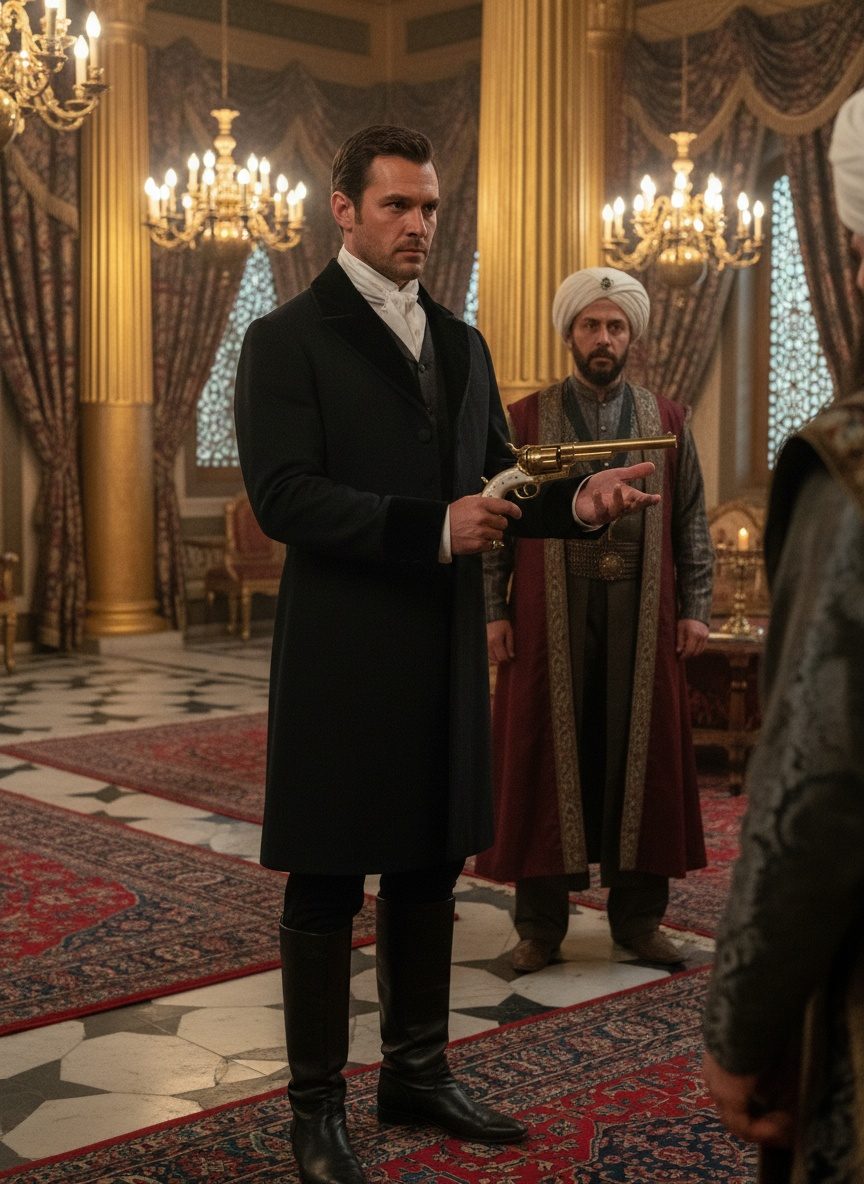
The late afternoon light filtered through the intricately carved windows of the Ottoman Sultan's palace, casting long shadows on the marble floors. Outside, the bustling city of Constantinople hummed with the everyday activities of one of the world's most vibrant trade hubs, where East meets West, and power pulsates at every corner of the Bosphorus. Within the opulent walls of the imperial residence, however, the world of commerce and diplomacy was interwoven with delicate threads of influence and intrigue. Here, in 1849, Samuel Colt, an ambitious American entrepreneur, was about to set events in motion that would reshape modern armament history with a single, daring lie.
The Sultan's Court: A Stage for Diplomacy
Entering the majestic halls of the Sultan's Palace, Colt was a man on a mission. Equipped with nothing but his charm, a finely crafted revolver inlaid with gold, and a tale of Russian interest, he navigated the immense, politically charged landscape of the Ottoman court. This vast and labyrinthine power structure, where layers of diplomacy and tradition combined in complex ways, was both intimidating and intoxicating for an ambitious salesman from America.
Colt had recently faced setbacks in Europe, where resistance to American innovations in firearms was strong. His revolvers, though innovative, still faced skepticism abroad. With the political climate in the Ottoman Empire being one of cautious observation between neighboring powers, Colt saw an opportunity. Playing upon the Sultan's paranoia over Russian expansion and influence, Colt fabricated the story that the Russians were already arming themselves with his revolvers. This cunning move was designed to create urgency and leverage against an imagined arms race, a shrewd tactic aimed at tipping the balance of decision-making in his favor.
A Golden Revolver and a Gilded Tale
Samuel Colt's resolve found its perfect showcase in the weapon he offered. The revolver, not just a piece of military hardware but a work of art, gleamed with golden flourishes, an aesthetic marvel indicative of its cutting-edge mechanism hidden beneath its decorative exterior. The revolver provided Colt with a celebrity-like status, not merely as an arms dealer but as an innovator bringing a touch of Western modernity to the stalwart traditions of Ottoman martial prowess.
The Sultan, intrigued by the craftsmanship and utility of this new technology, found himself drawn into Colt’s narrative of geopolitical chess. By positioning the sale as a competitive necessity, Colt tactically placed his revolvers at the equivalent of a diplomatic fulcrum, allowing him to lead the Sultan to believe that the Ottomans would not just be acquiring firearms, but securing their position in a wider conflict where prestige and power were at stake.
Diplomacy and Deception: Shadows of the Crescent and Cross
While the Ottoman Empire considered its purchase, back in Colt’s homeland, his name was fast becoming synonymous with innovation in armament. Despite the exaggeration and at times outright falsehoods of his tactics, Colt was cultivating international lines of commerce that would stitch him into the economic narrative of nations cautiously watching each other's military advancements.
His claim about Russian purchases, a masterstroke of speculation rather than fact, held just enough plausibility to make the Sultan’s court seriously consider the potential repercussions of action—or inaction. The specter of a technologically advanced Russian army, armed with Colt’s revolvers and marching toward Ottoman borders, conjured images of vulnerability that no ruler of the time could ignore.
The Wakening Arms Race and Colt's Legacy
Unbeknownst to both the Ottomans and the Russians, Samuel Colt’s little lie planted a seed of competition that would resonate throughout the corridors of power in both empires. The Sultan’s eventual order not only brought Colt the commercial success he sought, securing lucrative contracts for his firearms, but also fanned flames of an arms race based more on perception than reality. In this climate of mutual suspicion and strategic maneuvering, nations scrambled to ensure that technological advancements could promise a strategic advantage in a shifting world order.
The sale to the Ottomans marked a turning point, highlighting Colt's role as a catalyst in an arms race provoked by a clever yarn. Over time, his arms would proliferate across continents, equipping the soldiers of numerous countries and further embedding the revolver as a pivotal tool of empire-building. Colt's lie drove home the idea that in diplomacy, perception might often trump reality.
Today, Samuel Colt’s legacy thrives in the shadows of modern warfare and national security strategies built on the foundations of one man’s audacious gamble. His tale is one of vision and deception—an intricate interplay between innovation and intrigue that continues to echo in the international relations of the present, a testament to the idea that perceived threats can sometimes shape global reality as profoundly as actual ones.