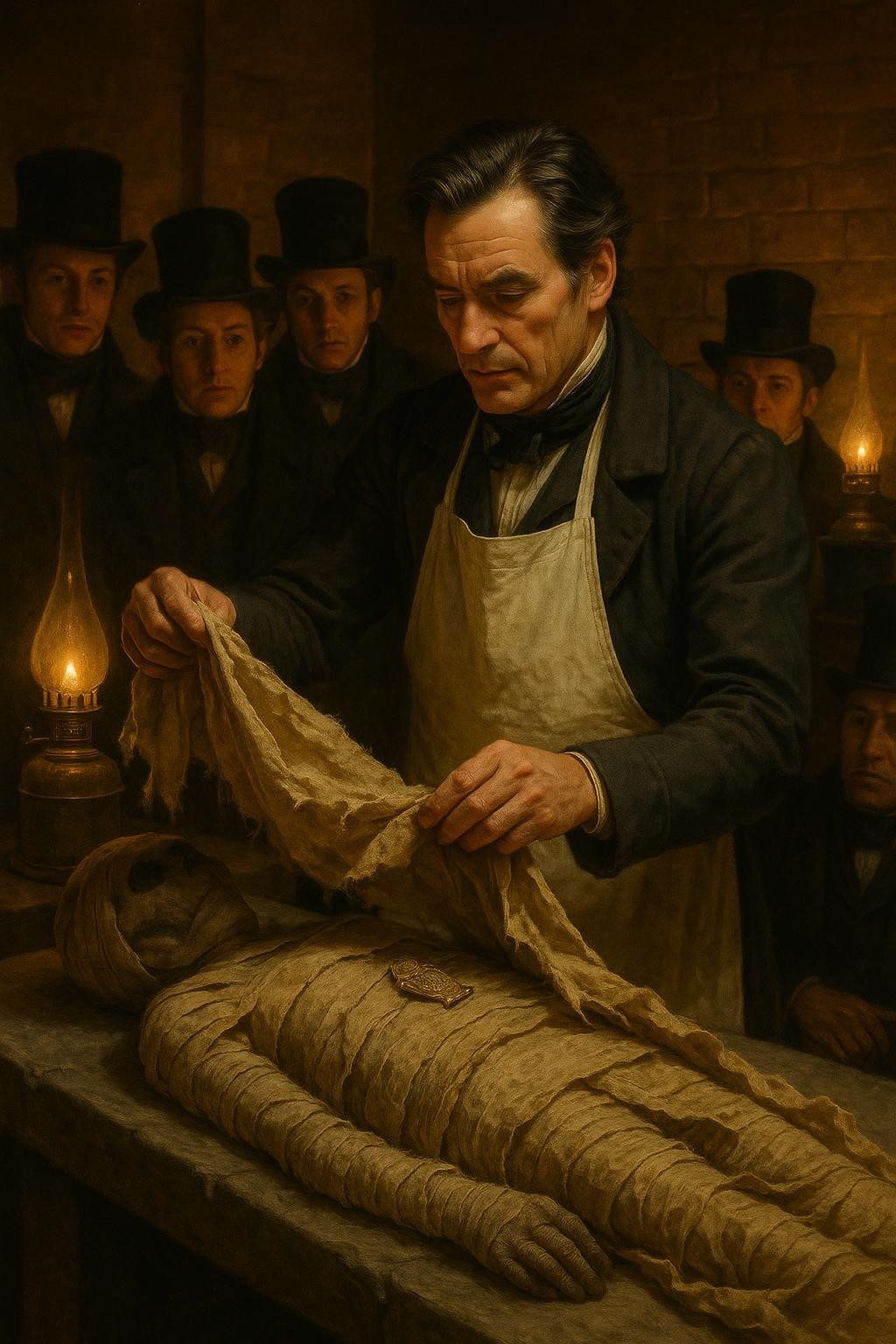
The scalpel glinted under the gaslight as Thomas Pettigrew leaned forward, his face reflecting a mix of anticipation and solemnity. The room brimmed with palpable tension, a hush settled as the eager spectators craned their necks for a better view. Layers of ancient Egyptian linen slowly gave way under the deft movements of Pettigrew's steady hands, revealing a mummified form that had lain untouched for thousands of years. Here, in the hallowed halls of London’s Royal College of Surgeons in 1825, history and science would dance an enigmatic waltz in the eyes of Victorian society.
For the era's sage and curious minds, this moment was not just a macabre entertainment but a gateway to an ancient world. With each unrolling bandage, Pettigrew was not merely unfurling the wraps of a mummy but unraveling the mysteries of a civilization that had long fascinated European scholars and laymen alike. Ancient Egypt's chronicles, written in grand monuments and sacred papyrus, had become a much-admired puzzle in the cultural tapestry of the 19th century. Pettigrew's public unwrappings, an exotic spectacle, synthesized the desires for knowledge, spectacle, and the allure of the mystical past. It was precisely this blend that propelled Thomas Pettigrew's mummy unwrapping into a sensational act of science and showmanship.
Before the audience accumulated in the room, the preserved remains of a man from around 1000 BC awaited discovery beneath the meticulously wrapped linen. The ancient Egyptian belief in the afterlife demanded impeccable preparation of the dead, and their intricate embalming processes promised immortality. As layer after layer was peeled away, traces of resins and funerary unguents infused the air with an unusual fragrance, bridging time across millennia. The crowd inhaled deeply, engaging in a form of communion with a civilization known for its reverence of the dead. What Pettigrew unveiled, however, was far more than mere ancient remains; it was tangible evidence of continuity in human civilization.
Pettigrew's undertaking was as much an encounter with modernity as it was a collision with antiquity. Within the dusty confines of the mummy's wrappings lay charms and amulets, silent witnesses to the beliefs and customs of their erstwhile owner. These trinkets, worn to aid the deceased's journey in the afterlife, spoke volumes to an audience yearning for spiritual and historical enlightenment. In a society increasingly guided by reason and empirical thinking, the unwrapping provided an unparalleled physical link to a culture known primarily through historical texts and archeological finds. Each glint of gold or semi-precious stone garnered gasps from the educated and elite seated around, a testament to Egypt's artistry and a civilization that had mastered techniques which both veiled and revealed life and death.
To Pettigrew, a distinguished surgeon with a peculiar fascination for Egyptian antiquities, these showings were more than mere dissection. They were an opportunity for education, a chance to construct a bridge between ancient worlds and the strides of modern science. He carefully documented his findings, his fingers tracing the hieroglyphics, seeking tales encrypted in the very fabric that bound the mummy. Pettigrew's work was pioneering; he was one of the first to introduce meticulous methodologies that chronicled such discoveries with scientific rigor. While his contemporaries might have found interest in the allure of spectacle alone, Pettigrew realized the potential for genuine archaeological insights.
Among these unanticipated revelations, the rediscovered face of a man, who had lived and thrived in a time when pharaohs ruled the Nile and engineering marvels marked the landscape, was one of eternal curiosity. A figure of slender composition, his skin drawn tight, seemingly stretched by time itself, this man lay undisturbed, a lesson in enduring craftsmanship. Pettigrew's cold, clinical gaze observed the minutiae of joints and bones, marveling at their reconstitution by embalmers who had once believed they were forging permanence.
The audience, entranced by both Pettigrew's diligence and the stories whispered by the past, bore witness to an evolving perspective of history—one where the mystique of eternity met the scrutiny of human inquiry. Until Pettigrew’s deliberate exposure, Britain’s encounters with Egyptian mummies were relegated to the eerie artifact, with curiosity seldom transcending wonder. But as mummified tales of ancient life unspooled, they breathed new vitality into the disciplines of archaeology and anthropology, reshaping how societies comprehended and sought to grasp the concept of preservation and progress.
Though many mummies were unfurled with less caution by those captivated by neither intellect nor science, Pettigrew’s approach made an indelible mark on the practice of Egyptology. He bore testament to what could be learned when historical encounters were grounded in a blend of reverence and curiosity. His unwrapping placed human beings, their lives and afterlives, squarely within a continuum of history rather than relegating them to the romance of myth or mere spectacle.
Long after the room cleared that evening, the legacy of Pettigrew's work persisted and echoed across nations and generations, inviting a re-evaluation of how contemporary eyes saw the enigmatic sands of Egypt. In doing so, Pettigrew not only transformed his audience's conception of what ancient Egypt had been but left behind a legacy of inquiry and fascination that continued to beckon the world to discover what lies beneath the sands. An antique dance of cloth and bone under Pettigrew's skilled hands demonstrated that even the past, with its silence, held lessons and stories waiting to be understood, not just in the relics unearthed but in the context it provided for the ages to come.