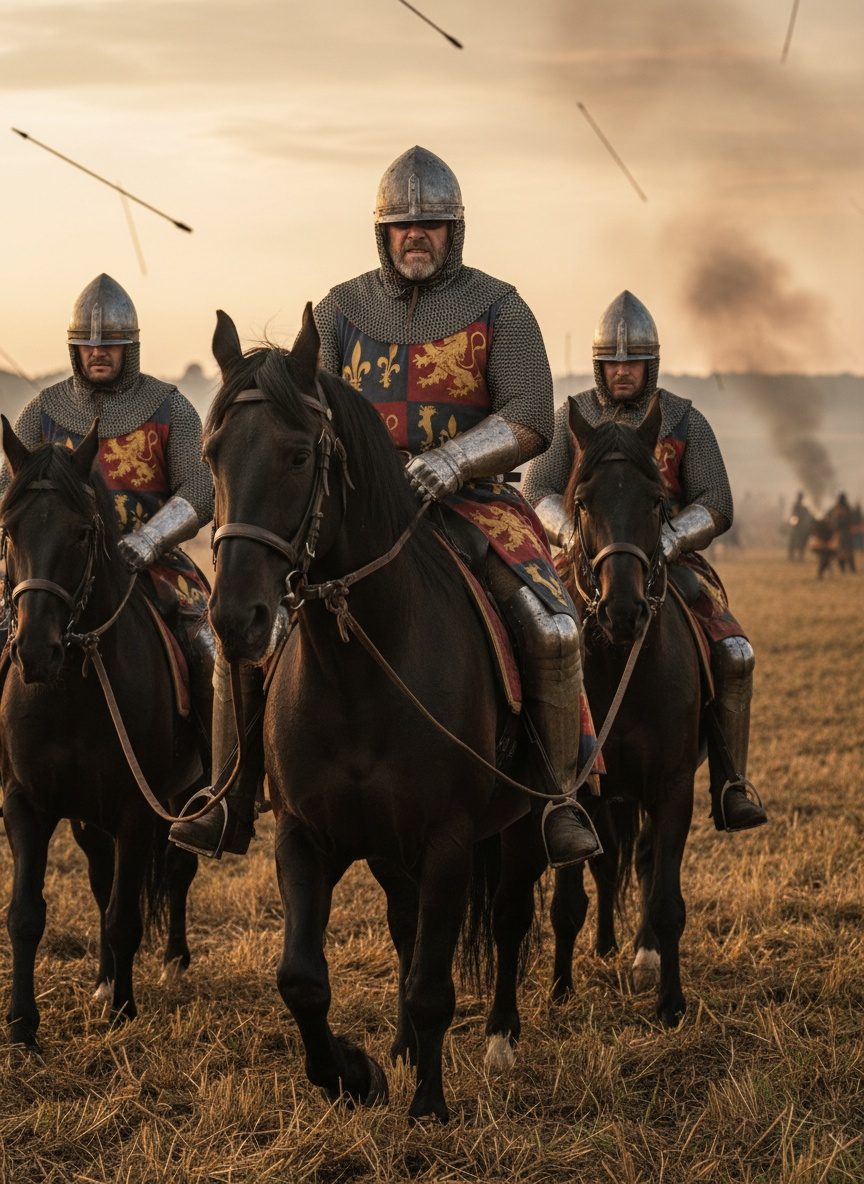
The summer sun was sinking low over the fields of northern France on August 26th, 1346. The air was charged with the deafening chaos of warfare as English longbowmen unleashed a relentless storm of arrows upon the French army at the Battle of Crécy. Amidst this turmoil, a horseman advanced with determination. He was not pursuing glory or victory; his charge was driven by a timeless honor, an indomitable spirit. This horseman was John of Bohemia, a king who led his knights into battle despite being completely blind. His extraordinary story remains one of the most remarkable and poignant tales of medieval chivalry.
The Blind King’s Resolve
Born in 1296, John of Bohemia inherited the throne at a young age, ascending to power in 1310. Regarded as a competent ruler, he established himself as an influential leader in Central Europe, earning the love and respect of his subjects. However, tragedy struck when disease robbed him of his eyesight sometime after 1336. Despite this profound disability, John refused to succumb to a life of idleness. His heart, undeterred by darkness, yearned for the days of heroism and conflict.
John’s moment of fate arrived during the Hundred Years' War, when he allied himself with the French forces led by King Philip VI. At the Battle of Crécy, the complexity of medieval allegiances placed him in direct opposition to the advancing English army under the command of King Edward III. Historic accounts tell of John’s desire to participate in the battle despite his blindness. It was said that he envisioned not just a battle of arms, but a testament of undying valor, one that transcended mere sight.
The Ties that Bound
As the armies assembled, the thunderous cries of men and horses filled the air, and dust rose like ghosts across the fields. John, sensing the urgency and futility of strained loyalties, made a remarkable request to his knights. He commanded them to tether his horse with theirs, so they could guide him into the heart of the battle. With both courage and sorrow, they obliged, knowing that this decision was both hauntingly noble and devastatingly final.
With their horses united, the group of knights plummeted into the enemy lines. It was not just a death march; it was a symbol of medieval chivalry, where the pursuit of honor defied logic and life itself. Their charge was quickened more by loyalty than by the thundering hooves beneath them. John’s blindness did not obstruct his path toward immortality; it became a clarion call that pierced the annals of history.
The Aftermath at Crécy
The English arrows flew with inscrutable precision, cutting through the air with a symphony of deadly intent. The clash of steel mingled with cries of pain and confusion when John, tied to his bravest men, plunged into that ill-fated storm. As history unfolded in the blood and mud of Crécy, daylight relented, drawing the night's curtains over the battlefield.
Come dawn, the grim task of accounting for the fallen began. Among the dead was King John of Bohemia, who was found still bound to his companions, knights who had chosen to ride with their king into the beyond. This powerful testament to loyalty and courage left a deep impression on the world. His action, unwavering against overwhelming odds, was celebrated as a chivalrous act across Europe, giving birth to a legend that outshone his physical deeds.
A Surprise for Many
Among those familiar with the events of the Battle of Crécy, there resides an often overlooked detail: the epitaph that John left behind. It is said that he uttered the words “Ich dien” or “I serve” before he charged. This phrase would later become part of the motto of the Prince of Wales, as adopted by Edward the Black Prince, whose forces would eventually triumph at Crécy. The homage was not to their adversaries' defeat, but to the timeless courage emblematic of John of Bohemia’s final ride.
Even more surprising is the detail that despite being on opposing sides, John had, over his lifetime, forged a bond of respect with King Edward III, previously recognizing him in a different conflict. Such was the paradoxical nature of medieval politics and warfare, where allegiances shifted like sand yet personal honor remained irrevocable.
The Blind King’s Legacy
The story of John of Bohemia refuses to settle into the dusty corners of forgotten history. It continues to resonate well beyond medieval battlefields as a powerful narrative of leadership, loyalty, and determination in the face of insurmountable challenges. His extraordinary resolve and the friendship forged through battles exemplify courage that speaks directly to the human spirit—transcending centuries, borders, and cultures.
Why does John’s tale matter today? In a modern era often viewed through the pragmatic lens of personal gain and societal divisions, his story challenges us to reflect on the deeper values of integrity, courage, and the personal bonds that draw us into noble causes. John of Bohemia saw not through the clarity of sight, but through the clarity of conviction. His saga is a timeless reminder that true vision often transcends what the eyes can perceive. In a world seeking heroes, the blind king’s legacy illuminates the battlefield of the human soul—where the greatest victories are born from within.