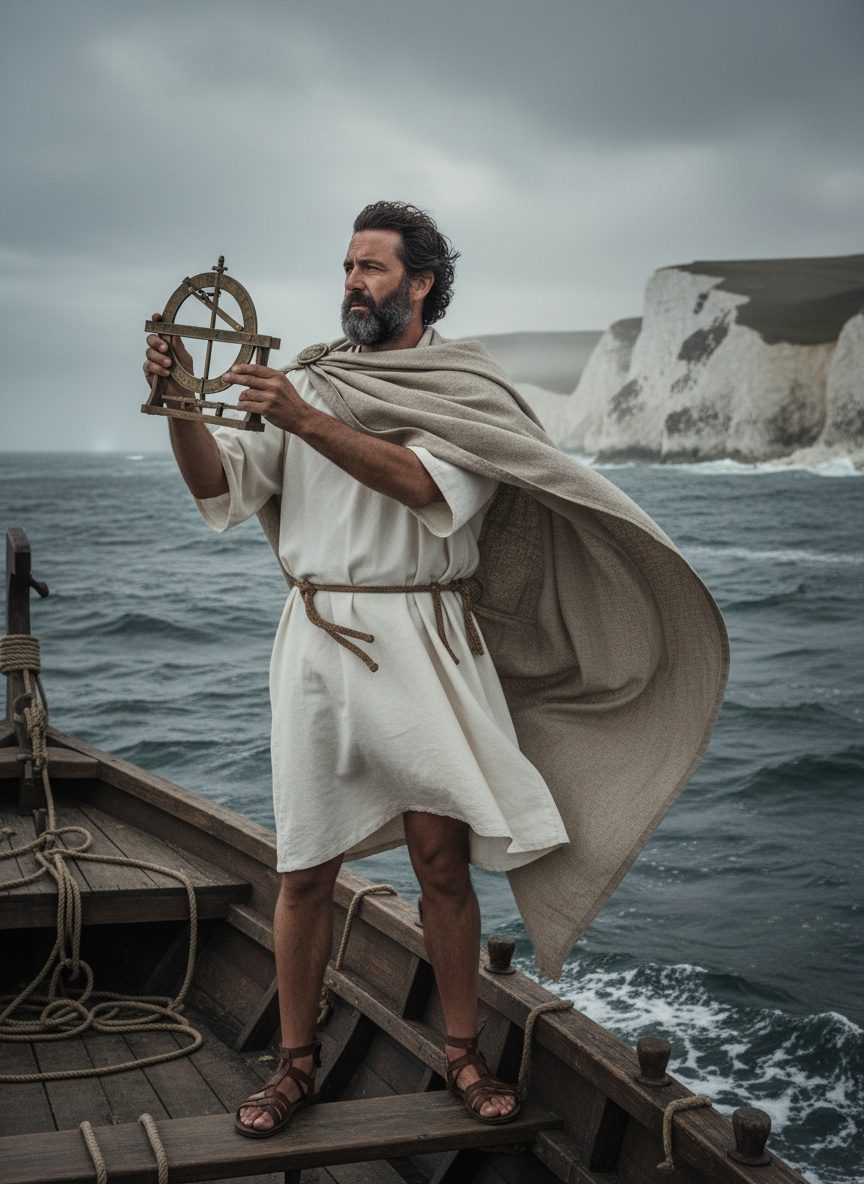
The salt spray stung Pytheas's eyes as he leaned into the wind, feet braced against the deck of his modest vessel. The sea was a mosaic of steel grey and foam, a vast plane of uncharted waters stretching out beneath the enigmatic northern skies. As his ship crested a wave, land loomed on the horizon: the distant coast of a place few Greeks had ever imagined, let alone seen. This was Britain, a mystical and uncharted world to the Greek merchants of Massalia, what is now modern-day Marseille. Pytheas had come not for conquest, but for curiosity — a quest to measure, describe, and understand.
The Merchant Navigator from Massalia
Pytheas hailed from Massalia, a bustling Greek colony nestled on the fringes of the vast Mediterranean. Renowned for its vibrant trade network and thirst for knowledge, Massalia was the gateway to both ancient and mysterious routes. Pytheas was no ordinary merchant; he was a mathematician, geographer, and above all, an adventurer. Unlike his contemporaries, whose voyages centered around established routes through the warm, familiar Mediterranean, Pytheas set his sights on the unknown, the cold, and the untamed.
His expedition took him beyond the well-trod paths of the known world, sailing past the Pillars of Hercules — known today as the Strait of Gibraltar — into the tumultuous waters of the Atlantic. For the first time in recorded history, a Greek explorer penetrated this vast and intimidating ocean, a place of myth and legend where sea monsters lurked and the edge of the world was said to lie. Pytheas's journey was less an act of defiance and more an embodiment of the Greek spirit of curiosity and intellect.
Sunlit Measures and Celestial Calculations
Upon reaching the British Isles, Pytheas did more than just tread new ground. Equipped with rudimentary astronomical tools, he measured the sun’s height at noon to calculate the islands’ latitude. This was not merely a scientific exercise but a testament to the ingenuity of Greek scientific methods. The realization that the world could be measured and comprehended, even in its farthest reaches, was awe-inspiring.
Though the specific instruments Pytheas used have been lost to history, it is known that he applied principles of geometry to his observations. His calculations, noted and preserved through later historians' accounts, placed Britain at a latitude remarkably close to its true position. This endeavor was a cornerstone in the development of geographical science, setting the stage for later explorations and mapping endeavors. Pytheas proved that navigation and exploration could be supported by the application of reason and observation, engendering a legacy of inquiry.
Barley and Beliefs: Encountering the Tribes
Exploration, for Pytheas, was as much about discovery of people as it was about the land. Among the mist-shrouded fields of this nascent world, he met and interacted with the island's tribes, exchanging tales and customs. Pytheas meticulously documented his interactions, characterizing the tribes by their customs, clothing, and diet, most notably their cultivation of barley, which was foreign to many Greeks. The grain, he noted, was used to make a rudimentary ale, a beverage that perhaps bore little resemblance to the wine-savored amphorae of home but was rich with cultural significance.
Pytheas's descriptions of these encounters offer a rare glimpse into pre-Roman Britain, providing insights into the social structures, economies, and agricultural practices of the Native Britons. His narratives stood as a groundbreaking record for generations to come, offering a window into a way of life that might otherwise have faded into the silent folds of history.
Beyond Britain: The Northern Horizon
While Britain was a revelation unto itself, Pytheas’s curiosity led him further north. Driven by tales of a land where the sun scarcely set, he sailed towards what he described as “Thule.” Scholars have speculated Thule to be a reference to the distant Shetland Islands or perhaps even Norway, where extended summer daylight ignites imaginations. This was a voyage to the fringes of the world as known and understood at the time, to a boundary where mythology and reality intertwined. Even in antiquity, the reach of Pytheas extended the conceptual horizon, reshaping the Greek understanding of the world’s geography.
Returning from that ethereal realm, Pytheas carried not only measurements and records but also the whispers of a lands' secrets. His observations of the arctic phenomena were among the first to be noted in Western literature, planting seeds of curiosity that others would eventually follow. Perhaps Pytheas himself did not grasp the full magnitude of his discoveries, but he indisputably expanded the geographic consciousness of his people and those who would come after.
The Legacy of Curiosity and Courage
As Pytheas made his return journey south, braving once more the unpredictable Atlantic squalls, his voyage had forged more than a geographical path. It established a legacy of curiosity—an enduring thirst for knowledge that rippled through the ages. Despite the loss of Pytheas's original writings to the passage of time, references from later scholars kept the spirit of his journey alive, inspiring subsequent generations to look beyond the horizon and question the limits of their world.
Pytheas's journey to Britain serves as a reminder of the transformative power of exploration and the relentless pursuit of knowledge. It is a story not only of discovery but of courage; to chart the unknown requires a willingness to embrace uncertainty and risk. In an era where borders are drawn ever wider, the tale of Pytheas reminds us of the power of seeing the world as it could be, beyond fear and beyond boundaries. He mapped a world that was larger, richer, and more connected than any of his contemporaries had ever imagined. Through his eyes, we can glimpse a vision of what it means to be human: ever curious, ever reaching further. A narrative woven from the threads of courage and enlightenment, Pytheas's story endures—more than a map, it is a beacon guiding the quest for understanding and the ceaseless journey of discovery.