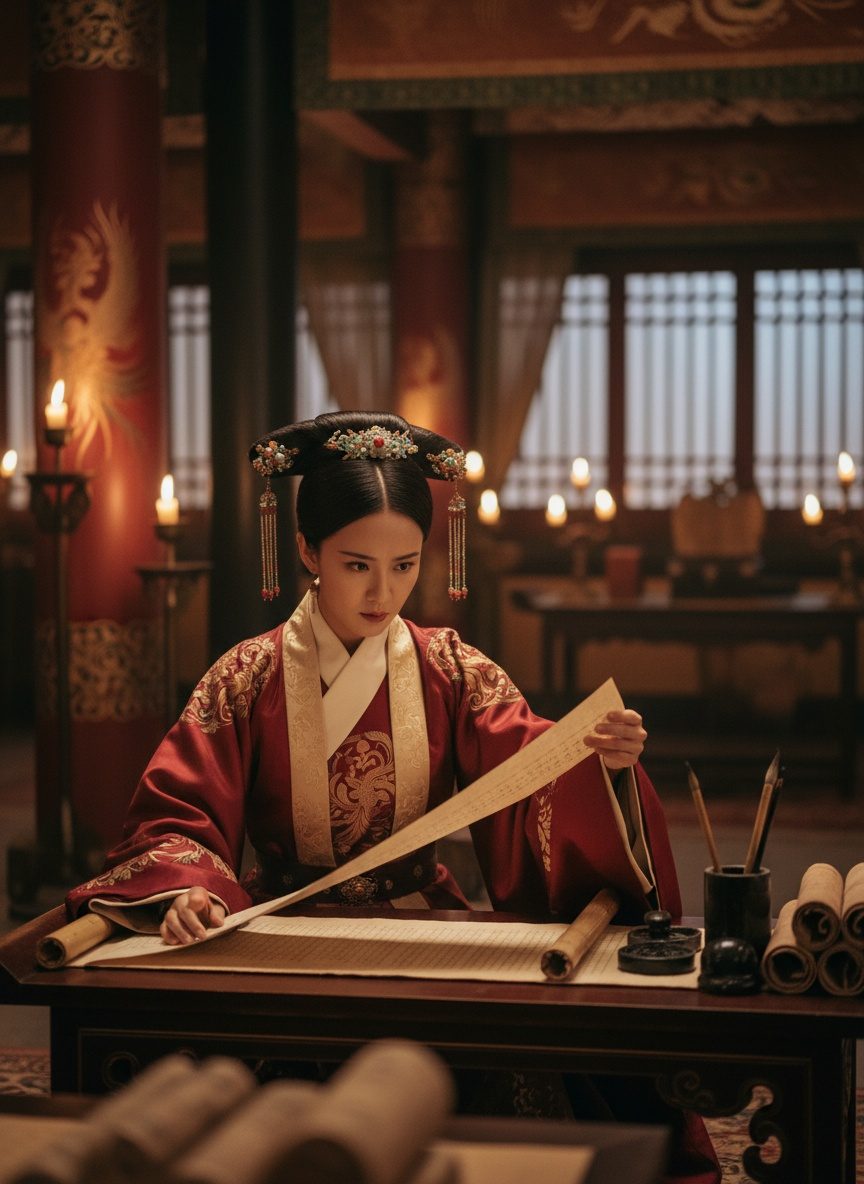
She heard the silk rustle gently against the floor as she moved through the corridors of the imperial palace, her ears attuned to the hushed whispers echoing off the ancient walls. The scent of incense hung heavy in the air, mingling with the faint mustiness of scrolls long sealed away in the palace library. This was her domain, a labyrinth of knowledge where the laws of an empire were encrypted, waiting to be decoded. Wu Zetian, a former concubine, understood that power was written in carefully penned characters by hands that seldom thought a woman might take up the brush and alter their destiny.
Wu had come to the palace young, just another figure in the backdrop of an emperor's fading grandeur. The world around her predicted a quiet, invisible life, shadowed by the events of corridors she would only tread to serve tea or conjure graceful dances. But Wu saw the palace for what it was—a school, a forge, a test of patience and intellect. She remembered the stories, those whispered fragments of the past shared among sisters and eunuchs: how women could be as cunning as they were gentle, and how the past had been rewritten by those brave enough to risk everything.
The Tang Dynasty of the 7th century was a tapestry of innovation and cultural flourishing, yet cloaked within its brilliance were the thick binds of tradition. Each new day presented Wu Zetian with an intricate dance of rituals and routines. But more importantly, it provided her access—what a rare gift it was—to the mind of an empire. In the emperor's library where she spent her hours, volumes clawed through dynastic decrees, liturgical drabblings, and the substantial heft of Confucian ideology. In this chamber of secrets, she forged weapons not of iron, but of wisdom.
For Wu Zetian had realized long ago that power resided not only in the dragon throne but within the hearts and minds that bent to its shadow. Her learning was a quiet revolution. Under the guise of a dutiful concubine, she memorized every statute, every precedence in the scrolls. She understood how laws could be sculpted, bent to new ends, much like the ornate vines embroidered on her silks. It was a delicate dancer’s battle she fought against time and society—one where knowledge was both shield and sword.
After the death of Emperor Taizong, as destiny deemed, Wu was expected to retreat into the shadows of monastic life, a fate nearly inescapable for the women of the court. Yet, what she pressed into her hands at this critical moment was destiny’s beaten path and quietly, she chose to forge her own. Even in seclusion, Wu Zetian was not hidden; she had already sown the seeds of influence deep in the fertile soil of court politics. She secured her place beside the new emperor, Gaozong, rekindling her old role not just as a concubine, but as a confidante who saw far beyond courtly letters.
Unlike many who sat adorned in robes and jewels, Wu's brilliance wasn't merely reflected by what she wore. It shimmered in her unprecedented grasp of diplomacy and courtly strategy. Her rise from concubine to empress was as ruthless as it was meticulously planned, clearing opponents with cunning precision. Ministers who scoffed at a woman's interference soon learned that laws bow as readily to sharp intellect as to power. Blossoming within her was a vision for China that brought her closer to the grandeur of the throne itself.
By 655 AD, Empress Wu had shifted the axis of power. She stood not just as a participant, but as the orchestrator of the empire's fate. Her reforms were as energetic as they were pragmatic, addressing issues that men had skirted around, from community-based taxation to religious oversight. She didn’t just adapt; she reconstructed, using the foundations of past emperors’ wisdom as stepping stones rather than thick-limbed obstacles. Unbeknownst to many, she carried within her a passion for Buddhism, a path to a more inclusive empire.
The challenge Wu Zetian faced was not merely in governing, but in convincing an empire to accept what had never been—a woman leading in her own right. Yet she was wise enough to embed her goals with symbols of tradition, even as she stretched its limits, honoring the balance ancestors always desired. It was a delicate weave she knit, cursed by some and envied by others, yet it held firm against all winds.
Through years of trials and tribulations, betrayals and alliances, Wu Zetian cultivated her might. By 690 AD, she did the inconceivable—ushering the end of the dynasty of her once overlords and proclaiming her own, the Zhou. As the first and only empress to rule China solely in her name, her newfound legitimacy reshaped the very fabric of political norms.
Wu Zetian’s ascent exemplified sagacity cloaked in patience, art forged in the crucible of heritage and foresight. She transformed the very perception of female power, not by force alone, but through an indomitable mind. Her reign remains a testament, inscribed not just in history books, but in the echoes of palatial corridors. She proved that beyond traditions, laws and empires could indeed be remade—a lesson etched where memory and stone converge.
Today, as her narrative seeps through time's fingers, we remember Wu Zetian not merely as a powerful ruler but as a maestro of change, who saw the world not in absolutes, but as a canvas of infinite potential.