April, 711 AD. A sea breeze carried the scent of salt and destiny over the bay as 7,000 men set foot on the land that would change the fate of two continents.
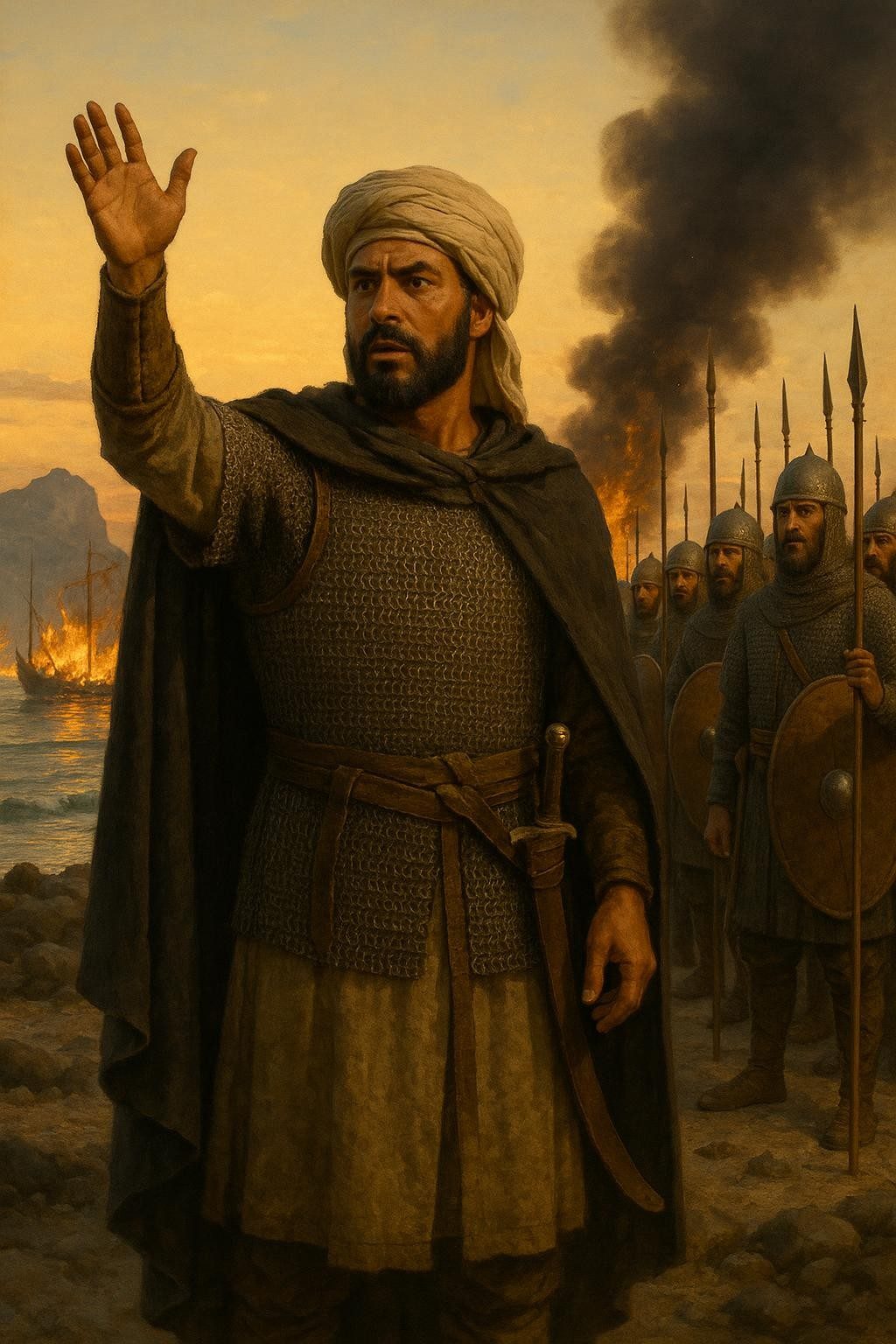
They had crossed the Strait of Gibraltar under the command of Tariq ibn Ziyad, a Berber general serving the Umayyad Caliphate. As his soldiers disembarked on the southern coast of Hispania, Tariq took an audacious step that would echo through the annals of history: he ordered the fleet to be burned. With the ships ablaze, the message was unmistakable—there would be no retreat, no turning back. For these men of North Africa, the only path was forward, into the heart of the Visigothic Kingdom.
This bold move set the stage for one of the most remarkable military campaigns of the early medieval period. Tariq's forces, made mostly of Berber Muslims, found themselves on foreign, yet fertile soil, not only in terms of agriculture but opportunities for conquest. Their adversaries were the Visigoths, a crumbling power weakened by internal strife and vulnerable to external threats.
The land before them was steeped in sleep, like a giant unaware of its own vulnerability. Europe was in the throes of transformation, yet insular, unaware of the storm that had landed on its shores. Tariq, whose very name was to become enshrined in the rock he landed upon—Jabal Tariq, or as it would be known henceforth, Gibraltar—understood the magnitude of his mission. The choice to burn the boats was more than a military maneuver; it was a psychological strategy, eliminating the concept of retreat and reinforcing commitment among his men through dramatic action. There lay only victory or death, a sharp focus that united them under the banner of their cause.
The speech that Tariq delivered to his soldiers by the light of the burning ships was as fiery as the flames that licked at the wood. His words, though now veiled by the mists of time, bristled with resolve, evoking the very immediacy of survival. "The enemy is before you, the sea is behind," he might have reminded them, a sentiment that is timeless in its urgency. With a path only leading forward, they became a force to reckon with, more relentless with the knowledge of having no safety net to fall back on.
The might of the Umayyad forces, under Tariq's strategic brilliance, moved swiftly across the Iberian Peninsula. Unlike the lumbering armies of traditional medieval warfare, their force was fluid, adaptable as the landscapes it traversed. The shock they wrought among the Visigoths was compounded by the domestic issues already fracturing the territory. Civil war, succession disputes, and factionalism had left the Visigoths ripe for the picking.
As Muslim forces advanced, they encountered a land divided, rival kings claiming dominion, yet none prepared for the sudden, sweeping change brought by these external foes. The battle of Guadalete was a crucial tipping point. There, Tariq's smaller, yet highly motivated army, achieved a decisive victory against King Roderic's much larger Visigothic forces, effectively dismantling the resistance at a stroke. The kingdom's disarray was made manifest in defeat, and with that, the Muslim expansion into Europe found solid footing.
The campaign that followed was rapid and surprisingly unchallenged. City after city capitulated or was unable to resist the new order that the Umayyads ushered in. Cordoba, Seville, and numerous other settlements became part of the growing Islamic empire in what seemed the blink of an eye. In the vacuum left by a fragmented Visigothic rule, the newly arrived rulers introduced elements of their own culture, governance, and religion. The terms of conquest by the Muslim forces usually involved agreements that permitted the conquered population to continue practicing their religion in exchange for the jizya, or a tax payable by non-Muslims. Such terms allowed for a relative continuity of life for many locals.
The impact of Tariq's incendiary decision, both literal and figurative, resonated for generations. Europe, a peninsula of many boundaries, suddenly found its southern flank opened to cultural, scientific, and commercial exchanges that challenged the isolated existence it had known. While there are varied opinions on the long-term implications, one cannot ignore the acceleration of change that began with Tariq ibn Ziyad's leap into history.
In the lull of retrospect, one ponders the layered outcomes of such a momentous undertaking. In a single summer, Europe began its transformation; a mosaic of culture, religion, and exchange that seeded miraculous growth in learning and understanding, an era later known as the brilliance of Al-Andalus. This story is more than a mere recounting of military conquest—it is a testament to the transformative power of audacity and unity, and how history so often turns on the simple decisions of its orchestrators. Tariq ibn Ziyad's choice to burn the boats was not just a ploy of desperation; it was a calculating endeavor and an indelible act of inspiration that dared history itself to take notice.