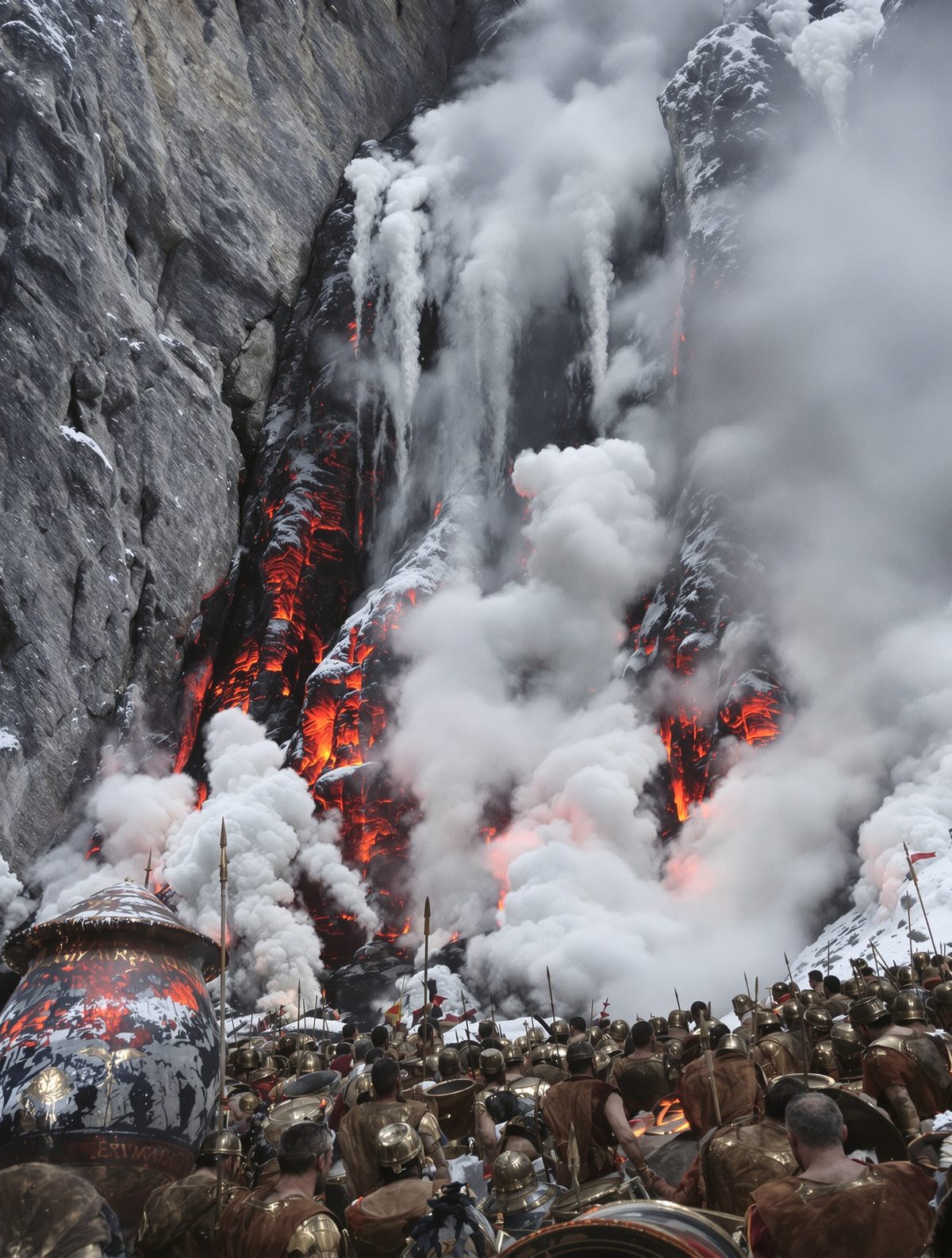
The dust clouds on the horizon looked like a sandstorm, but King Sennacherib knew better. His scouts had been tracking the army for days as it marched north through the desert—20,000 warriors from the heart of Africa, their bronze-tipped spears glinting in the sun, war elephants trumpeting at their flanks. At their head rode a prince barely old enough to grow a beard, yet commanding forces that would soon shake the foundations of the ancient world.
It was 701 BC, and the most powerful empire on Earth was about to meet its match in the most unlikely of places: the walls of Jerusalem, where a young Nubian named Taharqa was preparing to rewrite history.
The Eagle of Assyria Spreads Its Wings
Sennacherib's war machine was the ancient world's equivalent of the Death Star—seemingly unstoppable and absolutely terrifying. The Assyrian Empire stretched from the Persian Gulf to the Mediterranean, built on the bones of conquered cities and the tears of enslaved populations. Their siege engines could reduce stone walls to rubble. Their archers could darken the sky with arrows. Their psychological warfare was so effective that cities often surrendered at the mere sight of Assyrian banners on the horizon.
By 701 BC, Sennacherib had his sights set on the small kingdom of Judah and its fortified capital, Jerusalem. The city's young king, Hezekiah, had made the fatal mistake of rebelling against Assyrian rule. Now Sennacherib was coming to collect—not just tribute, but an example that would echo across his empire.
The Assyrian king had already crushed 46 fortified cities across Judah like a man stepping on ants. Archaeological evidence from Lachish, one of these conquered cities, reveals the brutal efficiency of Assyrian warfare: siege ramps built of stone and earth, walls breached by massive battering rams, and reliefs showing endless lines of captives being led away into slavery. Jerusalem was next, and everyone knew it would be the final act in Judah's brief independence.
But 600 miles to the south, in the golden palaces of Napata, someone was watching. And he was not pleased.
The Black Pharaohs Rise
Here's what they didn't teach you in school: for nearly a century, Africa ruled Egypt. The 25th Dynasty, known as the Black Pharaohs or Nubian Pharaohs, had swept north from their kingdom of Kush (modern-day Sudan) to become the most powerful rulers in the Nile Valley. They didn't just conquer Egypt—they became Egypt, adopting pharaonic traditions while maintaining their distinctly African identity.
Taharqa's uncle, Shabaka, sat on the throne of both Nubia and Egypt in 701 BC, making him arguably the wealthiest and most influential ruler in Africa. The Nubians controlled the gold mines that had made Egypt legendary, the trade routes that connected sub-Saharan Africa to the Mediterranean, and most importantly, they commanded respect through military prowess that stretched back over a thousand years.
The Nubians were no strangers to warfare. Their kingdom had survived and thrived in one of the harshest environments on Earth, forging a warrior culture that prized courage above all else. Their armies were famous throughout the ancient world for their archery skills—so renowned that the Egyptians had once called their land "Ta-Seti," meaning "Land of the Bow."
When news reached Napata that Assyria was threatening to dominate the Levant—Egypt's traditional sphere of influence—young Prince Taharqa volunteered to lead a relief force north. He was approximately 20 years old, battle-tested, and eager to prove himself worthy of the royal blood that flowed in his veins.
March of the War Elephants
Picture this: a 20-year-old African prince leading 20,000 warriors on a march that would cover over 1,000 miles, from the cataracts of the Nile to the hills of Judea. This wasn't just any army—this was a force that combined the military traditions of two great civilizations.
Taharqa's forces included Nubian archers whose accuracy was legendary, Egyptian infantry trained in pharaonic military traditions, and most spectacularly, war elephants. Yes, war elephants—nearly two millennia before Hannibal would shock Rome with his alpine elephant march, African rulers were already using these magnificent beasts as ancient tanks.
The logistics alone were staggering. Moving 20,000 troops, their supplies, and elephants across desert terrain required careful planning of water sources, food depots, and rest stops. Yet Taharqa managed it with the efficiency of a seasoned general, despite his youth. By the time his forces reached the borders of Judah, word of their approach had already reached Sennacherib's camp outside Jerusalem.
The Assyrian king was reportedly unimpressed. His records, carved in cuneiform on palace walls in Nineveh, dismissively refer to the approaching Egyptian and Nubian forces as "archers, charioteers, and cavalry" of "Egypt and Ethiopia"—hardly the words of a man who felt threatened. Sennacherib had crushed Egyptian forces before. How different could these Africans be?
He was about to find out.
The Night That Changed Everything
What happened next depends on which ancient source you trust, but all accounts agree on one thing: it was catastrophic for Assyria. The biblical account in 2 Kings speaks of an "angel of the Lord" striking down 185,000 Assyrian soldiers in a single night. The Greek historian Herodotus, writing centuries later, claimed that mice (or rats) invaded the Assyrian camp and gnawed through their bowstrings and shield straps, leaving them defenseless.
Modern historians suggest a more prosaic but equally devastating explanation: plague. The sudden arrival of Taharqa's forces may have introduced diseases to which the Assyrians had no immunity, or the stress of facing a two-front siege may have triggered an epidemic already brewing in the crowded military camp.
Whatever the exact cause, the result was undeniable. Sennacherib's mighty army—the force that had seemed unstoppable just days before—was suddenly crippled. The king who had never failed to take a city found himself in full retreat, racing back to Nineveh with the remnants of his forces while Jerusalem's walls remained unbreached.
Taharqa had achieved something that seemed impossible: he had forced the withdrawal of the most powerful military force in the ancient world. The young Nubian prince had saved Jerusalem, preserved the kingdom of Judah, and announced to the world that Africa was a power to be reckoned with.
The Ripple Effects Across Empires
The consequences of that night in 701 BC reverberated across three continents. Sennacherib never fully recovered from the disaster. Though he continued to rule Assyria for another two decades, his aura of invincibility was shattered. The empire that had seemed destined to dominate the ancient world had been humbled by a 20-year-old from Africa.
For Taharqa, the victory was just the beginning. He would eventually become pharaoh himself, ruling both Nubia and Egypt from 690 to 664 BC. His reign marked the height of the 25th Dynasty's power, with Nubian culture and influence reaching from central Africa to the Levant. He built temples and monuments throughout his empire, including significant additions to the sacred site of Jebel Barkal in Sudan, which the Nubians considered the birthplace of the god Amun.
Most importantly for world history, Jerusalem survived. The small kingdom of Judah continued to exist, preserving the religious and cultural traditions that would eventually give birth to both Christianity and rabbinic Judaism. Without Taharqa's intervention, the Western world's religious landscape might have looked completely different.
Yet somehow, this remarkable young king has been largely forgotten by popular history. While we celebrate other ancient military geniuses like Alexander the Great or Julius Caesar, Taharqa's name is barely known outside academic circles. Perhaps it's because acknowledging his achievements would require admitting that Africa produced sophisticated kingdoms and brilliant military leaders at a time when Europe was still emerging from the Bronze Age.
The King They Forgot to Remember
Today, as we grapple with questions about Africa's place in world history and the legacy of ancient civilizations, Taharqa's story offers a powerful reminder: the narrative of human achievement has always been more diverse and complex than our textbooks suggest. A young African prince once stood between the ancient world's greatest empire and the destruction of Jerusalem—and he won.
The next time someone suggests that Africa was isolated from ancient world affairs, remember the war elephants marching north through the desert, the 20,000 warriors following their young prince into legend, and the night when the course of three empires changed forever. History, as they say, belongs to the victors—but sometimes, it also belongs to those brave enough to remember the victories that others chose to forget.
In the dusty ruins of Sennacherib's palace at Nineveh, archaeologists have found the king's own account of his campaign against Jerusalem. Tellingly, while he boasts of capturing dozens of other cities, he never claims to have taken Jerusalem itself. Instead, he says he shut up Hezekiah "like a bird in a cage"—the ancient equivalent of claiming you could have won if you'd really wanted to. It's the kind of face-saving language that military commanders have used throughout history when they've been outmaneuvered by someone they underestimated.
Someone like a 20-year-old prince from the heart of Africa, whose war elephants and brilliant tactics reminded the world that true power doesn't always come from where you expect it.