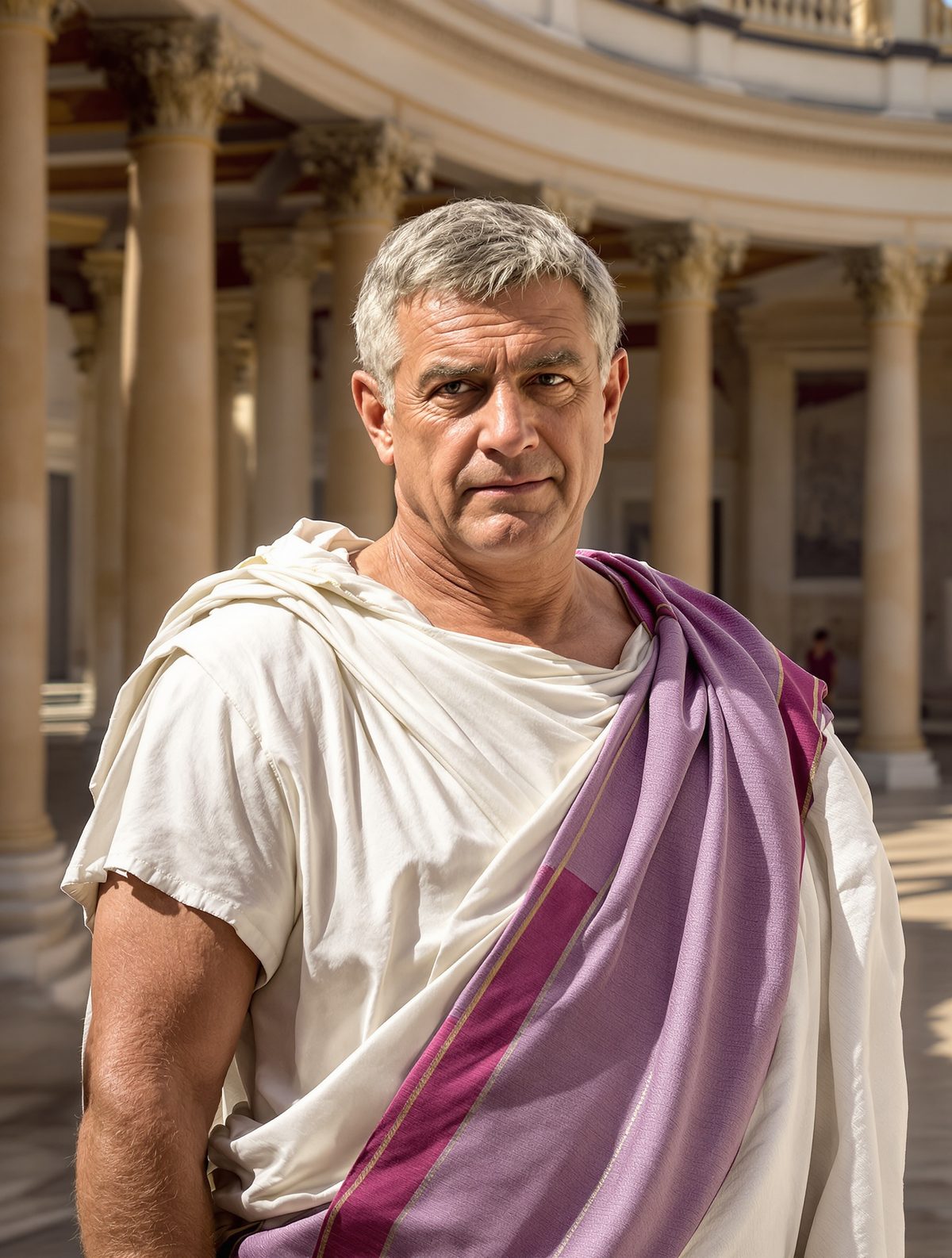
Picture this: It's a sweltering afternoon in ancient Athens, circa 430 BC. The agora buzzes with merchants hawking their wares, philosophers debating in the shade, and citizens conducting the business of democracy. Suddenly, a hush falls over the crowd as an elderly man with wild hair and penetrating eyes stands before them. What he's about to say will shake the very foundations of their world.
"The sun," declares Anaxagoras of Clazomenae, his voice carrying across the stunned gathering, "is nothing more than a glowing stone. Larger than the entire Peloponnese, yes—but merely a rock nonetheless."
The reaction is immediate and explosive. Gasps of horror ripple through the crowd. Someone shouts "blasphemy!" An old woman spits on the ground and mutters prayers to Apollo. The philosopher has just committed what amounts to intellectual suicide in a city where the sun god Helios rides his golden chariot across the heavens each day, where every sunrise is a divine miracle.
But Anaxagoras isn't finished. He's about to become the first person in recorded history to be prosecuted for his scientific beliefs—a cautionary tale that would echo through the centuries, foreshadowing the trials of Galileo and countless other truth-seekers who dared to challenge the accepted order of things.
The Dangerous Mind That Came From the East
Anaxagoras hadn't always been Athens' most wanted intellectual. Born around 500 BC in Clazomenae, a prosperous Greek city on the coast of Asia Minor (modern-day Turkey), he came from wealth but abandoned his inheritance to pursue something far more valuable and dangerous: knowledge.
Around 480 BC, this brilliant young man made a decision that would change both his life and the course of Western thought. He left his comfortable home and traveled to Athens, the beating heart of the Greek world, where democracy was taking its first tentative steps and human reason was beginning to challenge divine explanation.
Athens in the 5th century BC was unlike anywhere else on Earth. It was a city where a cobbler could vote on matters of war and peace, where playwrights like Sophocles explored the deepest questions of human existence, and where philosophers gathered in gymnasiums to debate the nature of reality itself. Into this intellectual cauldron stepped Anaxagoras, carrying ideas so radical they would make even progressive Athenians recoil in horror.
What made Anaxagoras particularly dangerous wasn't just his theories—it was his method. While other philosophers relied on logic and abstract reasoning, Anaxagoras was one of the first to base his conclusions on careful observation of the natural world. When a massive meteorite crashed near the Aegean Sea around 467 BC, most people saw it as an omen from Zeus. Anaxagoras saw it as evidence that the heavens were made of the same materials as Earth.
The Student Who Would Rule an Empire
Among the eager young minds drawn to Anaxagoras' revolutionary ideas was a promising politician named Pericles. This wasn't just any student-teacher relationship—it was a meeting of minds that would shape the Golden Age of Athens and create one of history's most dramatic courtroom confrontations.
Pericles, who would later be called the "first citizen of Athens," spent years absorbing Anaxagoras' rationalist approach to understanding the world. The philosopher taught his pupil that natural phenomena had natural causes, that the universe operated according to discoverable principles, and that human reason could unlock the secrets of existence itself.
These lessons would prove invaluable when Pericles rose to power. His rational approach to governance, his masterful oratory, and his ability to see beyond superstition to practical solutions—all bore the unmistakable influence of his teacher's methodology. Under Pericles' leadership, Athens would build the Parthenon, establish a vast maritime empire, and become the cultural center of the ancient world.
But there was a dark irony brewing. As Pericles' star rose, his teacher's radical ideas were making powerful enemies. The same rationalist thinking that helped create the Golden Age was about to put its originator on trial for his life.
When Gods Become Rocks: The Heresy That Shook Athens
Anaxagoras' cosmic theories read like a ancient science textbook that wouldn't be out of place in a modern astronomy class. He proposed that the sun was a mass of glowing metal or stone, approximately the size of the Peloponnese peninsula—making it larger than most Greeks could even imagine. The moon, he argued, was made of earth and rock, complete with mountains and valleys. Its light was merely reflected sunlight, and its phases were caused by the shadow of the Earth.
Even more shocking, he suggested that the moon was inhabited by living beings. The Milky Way? Just distant stars too far away to see individually. Meteors and comets? Celestial bodies following natural laws, not divine messengers.
To understand how revolutionary this was, imagine someone in medieval Europe declaring that cathedrals were just piles of stone with no spiritual significance. Anaxagoras wasn't just proposing alternative scientific theories—he was systematically dismantling the entire religious framework that gave meaning to Greek life.
The sun wasn't Helios driving his golden chariot across the sky; it was a chunk of burning rock. The moon wasn't Artemis hunting through the heavens; it was a lifeless world not unlike Earth. The stars weren't the gods' jewelry scattered across the celestial dome; they were distant suns burning in the cosmic darkness.
Perhaps most disturbing of all, Anaxagoras proposed that everything in the universe—from the smallest pebble to the mightiest celestial body—was made of the same fundamental materials, mixed in different proportions. This concept, which he called "seeds" or "things," was remarkably close to our modern understanding of atoms and elements. But to traditional Greeks, it was pure blasphemy.
The Trial That Shook the Foundation of Free Thought
By 430 BC, the political winds in Athens had shifted dramatically. The city was embroiled in the early stages of the Peloponnesian War with Sparta, and paranoia was reaching fever pitch. Conservative forces, always suspicious of Pericles' progressive policies, saw an opportunity to strike at the great statesman through his teacher.
The formal charge against Anaxagoras was asebeia—impiety against the gods. But everyone understood what was really happening. This was political warfare disguised as religious prosecution. By attacking Pericles' mentor, his enemies hoped to undermine the leader himself and shift Athens toward a more conservative, traditional path.
The trial was a sensation that gripped the entire city. Here was the man who had taught their greatest leader, whose ideas had influenced a generation of Athenian intellectuals, standing accused of denying the very gods who protected their city. The prosecutor painted him as a dangerous foreign influence who had corrupted Athenian youth with his impious theories about the cosmos.
Picture the scene: the elderly philosopher standing before hundreds of citizen-jurors in the agora, the same space where he had once lectured eager students about the wonders of the natural world. Now those same citizens were deciding whether his quest for knowledge deserved death.
The evidence against him was damning in their eyes. He had publicly declared that the sun was a stone, that the moon was made of earth, that the gods played no role in celestial phenomena. Witnesses testified to his shocking claims about the nature of reality. His own students' notes were read aloud as evidence of his heretical teachings.
The Great Defender and the Impossible Choice
Just when it seemed that Athens might execute one of history's greatest early scientists, Pericles stepped forward. The most powerful man in Athens, at the height of his influence and prestige, chose to risk everything to defend his old teacher.
Pericles' defense was masterful, combining emotional appeal with practical politics. He reminded the jury of Anaxagoras' contributions to Athenian intellectual life, his role in educating the city's leaders, and his decades of service to the pursuit of knowledge. More cunningly, he made it clear that attacking Anaxagoras was really an attack on him—and by extension, an attack on the democratic institutions and imperial ambitions that had made Athens great.
The defense worked, but only partially. Faced with the combined pressure of Pericles' political machine and the genuine respect many Athenians held for the elderly philosopher, the jury agreed to a compromise. Instead of death, they would offer Anaxagoras a choice: publicly recant his theories and submit to the religious authorities, or accept exile from the city he had called home for nearly fifty years.
For a man who had sacrificed his inheritance, his homeland, and his safety in the pursuit of truth, there was really no choice at all. Anaxagoras chose exile.
The Rock That Started an Intellectual Revolution
In 430 BC, as Anaxagoras gathered his few possessions and prepared to leave Athens forever, few could have imagined the profound impact his "heretical" ideas would have on human civilization. The old philosopher, now in his seventies, settled in Lampsacus on the Hellespont, where he was welcomed as a honored teacher rather than feared as a dangerous heretic.
But his influence had only just begun. His student Pericles continued to apply rational, scientific thinking to governance, helping to create the democratic ideals that would eventually spread across the world. Other students carried Anaxagoras' methods to different cities, planting seeds of scientific inquiry that would eventually bloom into the work of Aristotle, Archimedes, and countless others.
The meteorite that had first inspired Anaxagoras to question the divine nature of celestial objects was right there in plain sight, a chunk of cosmic debris that anyone could examine. But it took a special kind of courage to look at that rock and see not the anger of Zeus, but evidence of a vast, material universe operating according to natural laws.
Today, as we watch the sun set knowing it's a nuclear furnace 93 million miles away, as we plan missions to the rocky, cratered moon that Anaxagoras described with stunning accuracy, as we discover exoplanets orbiting distant stars he correctly identified as other suns, we're living in the world that began when one brave philosopher looked up at the sky and saw not gods, but nature.
The trial of Anaxagoras stands as a eternal reminder that the pursuit of truth has never been safe or easy. Every major scientific breakthrough—from heliocentrism to evolution to climate science—has faced the same choice between comfortable mythology and uncomfortable reality. And in every case, the courage to choose truth over tradition, fact over faith, has ultimately moved humanity forward.
Sometimes, the most dangerous thing you can do is simply tell people that the sun is just a rock. Even when you're absolutely right.