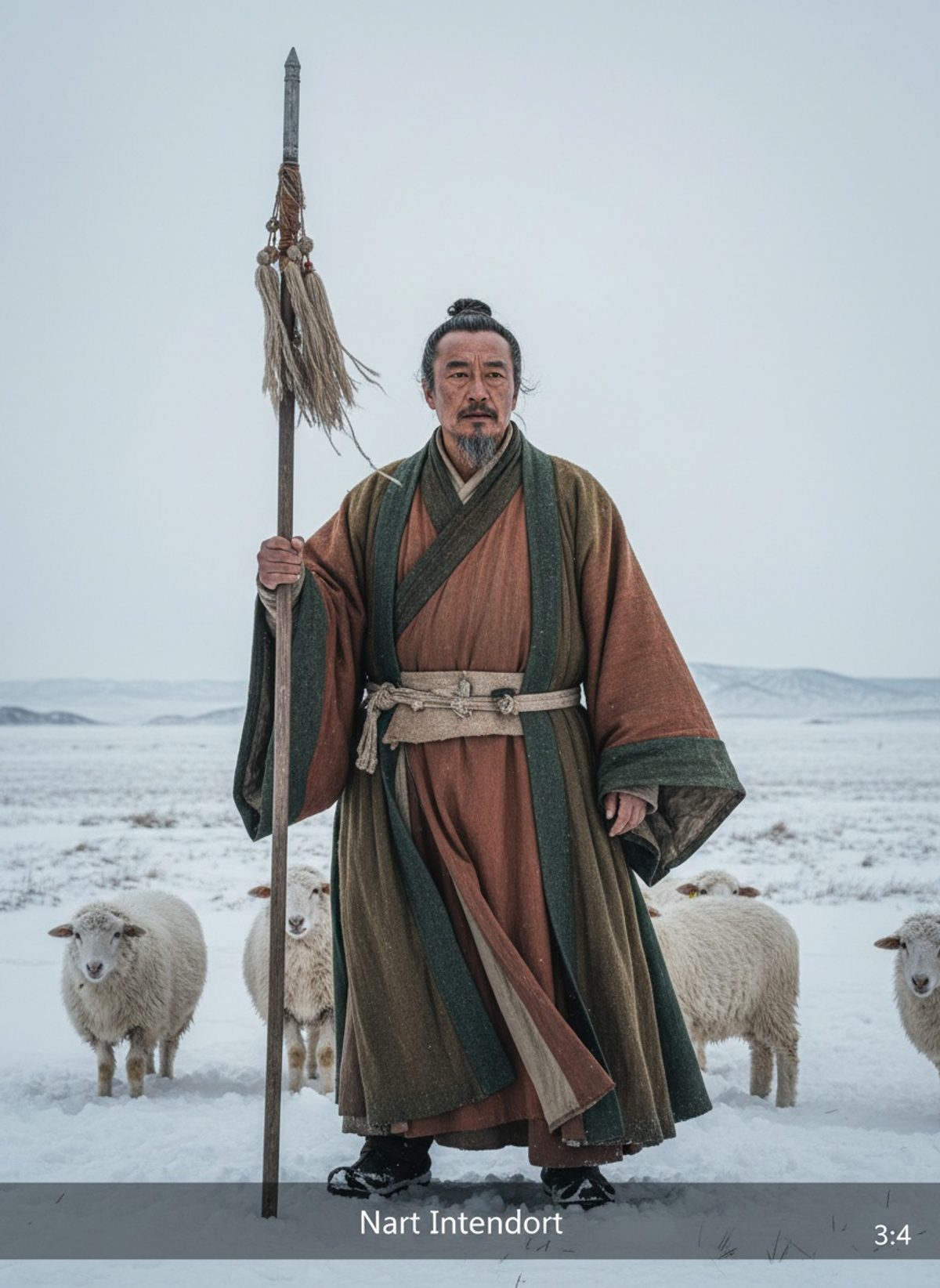
The icy winds bit through Su Wu's robes as he scanned the vast, desolate landscape of the Siberian steppe. His fingers, numb from the cold, gripped the wooden crook he now used as a staff, a stark reminder of his unexpected fate. Around him, the sheep bleated softly, oblivious to the silent oath that had chained Su Wu to this frozen wasteland. Once a respected envoy of the Han Dynasty, he had resolved to remain loyal, no matter the cost.
The Unyielding Diplomat
Su Wu's mission seemed straightforward. As one of the most trusted envoys of the Han emperor, he was dispatched to the lands of the Xiongnu to negotiate peace. These nomadic warriors from the north had been a persistent threat to China’s borders for generations. Yet, the straw that should have paved a diplomatic road quickly ignited into a blaze when the Xiongnu leaders unfolded their true demands.
In a dimly lit tent, under the stern gaze of his captors, Su Wu was presented with a grim choice: forsake his emperor and join the ranks of the Xiongnu or face dire consequences. The torches flickered against the tent’s walls as silence descended upon the gathering. It was then that Su Wu, in a startling display of resolve, drew his own sword and pressed it to his chest, his eyes steely and resolute. He would rather embrace death than dishonor his emperor or his homeland.
The Xiongnu, seeing the strength of his spirit, decided against executing him. Instead, they opted for a more torturous spread of time. They exiled him to the frigid expanses of Siberia, where the World Kang was his only companion. Here he was given a flock of sheep, symbolic chains that carried both derision and test. In this lonely and hostile environment, the cold was not his only enemy. There was the threat of despair; the loneliness that could erode even the strongest of wills. Yet, for Su Wu, each snowflake was a reminder of the purity of his devotion.
Trial by Wilderness
The years rolled by like the endless waves of grass under the Siberian sky. Su Wu's plight became a legend, whispered across campfires far and wide. In the absence of human companionship, he developed an unspoken bond with his flock, working tirelessly to ensure their survival as he endured himself. There was no shelter from the elements, no respite from the harsh realities of this new life. His hands, once accustomed to the delicate art of diplomacy, grew calloused and cracked from labor.
Each day presented new challenges. Wolves prowled the perimeter of his makeshift camp, their howls echoing through the night air. Starvation and hypothermia were constant threats, yet they could neither break his body nor his spirit. Su Wu remained unbroken, fueled by an unextinguishable hope that one day he would return to his homeland.
The Xiongnu, perhaps expecting his resolve to deteriorate with time, occasionally checked on him, no doubt surprised by his unwavering resolve. Unyielding as the mountains themselves, he endured rains that turned the steppe into a swamp of mud, snowstorms that buried the land in an unsettling stillness, and blistering summers that seared the earth.
In these desolate reaches, Su Wu embodied a steadfastness that was as unyielding as the Siberian winter itself. This forsaken outpost became his crucible—a place where human will was tested to its uttermost limits and emerged pristine, untainted by compromise.
The Return of the Loyal Envoy
After nineteen years, during a renewed campaign of diplomacy, the Han Dynasty managed to negotiate Su Wu’s release. His return was not merely a physical journey over vast distances but a profound reinstatement of Han dignity and unwavering loyalty. As he was finally escorted back to his homeland, Su Wu’s reputation preceded him. This man, who had sustained a flicker of defiance in the darkest of times, was heralded as a national hero, a living testament to the integrity and unyielding spirit of the Han Dynasty.
Upon crossing the border, the reception that awaited him was one not of pomp but of reverence. Soldiers who had once fought to protect those borders now guarded them; farmers who tilled the land knew his tale; children whose future he had preserved carried flowers to honor him. The emperor and the court welcomed him as one would a long-lost patriarch. It was a scene that transcended joy and dipped into the realm of solemnity.
Su Wu’s story is more than a mere account of survival—it is a narrative thread woven into the tapestry of a civilizational ethos that revered loyalty, honor, and the indomitable human spirit. With his return, Su Wu offered a powerful message: unwavering fidelity to one's principles can withstand the harshest trials, a beacon to perpetually guide those who face their own barren steppes and hostile terrains.
In a world where allegiances are often swayed by self-interest or fear, Su Wu's enduring legend echoes through time as a testament to the virtues of integrity and loyalty. His life serves as a vivid reminder that true courage is not found in one's capacity to change with circumstances, but in the steadfastness to remain unchanged in resolve against all odds. The sheep, the steppe, and the Siberian winds witnessed not a broken man, but a pillar of timeless loyalty. Today, as we dig deep into history's uncovered troves, Su Wu stands as a luminary of the past, lighting futures yet to unfold.