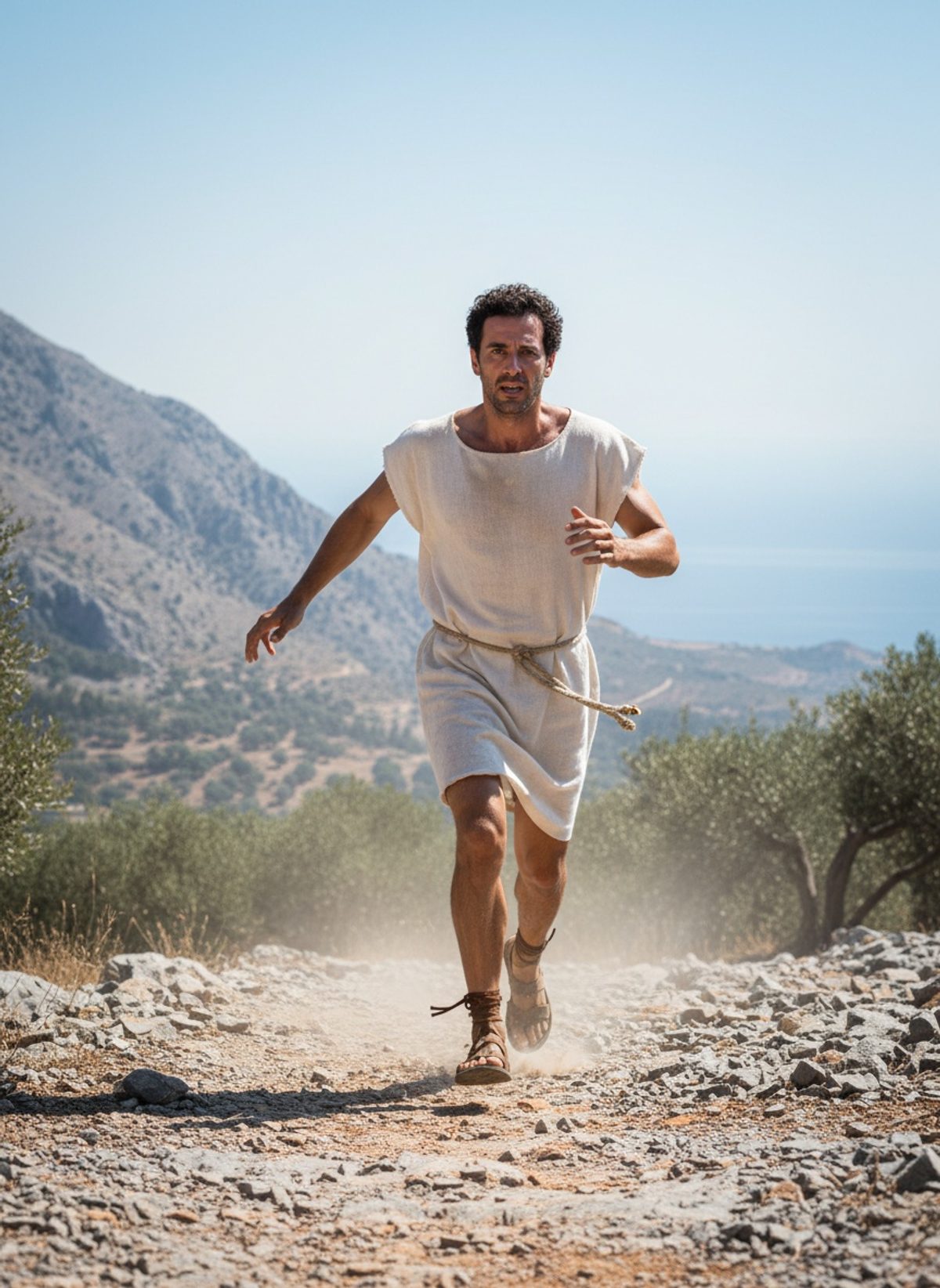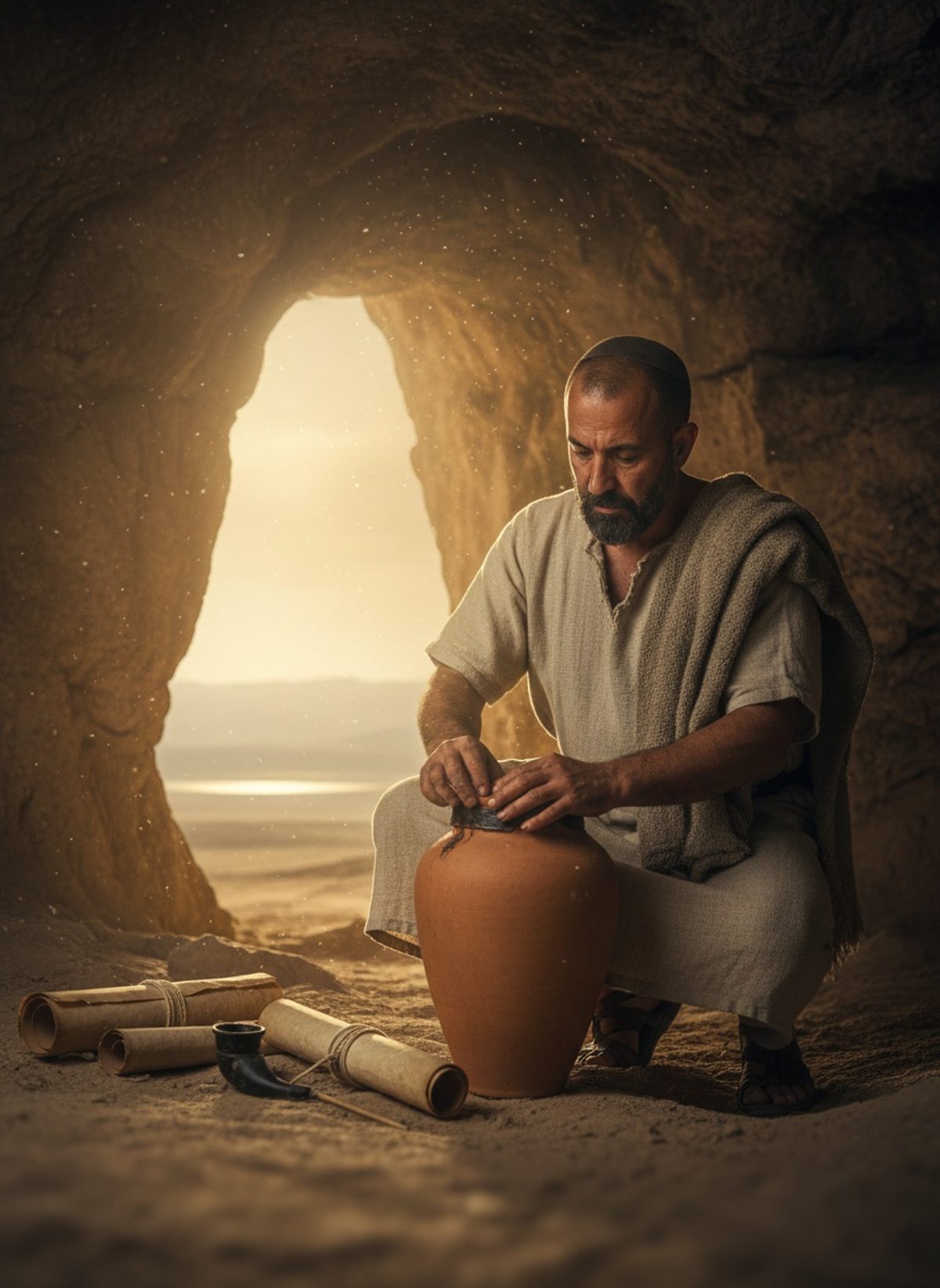
In 68 BCE, a man sealed a scroll in a clay jar. His world ended, but his message endured for millennia. Two thousand years later, an errant stone released a voice from the past.
The Lost World of the Essenes
Imagine standing on the craggy cliffs above the Dead Sea, the lowest and one of the most barren spots on Earth. It’s the 1st century BCE, and you are part of a small Jewish sect known as the Essenes, a group shrouded in mystery and committed to the strict observance of religious laws and communal living. Here, in Qumran, they seek refuge from the turbulent world beyond, a world teetering on the brink of destruction as Roman forces surge through the shifting sands of Judaea.
The Essenes were a tight-knit group, driven by the belief that the world as they knew it would soon end. They were meticulous in their record-keeping, copying their sacred texts with painstaking precision onto scrolls. The scrolls were considered vital, both for their spiritual value and as a safeguard against oblivion. In a time of turmoil, these records were their lifeline, a bridge to the divine even as earthly powers threatened to unravel their world.
Yet, as the Roman legions approached, the Essenes faced the grim realization that they might not outlive the chaos. The scrolls, filled with the words of prophets and priests, were sealed within clay jars and hidden away in the limestone caves above Qumran. One such jar held a document that would remain tucked away in the silent caverns for more than two millennia, its contents unseen, untouched, and forgotten until the mid-20th century.
The Shepherd's Discovery
The dusty year of 1947 would see an accidental revelation, as it had so often done in history. A young Bedouin shepherd named Muhammad edh-Dhib chose an unusual way to dislodge a stray goat in the hills above the Dead Sea. He tossed a stone into one of the countless caves dotting the rugged terrain. Instead of scattering goats, the stone shattered pottery, startling Muhammad with its unexpected reverberation.
Curious, he entered the shadow-filled cave to find a collection of clay jars, most of them broken, yet a few, remarkably intact. Inside one of these jars, he found leather scrolls, flecked and browned with age. Not knowing the value of his find, Muhammad and his companions sold the scrolls to a local antiquities dealer in Bethlehem. Neither the shepherds nor the dealer could have fathomed that they held in their hands one of the most significant archaeological discoveries of the 20th century.
Among these unearthed treasures was a scroll that would later be identified as the Isaiah Scroll, the oldest complete manuscript of the Book of Isaiah. This find would ignite a flurry of subsequent discoveries across the Judean Desert, yielding a trove of biblical and non-biblical texts now collectively known as the Dead Sea Scrolls, many attributed to the Essenes themselves.
The Echoes of The Past
The impact of the Dead Sea Scrolls resonated far beyond the ancient cliffs and caves. Historians, linguists, and theologians pored over the fragments, piecing together not only religious texts but also a vivid tableau of Jewish life during the Second Temple period. The scrolls shimmer with the insights of a community grappling with ideas of purity, messianism, and apocalypticism, weaving remarkable threads into the greater fabric of Judeo-Christian heritage.
Scholars have noted the uncanny accuracy with which the Hebrew scriptures of the Isaiah Scroll align with the Masoretic text, the authoritative Hebrew text of the Jewish Bible. This congruence, despite a chasm of two millennia, challenges assumptions about scriptural transmission and preservation across time. The scrolls also introduce previously unknown texts, offering tantalizing glimpses into the diverse and contested landscape of early Judaism.
But the scrolls are more than artifacts or relics; they are echoes of an ancient voice breaking through the vast silence of the ages. They are a reminder of the transient nature of civilizations and the fragility of beliefs, even as they affirm the enduring quest to understand the divine. A stone’s throw in a cave invoked an ancient dialogue, connecting us to those who existed in an era much like our own—fraught with uncertainty yet defined by a relentless pursuit of meaning.
As these ancient documents continue to be studied, piece by piece, they speak anew. They compel us to ponder our chronicles and those voices preserved within. In our pursuit of understanding, they affirm our own place in the long narrative of human curiosity and determination, whispering from the dust that our quest for knowledge bridges not only epochs but also the timeless human spirit yearning for connection with its past.