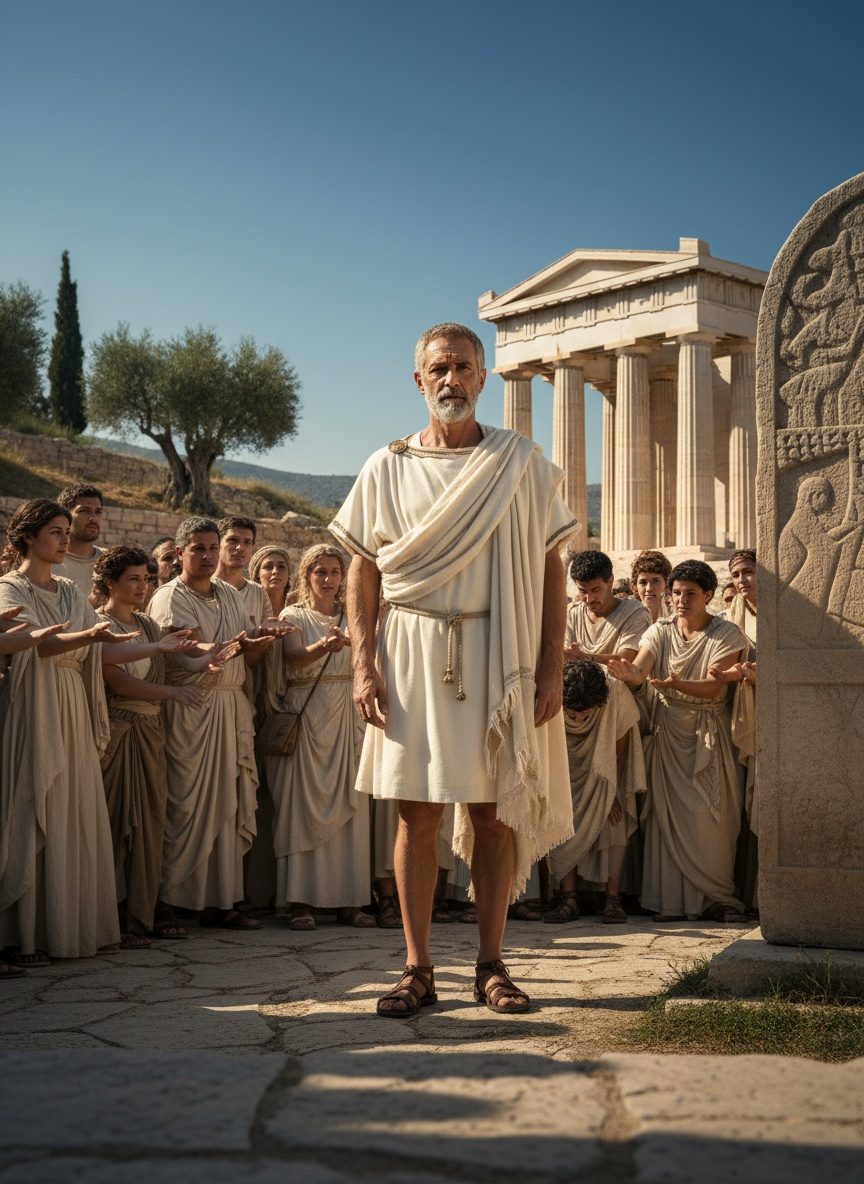
The warm Athenian sun bathed the city in a golden hue, casting long shadows from its towering columns. The streets were alive with murmurs of merchants selling their goods, the gentle clinking of amphorae, and the occasional neigh of a horse. It seemed like a city bustling in prosperity, but beneath this veneer of harmony, discontent simmered. Athens in 594 BC stood at a precipice, teetering on the brink of chaos. Like the shifting winds over the Aegean, the mood was tense, and a storm was brewing on the horizon—a storm that threatened to tear the city asunder with strife and civil unrest.
The Gathered Storm
Athens, known for its burgeoning culture and nascent democracy, had reached a critical impasse. The divide between rich and poor loomed large, like an insurmountable chasm, with the privileged aristocrats holding the reins of power and wealth, while the common folk suffered under the heavy yoke of debt. It was an inequity so severe that many were forced into slavery to settle their dues, a situation as intolerable as the sweltering summer heat. The threat of revolution hung thick in the air, as palpable as the dust stirred by the hoofbeats on its ancient roads.
The city’s leaders, anxious to avoid the looming disaster, turned to Solon, a man celebrated not for his sword, but his wisdom. They pleaded with him to assume control, to wield the sweeping authority needed to right the ship of state before it was dashed against the rocks. Solon accepted the challenge, tasked with rewriting the laws of Athens to restore equity and justice—a Herculean task that would prove transformative.
The Wise Lawmaker
Solon, a statesman cut from a different cloth, understood the delicate balance that must be struck to ensure peace and stability. He embarked on his mission with an unwavering dedication, underpinned by his belief in the communal values of fairness and accountability. With a deft touch, he instituted reforms that sought to relieve the plight of the indebted Athenians, erasing debts that shackled souls and stripping away the crippling burden of debt bondage. He abolished the practice of using one's life as collateral, freed those enslaved for their debts, and reclaimed Athenian citizens sold abroad—a gesture that rippled through the populace like a refreshing gust of wind on a sweltering day.
Yet, Solon's brilliance lay in his capacity to balance these humanitarian strides with measures that appealed to the wealthy and influential. Understanding that sudden upheaval could incite further discord, he ensured his reforms were measured and sustainable. Solon reorganized the societal structure, categorizing citizens into four classes based on income rather than birthright, giving the less affluent some say in governance—a calculated shift that sowed the seeds for what would eventually mature into Athenian democracy.
A Lawgiver’s Departure
Having set his sweeping reforms on parchment, Solon did something quite unexpected. Instead of seizing power and ruling as a tyrant, a course many in his position might have taken, he simply walked away, like a painter leaving a fresco to stand on its own. His decision to step aside was rooted in his belief that the laws needed to grow wings, to fly unaided by their creator’s hand. He entrusted the enforcement and adaptation of his laws to the very people they governed, urging them to adhere to his statutes for a decade before contemplating any changes.
Solon's departure was as dramatic as his reforms, and it left Athenians reeling. How could a man, when given such power, simply walk away? Did he doubt his own work? Or was it a strategic maneuver to prevent his reforms from being overshadowed by the cult of personality that inevitably arises from prolonged rule?
Solon’s chosen path laid bare a man ahead of his time—one who believed in the potential of law, not just the enforcement of it, and who recognized the corruption that can spring from unchecked power.
The Legacy Unfolds
Solon’s departure marked the beginning of a new era for Athens, his laws becoming the foundation upon which the edifice of democratic governance would eventually be erected. It was as if each article in his code was a brick in a grand structure—a structure that would inspire generations to come, from the Athenian golden age to modern democracies that still grapple with the delicate act of governing diverse populations.
Why does Solon’s story matter to us nearly three millennia later? It’s a reminder that leadership can take many forms, and sometimes the greatest power lies in choosing to relinquish it. Solon's reforms were not merely about restoring balance to a teetering city; they were about planting an enduring seed—one that dared to imagine a society based on equity, justice, and the rule of law. In an era marked by leaders who cling to power, Solon’s legacy of profound, selfless stewardship offers a timeless lesson in the virtues of foresight and restraint.